History
The History of Taekwondo: From the Kwans to the Olympic Mat
How Korea built taekwondo after 1945 from karate, native traditions and national ambition, split it between two federations and made it Olympic in 2000.
7 min read · 20 September 2026 · updated 21 September 2026
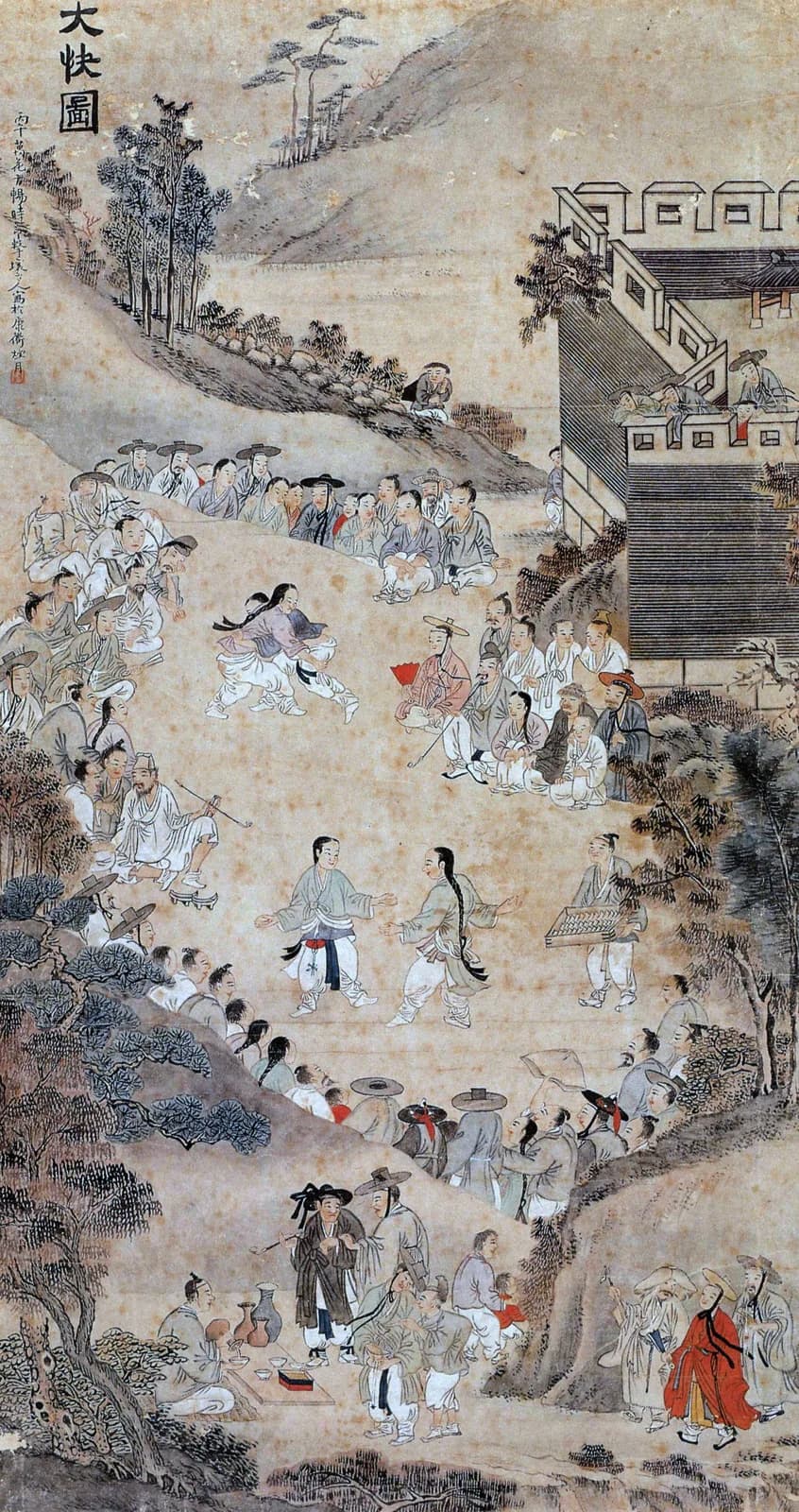
Photo: Daekwaedo by Yu Suk, 1846, showing ssireum and taekkyon at a festival. Public domain, via Wikimedia Commons.
In this article
Timeline
- 4th–7th c.
Murals in Goguryeo tombs show unarmed fighters; the Silla kingdom's Hwarang youth are trained in combat – the roots later claimed for taekwondo.
- 1790
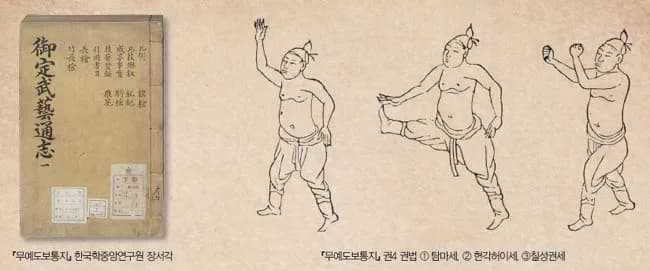
The Muyedobotongji, a military manual commissioned by King Jeongjo, illustrates Korean and Chinese unarmed and weapon methods.
- 19th c.
Taekkyon, a kicking and sweeping folk game, is played at festivals in Seoul and recorded in paintings and travellers' accounts.
- 1910–1945
Japanese colonial rule. Korean students learn karate and judo in Japan; native traditions decline.
- 1944–1946
The first kwans open in Seoul after liberation: Chung Do Kwan (Lee Won-kuk), Moo Duk Kwan (Hwang Kee), Song Moo Kwan, Ji Do Kwan and the YMCA Kwon Bop Bu.
- 1955
A naming committee adopts the name “taekwondo” on 11 April at the proposal of General Choi Hong-hi.
- 1961
The Korea Taekwondo Association is formed to unify the kwans; taekwondo enters the Korean army and schools.
- 1966
Choi Hong-hi founds the International Taekwon-Do Federation (ITF) in Seoul; he later moves it to Canada.
- 1972
The Kukkiwon opens in Seoul as the national academy and headquarters.
- 1973
The World Taekwondo Federation is founded on 28 May and the first World Championships are held in Seoul.
- 1988
Taekwondo is a demonstration sport at the Seoul Olympics, and again at Barcelona 1992.
- 2000
Taekwondo becomes a full Olympic sport at Sydney.
- 2012
Electronic scoring vests and helmets are used at the London Olympics, changing how the sport is fought.
On 11 April 1955 a committee of generals, politicians and kwan heads voted on a word. The art they were naming had been taught in Seoul for eleven years, in karate uniforms, through karate kata with Korean names, under labels that meant “Chinese hand” and “empty hand”. General Choi Hong-hi wanted a name that owed nothing to Japan or China. He got one: tae, foot; kwon, fist; do, way. Today taekwondo is the most practised martial art in the world by number of federations, and it is younger than it looks.
The short answer: taekwondo's techniques came from Japanese karate, its name from a committee, its kicks from a decision taken in the 1960s and its Olympic place from a Korean state that wanted one. The older Korean traditions it claims – taekkyon, subak, a military manual of 1790 – are real, but they are ancestors by adoption. What follows keeps the two apart: the Korea that existed before taekwondo, and the single generation that built the art, split it between two federations and, in 2000, put it on the Olympic mat.
Key facts
- Origin
- Seoul, 1944–1955: five kwans founded by Korean karate and kung fu students
- Older Korean roots
- Taekkyon (folk kicking game), subak, Muyedobotongji (1790)
- Name adopted
- 11 April 1955, proposed by Choi Hong-hi
- Federations
- ITF (1966, Choi); World Taekwondo (1973, Kukkiwon, Seoul)
- Olympics
- Demonstration 1988 and 1992; full sport since Sydney 2000
- Hallmark
- Fast, high kicks; sparring scored by electronic vests since 2012
The Korea that taekwondo claims
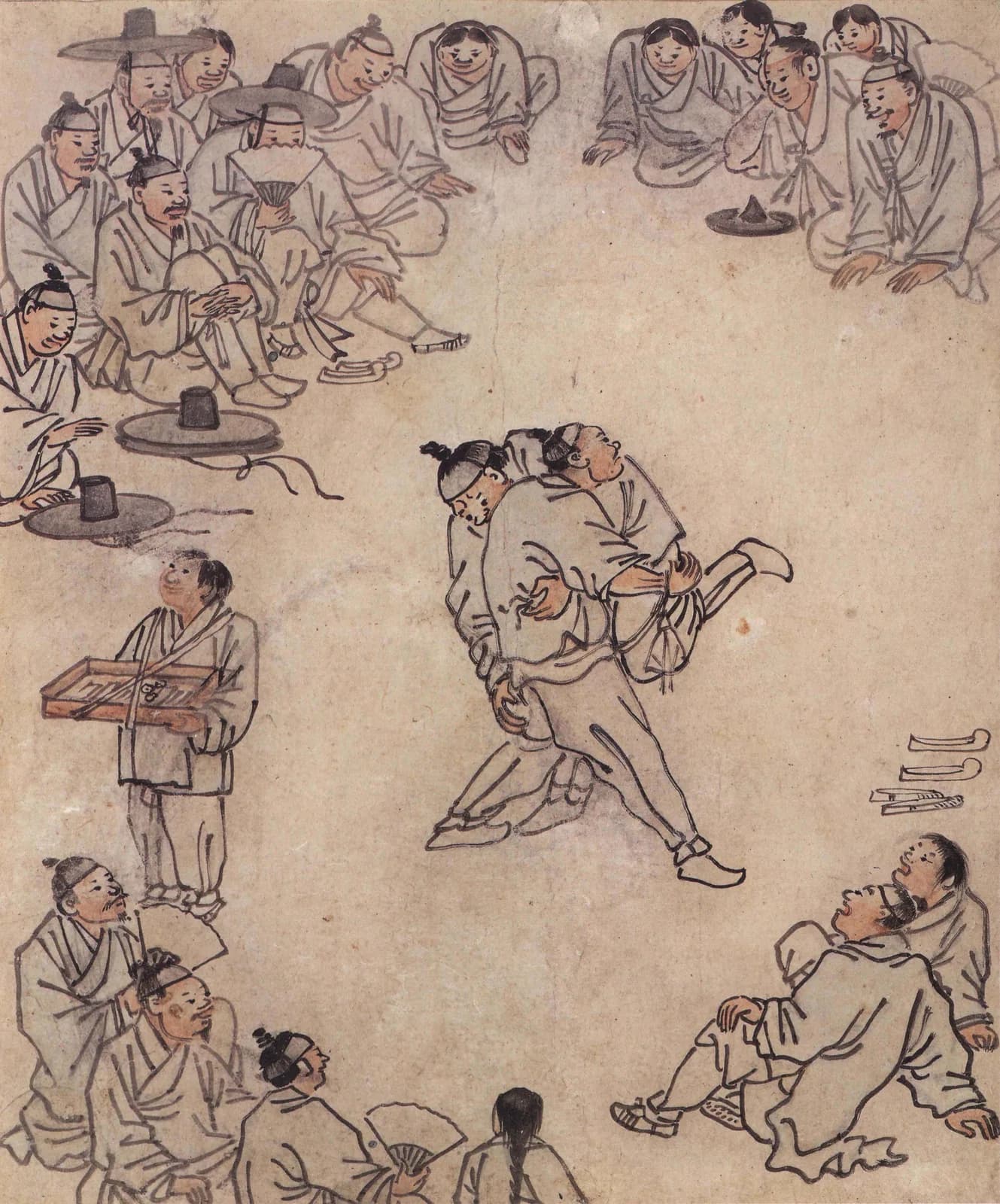
Taekwondo's official histories reach a long way back, and there is something there to reach for. Murals in the tombs of the Goguryeo kingdom (1st century BC to 668 AD) show men in fighting stances. The Hwarang, an elite of young nobles in the Silla kingdom, trained in combat and Confucian ethics. Medieval records mention subak, an unarmed method practised by soldiers and at court. And in 1790 King Jeongjo had a comprehensive military manual compiled, the Muyedobotongji, whose illustrated chapters on empty-hand fighting, sword, spear and staff draw on Korean, Chinese and Japanese sources.
The ancestor with the strongest claim is taekkyon, a folk game recorded in Seoul in the 18th and 19th centuries. Two players faced each other and tried to trip, sweep or kick the other down, bouncing on a rhythmic footwork that kept the weight moving and the legs busy. Yu Suk painted it in 1846, in the Daekwaedo, being played beside the wrestling at a festival while a crowd looked on. Under Japanese rule the game nearly died. One practitioner, Song Deok-gi, kept it going into the 1980s, when it was revived and later recognised by UNESCO – which makes taekkyon, for a while, a tradition with very nearly a population of one.
None of this is where taekwondo's techniques came from. From 1910 to 1945 Korea was a Japanese colony, Korean traditions were discouraged and Japanese ones taught, and the Koreans who would found taekwondo learned to fight the Japanese way.
Five schools and a name, 1944–1955
When Japan surrendered in August 1945, Korea was suddenly free and full of young men who had studied in Japan, and several of them had spent their student years in karate dōjō. Lee Won-kuk had trained with Funakoshi Gichin at the Shōtōkan; so had Ro Byung-jik. Chun Sang-sup had done karate and judo. Yun Byung-in had learned karate and, unusually, Chinese boxing in Manchuria. Hwang Kee claimed Chinese training and had certainly studied karate books. Between 1944 and 1946 each of them opened a school in Seoul, a kwan: Lee's Chung Do Kwan, Hwang's Moo Duk Kwan, Ro's Song Moo Kwan, Chun's Ji Do Kwan and Yun's YMCA Kwon Bop Bu, later Chang Moo Kwan. Their students wore karate uniforms, practised karate kata under Korean names and called what they did tang soo do or kong soo do, the Korean readings of “Chinese hand” and “empty hand”. It was karate with a Korean accent.
Then the Korean War (1950–1953) scattered the kwans and killed or displaced several of their founders. It also produced the man who named the art. Choi Hong-hi (1918–2002) had learned karate as a student in Japan and come home to become a general in the new South Korean army, where he taught the art to soldiers and pressed for a single Korean name with no debt to Japan or China. On 11 April 1955 the committee gave him his word: taekwondo. Not every kwan took it. Hwang Kee's Moo Duk Kwan kept tang soo do, which is why that name survives in the United States today.
One art, two federations
In 1961 the kwans were pushed into a single body, the Korea Taekwondo Association, and the art went into the South Korean army, where whole divisions trained in it and where the Korean troops sent to the Vietnam War taught it to their allies. Through the 1960s instructors were dispatched to Southeast Asia, Europe and the Americas, usually with government backing, and taekwondo spread through the world faster in that decade than any martial art before or since.
Choi Hong-hi, meanwhile, had been building a system of his own. He wrote twenty-four forms, the Chang Hon patterns or tul, named for figures from Korean history; he developed a theory of power and the characteristic “sine wave”, a rise and fall through every movement; and in 1966 he founded the International Taekwon-Do Federation (ITF) in Seoul. Then he fell out with the Korean government, over his politics and, decisively, over his contacts with North Korea. In 1972 he moved the ITF to Toronto. He later taught taekwondo in North Korea, and he died in Pyongyang in 2002.
The Korean state answered with buildings and paperwork. The Kukkiwon, a national academy and headquarters, opened in Seoul in 1972. On 28 May 1973 the World Taekwondo Federation was founded there under Kim Un-yong, a former intelligence officer who would go on to become a vice-president of the IOC, and the first World Championships were held in Seoul the same week. The Kukkiwon wrote new forms, the Taegeuk and the black-belt poomsae, to replace both the karate-derived and the ITF patterns, and began issuing the dan certificates that most of the world's taekwondo black belts now hold. The split with the ITF has never healed. The two arts have drifted apart in technique, in rules and even in what they wear.
The road to Sydney
Kim Un-yong's aim was the Olympics, and Seoul's own Games gave him the stage. Taekwondo was a demonstration sport at Seoul in 1988 and again at Barcelona in 1992. In 1994 the IOC voted it onto the programme, and at Sydney 2000 it became a full medal sport, with four weight classes for each sex. It has been on every programme since, and its medal tables are among the most international in the Games: fighters from Iran, Turkey, Thailand, Côte d'Ivoire, Jordan and Great Britain have won gold alongside Koreans and Chinese.
The rules then went to work on the art. WT sparring is continuous, three rounds on a mat, in a chest protector and helmet. Kicks to the body score more than punches, kicks to the head and turning kicks score most, and punches to the head are forbidden, so the arithmetic points at the feet. In 2012 electronic scoring arrived: sensors in the vest, and from 2016 in the helmet, triggered by socks with magnetic contacts, replaced the judges' eyes for body kicks. Fighters adapted with a lighter, more upright style built on fast front-leg kicks and pushing kicks. Critics, many of them older practitioners, say the sport has moved a long way from the fighting art. Supporters reply that no other Asian martial art has kept its Olympic place for a quarter of a century.
Sixty years after the vote
Taekwondo is taught in almost every country. World Taekwondo counts more than 200 member federations, and the ITF, split into several organisations after Choi's death, adds millions more practitioners. In South Korea it is still a school subject and a compulsory part of military training; the Kukkiwon's demonstration team, all jumping and breaking, is the art's public face; and taekkyon, the game Song Deok-gi carried through the century, is practised as a separate tradition. The name a committee chose in 1955 is, sixty years on, the world's most widely organised way of learning to kick.
Where to go next
- The taekwondo discipline hub collects training articles, workouts and gear for the sport.
- The art the founders learned first, in the dōjō of Japan: The History of Karate.
- Another Olympic combat sport whose rules rewrote the art: Judo: Kanō Jigorō and the Gentle Way.
- Fast feet come first: Jump Rope Conditioning.
Sources
- World Taekwondo – History
- Kukkiwon – World Taekwondo Headquarters
- Alex Gillis, A Killing Art: The Untold History of Tae Kwon Do (ECW Press, 2008)
- Udo Moenig, Taekwondo: From a Martial Art to a Martial Sport (Routledge, 2015)
- International Olympic Committee – Taekwondo
- Wikipedia: Taekwondo
- Wikipedia: Choi Hong-hi
- Wikipedia: Taekkyon
Frequently asked questions
- How old is taekwondo?
- The name dates from 1955 and the organised art from the schools (kwans) founded in Seoul from 1944. Korea has older unarmed traditions, such as taekkyon and the methods in the 1790 Muyedobotongji, and taekwondo claims them as ancestors, but the techniques and uniform of the early kwans came mostly from Japanese karate.
- Is taekwondo just Korean karate?
- It began close to it. The founders of the first kwans had learned Shotokan and other karate in Japan, and their early forms were karate kata. From the 1960s the Korean federations deliberately built a distinct art around high, fast kicks, new forms (poomsae) and a sport rule set that rewards kicking, which is what makes taekwondo look different today.
- What is the difference between WT and ITF taekwondo?
- World Taekwondo (WT, founded 1973, based at the Kukkiwon in Seoul) runs the Olympic sport with continuous sparring, chest protectors and electronic scoring. The International Taekwon-Do Federation (ITF, founded 1966 by Choi Hong-hi) uses his tul patterns, lighter contact and a sine-wave movement style. They split for political reasons in the 1970s.
- Who founded taekwondo?
- No single person. General Choi Hong-hi proposed the name in 1955 and founded the ITF; the kwan founders – Lee Won-kuk, Hwang Kee, Ro Byung-jik, Yun Byung-in, Chun Sang-sup and others – built the schools; Kim Un-yong organised the Kukkiwon and World Taekwondo. Korean government support tied them together.
- When did taekwondo become an Olympic sport?
- It was demonstrated at Seoul 1988 and Barcelona 1992 and became a full medal sport at Sydney 2000. It has been on every programme since.
- Why do taekwondo fighters kick so much?
- Because the sport rules reward it: kicks to the trunk and especially the head score more than punches, punches to the head are not allowed, and electronic scoring detects kicks. The emphasis on kicking was also a deliberate choice in the 1960s to distinguish the art from karate.