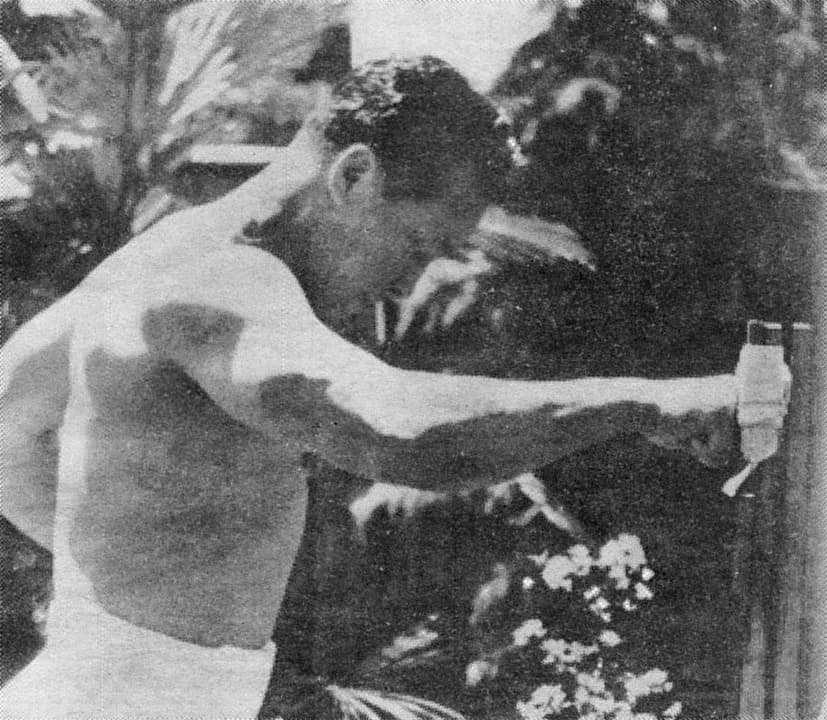
History
The History of Karate: From Okinawan Te to the Olympic Games
How Okinawan te absorbed Chinese boxing, became karate-dō in Japan, split into styles, spread through the world and reached the Tokyo Olympics.
10 min read · 20 September 2026 · updated 21 September 2026
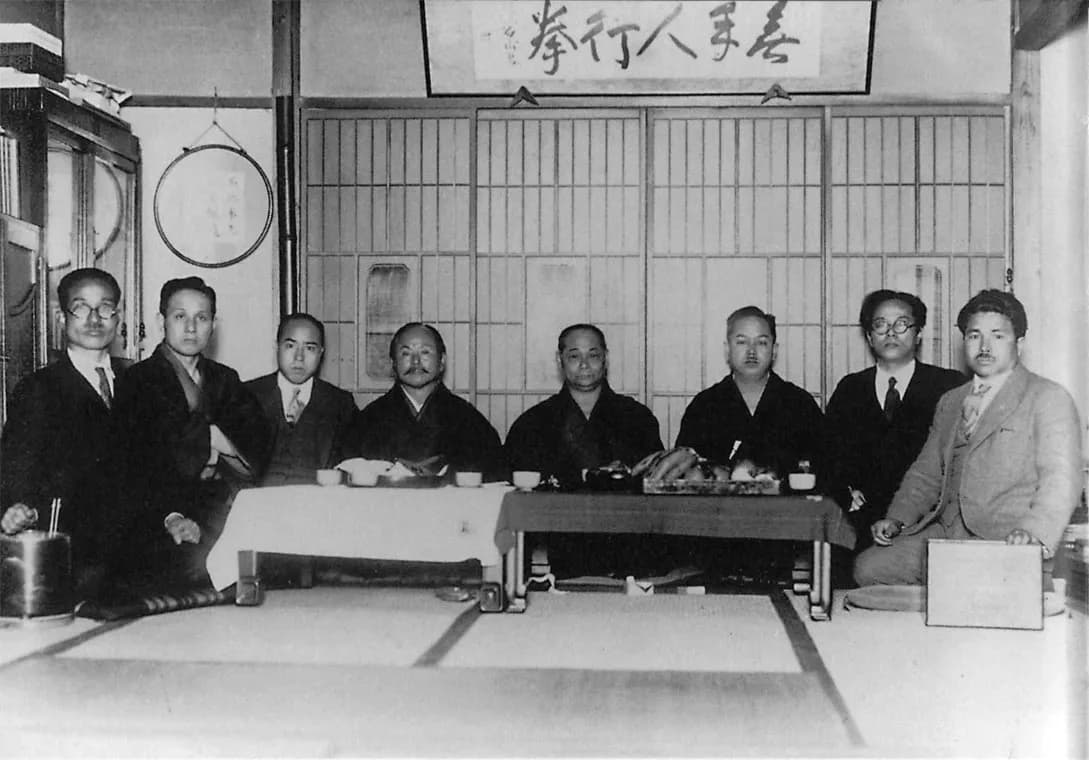
Photo: Karate masters at the 1936 meeting in Naha, Okinawa. Public domain, via Wikimedia Commons.
In this article
Timeline
- 1392
Chinese families from Fujian settle in Kume village near Naha, bringing trade, learning and, according to tradition, Chinese boxing to the Ryukyu Kingdom.
- 1609
The Satsuma domain of Japan invades Ryukyu. The kingdom keeps its king and its Chinese ties but lives under Japanese control for 270 years.
- c. 1750–1815
Sakugawa Kanga, remembered as “Tōde” Sakugawa, studies in China and teaches in Shuri – the first name in most karate lineages.
- 1879
Japan abolishes the Ryukyu Kingdom and makes Okinawa a prefecture. Te loses its royal patrons and becomes a private tradition.
- 1901
Itosu Ankō begins teaching karate in Okinawan schools; the Pinan kata follow, written for children.
- 1908
Itosu's Ten Precepts of Karate argue for the art as physical education for the whole nation.
- 1922
Funakoshi Gichin demonstrates karate in Tokyo at a Ministry of Education exhibition and stays to teach.
- 1924
Keio University founds the first university karate club; the black belt and dan grades are adopted from judo.
- 1933
The Dai Nippon Butokukai recognises karate as a Japanese martial art; the characters for “Chinese hand” give way to “empty hand”.
- 1930s
The four major styles take their names: Gōjū-ryū (Miyagi Chōjun), Shitō-ryū (Mabuni Kenwa), Wadō-ryū (Ōtsuka Hironori) and Shōtōkan (Funakoshi's students).
- 1949
The Japan Karate Association is founded in Tokyo; competition rules for kumite follow in the 1950s.
- 1964
Ōyama Masutatsu founds Kyokushin, the first major full-contact style.
- 1970
First World Karate Championship in Tokyo under the WUKO, forerunner of the World Karate Federation.
- 2021
Karate is contested at the Tokyo Olympics – its only appearance on the Games programme so far.
In 1922 the prefecture of Okinawa had to send someone to Tokyo. The Japanese Ministry of Education had invited the island to present its fighting art at a physical education exhibition, and the man chosen was Funakoshi Gichin, a schoolteacher who could write, spoke standard Japanese and was, by his own account, an unremarkable fighter. He gave his demonstration, was asked to stay, and never lived in Okinawa again. The art he brought with him was called “Chinese hand”. By 1933 it would be called “empty hand”, wear a white uniform, award black belts and be registered as a Japanese martial art.
The short answer: karate is a village art from a small kingdom between China and Japan, and that geography explains most of what happened to it. Okinawan te absorbed Fujian boxing over centuries, lost its royal patrons, came back as a school subject, was rebuilt in Tokyo on the model of judo, split into styles in the 1930s and went out after 1945 to become the best-known martial art on earth. In 2021 it spent one edition at the Olympic Games. This is the road from the royal capital of Shuri to Tokyo.
Key facts
- Origin
- Okinawa (Ryukyu Kingdom); local te plus Fujian Chinese boxing
- Old names
- Te (“hand”), tōde (“Chinese hand”); Shuri-te, Naha-te, Tomari-te
- Brought to Japan
- Funakoshi Gichin, Tokyo, 1922
- Main styles
- Shōtōkan, Gōjū-ryū, Shitō-ryū, Wadō-ryū (named 1930s); Kyokushin (1964)
- World body
- World Karate Federation (WUKO 1970, WKF since 1993)
- Olympics
- Tokyo 2020 (held 2021), kata and kumite – single appearance
Ryukyu: a kingdom between China and Japan
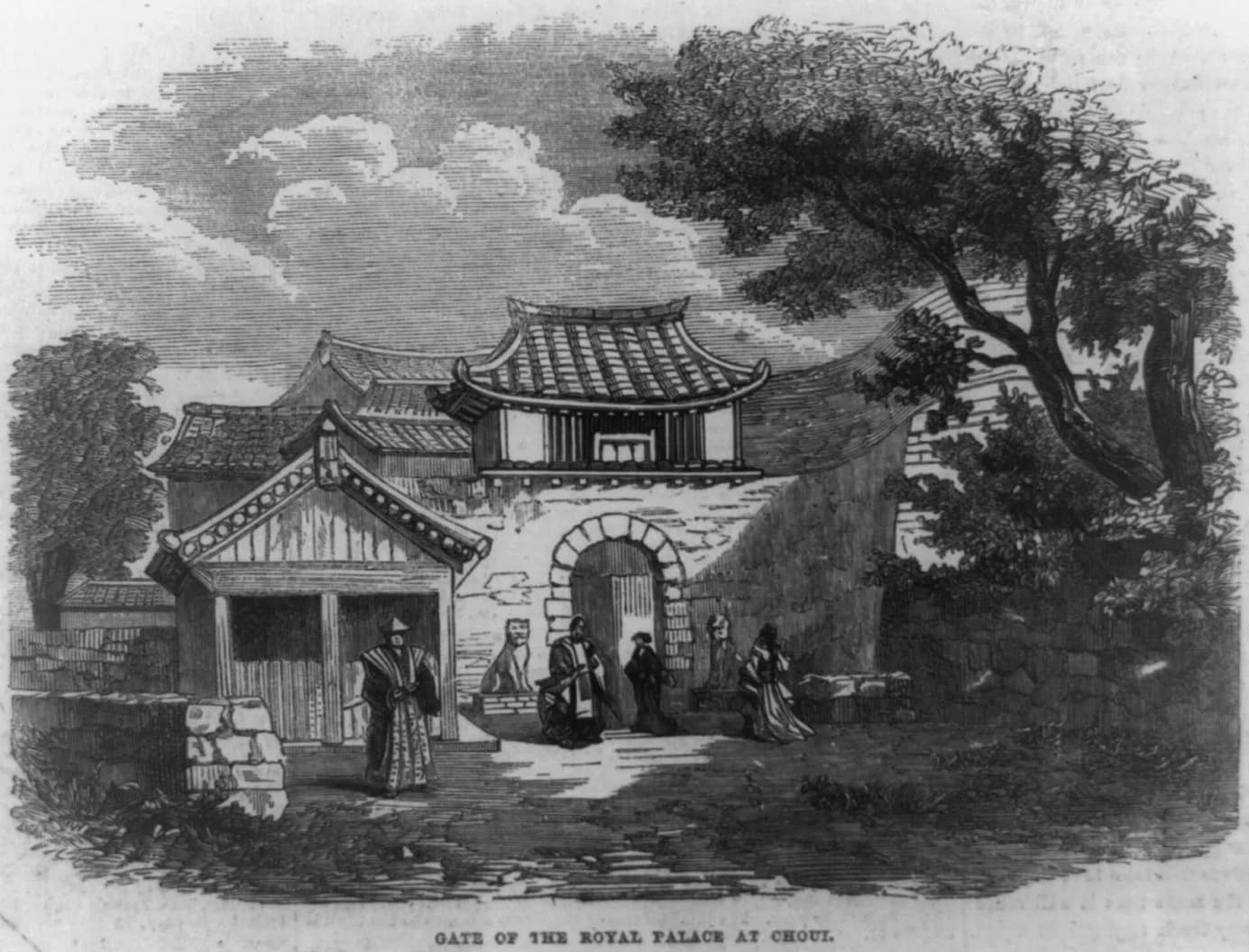
Okinawa is the largest of the Ryukyu Islands, a chain that runs from the south of Japan almost to Taiwan, and from 1429 those islands were one kingdom with its capital at Shuri. It lived by trade. The kingdom paid tribute to Ming China, sent its scholars and officials to study in Fujian and received Chinese envoys in return; in 1392, according to the royal chronicles, a group of Chinese families settled in the village of Kume beside the port of Naha and became the kingdom's standing link to Chinese learning. Ships also went to Japan, Korea and Southeast Asia. An Okinawan port was a place where several countries' fighting methods could meet, and they did.
The native art was simply te, “hand”. What it looked like before the 18th century nobody knows, because nobody wrote it down. What is certain is that it took in Chinese boxing over a long period, and that the Fujian styles a Ryukyuan official would have met – White Crane above all, and the southern methods related to it – are still visible in Okinawan karate today: the short stances, the open-hand techniques, the breathing exercises. The Okinawans called the mixture tōde or tūdī, “Chinese hand”, and wrote it with the characters that would later be read as karate.
Two political events shaped it. In 1609 the Satsuma domain of southern Japan invaded and turned Ryukyu into a vassal that kept its king and its China trade but took its orders from Japan. The court had already restricted the carrying of weapons in the 15th century, and Satsuma kept the limits in place. The popular story that unarmed peasants invented karate to fight armed samurai is a later legend, and a sturdy one. The people who actually practised te were the shizoku, the kingdom's officials and gentry, who served as bodyguards, police and diplomats, and who had the leisure to train.
Shuri, Naha and Tomari: the Okinawan masters
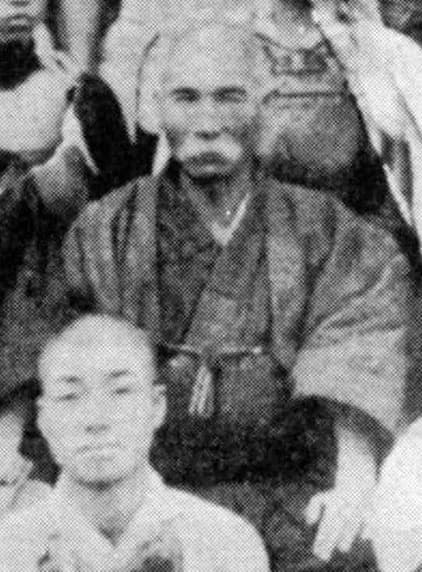
The first name most lineages write at the top of the tree is Sakugawa Kanga (c. 1750–1815), remembered as “Tōde” Sakugawa, who is said to have studied in China and taught in Shuri. His student Matsumura Sōkon (c. 1809–1899) was bodyguard to three Ryukyuan kings, studied in Fujian and, tradition says, in Satsuma, and taught what became Shuri-te, the style of the capital: long stances, fast straight-line techniques, everything built for speed. Down at the port, Higaonna Kanryō (1853–1915) came home from years in Fuzhou with a close-range, Chinese-flavoured method of fighting and breathing that became Naha-te. In the village between the two grew Tomari-te. The three overlapped all the time. The names describe emphases, not walls.
Teaching was private, often at night, from one master to a handful of students, and it ran on kata: fixed sequences of techniques that could be practised alone and that carried a style's fighting applications, the bunkai, in a form that needed no book. The kata names still say where they came from. Naihanchi, Passai, Kūsankū and Seisan are Okinawan renderings of Chinese words, or of the Chinese masters the forms were credited to.
In 1879 Japan abolished the Ryukyu Kingdom and made Okinawa a prefecture. The court that had employed the masters was gone, and the art could have gone with it. That it did not is mostly the doing of Matsumura's student Itosu Ankō (1831–1915). In 1901 Itosu put karate into the physical education of an Okinawan primary school, and in the following years into the prefecture's teacher-training college and its middle school. To teach children without hurting them he wrote the five Pinan kata, later called Heian. In 1908 he sent the prefecture his Ten Precepts of Karate, arguing that the art built bodies and character and belonged in the education of the whole nation. That letter is the founding document of modern karate. It is the moment the art stopped being a secret and became a subject.
Funakoshi and the move to Japan
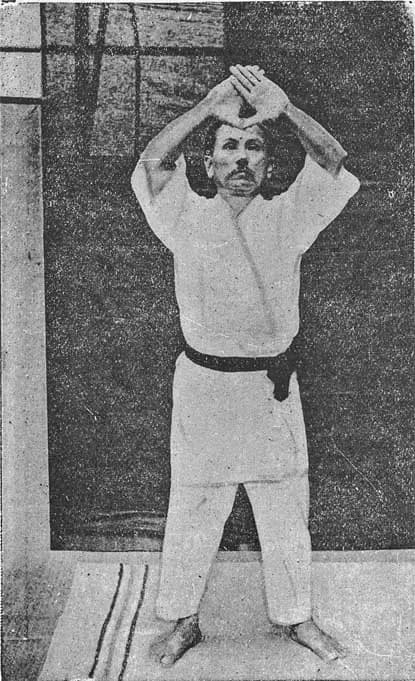
Which brings us back to Funakoshi (1868–1957), Itosu's student, who was in Tokyo in 1922 because he was literate, spoke the language of the mainland and had already organised demonstrations at home. What he found there was a template. Kanō Jigorō had turned jujutsu into judo: a school subject with a white uniform, a belt system, a dōjō code and a governing body. Funakoshi took the lot. He borrowed the keikogi and the coloured belts, awarded the first karate black belts in 1924, founded a club at Keio University the same year, and wrote the first books on the art in Japanese, Ryūkyū Kenpō: Karate in 1922 and Karate-dō Kyōhan in 1935. He gave the kata Japanese names and reworked their sequences. He added dō, “way”, so that karate-dō could stand beside judo and kendo as a discipline of character.
The renaming that mattered most was the art's own. The kara of tōde meant Tang – that is, China – and in a Japan growing more nationalist by the year and at war with China from 1931, an art called “Chinese hand” had no future. Funakoshi and his contemporaries swapped the character for a homophone meaning “empty”, and explained it as philosophy: the empty hand, free of weapons and free of self. In 1933 the Dai Nippon Butokukai, the official body of the Japanese martial arts, recognised karate as Japanese budō under its new name. The philosophy was sincere. The timing was not an accident.
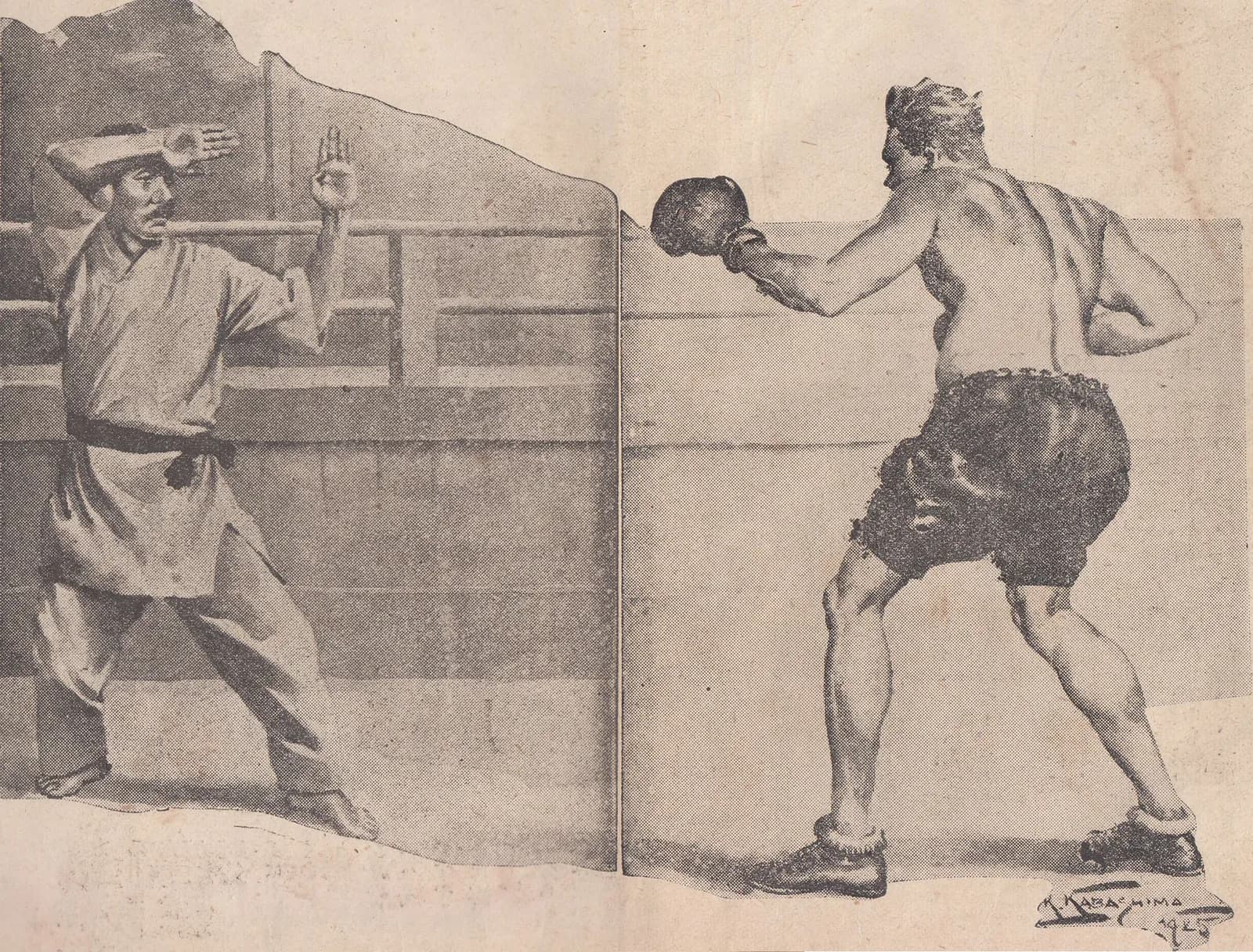
The styles take their names
The 1930s turned lineages into brands. The Butokukai asked the Okinawan masters to register their schools under style names, as the Japanese arts did, and all four of the major Japanese styles date from the decade. Miyagi Chōjun (1888–1953), Higaonna's successor, named his Naha-te line Gōjū-ryū, “hard-soft school”, in 1930, after a line in a Chinese boxing classic. Mabuni Kenwa (1889–1952), who had trained under both Itosu and Higaonna, founded Shitō-ryū in Osaka in 1934 and named it after the pair of them. Ōtsuka Hironori (1892–1982), a jujutsu master who had trained with Funakoshi, folded Japanese throws and evasions into karate and called the result Wadō-ryū, “way of harmony”. Funakoshi alone never named a school. His students called the dōjō built for him in 1936 the Shōtōkan, after his pen name Shōtō, “waving pines”, and the style has answered to the name of a building ever since.
Okinawa kept its own lines. Shuri-te and Tomari-te became the several branches of Shōrin-ryū; Uechi Kanbun brought a Fujian style home from China and founded Uechi-ryū; Motobu's methods survive as Motobu-ryū. Each of them regards the mainland styles as its descendants rather than the reverse, and the relationship between Okinawan karate and Japanese karate has been a polite argument ever since.
Sport, JKA and the world
The Second World War stopped everything. The Battle of Okinawa in 1945 killed a quarter of the island's population, many of its masters among them. Afterwards karate came back faster than judo or kendo, and for an ironic reason: the occupation authorities did not ban it, because they took it for a Chinese exercise rather than a Japanese military art. The Chinese origin the 1930s had renamed away turned out to be useful after all.
In 1949 Funakoshi's senior students founded the Japan Karate Association (JKA) in Tokyo. It built the first instructor programme, wrote rules in the 1950s for kumite competition – techniques stopped short of contact and scored for form and control – and from the late 1950s sent teachers abroad. The first All-Japan Championship was held in 1957. Funakoshi died the same year, at 88.
The JKA's instructors, and those of the other styles, went out into a world that had just discovered Japan. American servicemen stationed in Japan and Okinawa carried karate home in the 1950s. Ōyama Masutatsu (1923–1994), Korean-born, a student of Funakoshi and of Gōjū-ryū, founded Kyokushin in 1964, a full-contact style whose knockdown tournaments became the sport's second great branch. European federations formed in the 1960s, and in 1970 the World Union of Karate-do Organizations (WUKO) held the first World Championship in Tokyo. WUKO became the World Karate Federation in 1993, won recognition from the International Olympic Committee in 1999, and today counts almost 200 member federations.
Popular culture did the rest. The Karate Kid filled dōjō across the West with children in 1984; the Okinawan “karate boom” of the 1980s and 1990s, and Kyokushin's tournaments, kept the traditional side alive; and Kyokushin fighters above all fed into kickboxing and K-1. By the 2000s, on most estimates, tens of millions of people practised karate in every country that had a sports federation.
Tokyo 2020: the Olympic moment
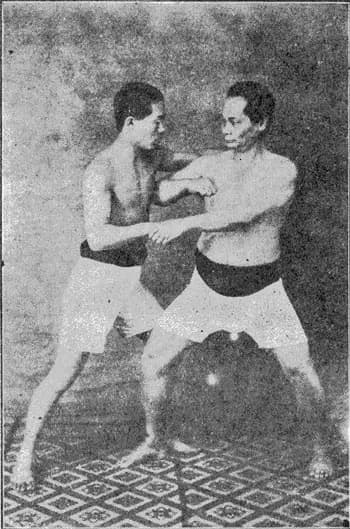
Karate's Olympic campaign ran for two decades and ended with one Games. Tokyo's organising committee used its right to propose additional sports, and in 2016 the IOC added karate to the 2020 programme: medals in kata, judged on technique and power, and in kumite, scored by points for controlled strikes across three weight classes for each sex. The pandemic pushed the competition to August 2021, at the Nippon Budokan, where the first Olympic champions included Japan's Kiyou Shimizu and Ryō Kiyuna in kata. Karate was not selected for Paris 2024 or Los Angeles 2028. For the moment, Tokyo stands alone.
For the art itself that changes very little. Karate is several things at once: an Okinawan tradition centred on kata and their applications; a Japanese budō with its ladder of dan grades; a world sport with two disciplines; and a full-contact branch that shades into kickboxing. Every one of them still teaches the Pinan kata that Itosu wrote for schoolchildren in 1901, and every one of them still bows at the door of the dōjō the way Funakoshi's students bowed at Keio in 1924.
Where to go next
- Training articles, workouts and gear for the art are collected in the karate discipline hub.
- The template Funakoshi borrowed for uniform, belts and dōjō culture: Judo: Kanō Jigorō and the Gentle Way.
- Karate's Korean cousin took a different road: The History of Taekwondo.
- The straight punch that Shuri-te prized, and how to stop throwing it badly: The Jab: Five Most Common Mistakes.
Sources
- World Karate Federation – History of karate
- Funakoshi Gichin, Karate-dō: My Way of Life (Kodansha, 1975)
- Mark Bishop, Okinawan Karate: Teachers, Styles and Secret Techniques (Tuttle, 1989)
- Japan Karate Association – History
- Wikipedia: Karate
- Wikipedia: Gichin Funakoshi
- Wikipedia: Ankō Itosu
- Wikipedia: Karate at the 2020 Summer Olympics
Frequently asked questions
- Where does karate come from?
- From Okinawa, the main island of the Ryukyu Kingdom, which traded with China and was ruled by Japan from 1609. The local fighting art, te, absorbed Chinese boxing over centuries and was called tōde, “Chinese hand”, before it was renamed karate, “empty hand”, in Japan in the 1930s.
- Is karate Japanese or Chinese?
- Both, in layers. Its techniques were shaped in Okinawa under strong Chinese influence, particularly from Fujian boxing; its modern form – uniform, belts, dōjō etiquette, competition – was created in mainland Japan in the 1920s and 1930s on the model of judo and kendo.
- What are the main karate styles?
- The four large Japanese styles are Shōtōkan, Gōjū-ryū, Shitō-ryū and Wadō-ryū, all named in the 1930s. Okinawa keeps its own lineages, such as Shōrin-ryū and Uechi-ryū, and Kyokushin (1964) started the full-contact branch.
- Why do karate kata exist?
- Kata are set sequences of techniques that preserved the art when it was taught in secret and without writing. Each kata encodes applications (bunkai) against grabs and strikes. Sport karate also scores kata as a competition discipline.
- Is karate an Olympic sport?
- It was contested once, at the Tokyo Olympics held in 2021, in kata and kumite. It was not included for Paris 2024 or Los Angeles 2028, so at present it is an Olympic-recognised sport without a place on the programme.
- What does “empty hand” mean?
- The characters kara-te were written “Chinese hand” in Okinawa. Funakoshi Gichin and others changed the first character to a homophone meaning “empty” in the 1930s, both to mark the art as Japanese and to point to its philosophy of fighting without weapons and without ego.