History
The History of Capoeira: From the Senzala to World Heritage
How enslaved Africans in Brazil created capoeira, how it survived a century of persecution, and how two masters in Salvador made it a UNESCO heritage.
8 min read · 20 September 2026 · updated 21 September 2026
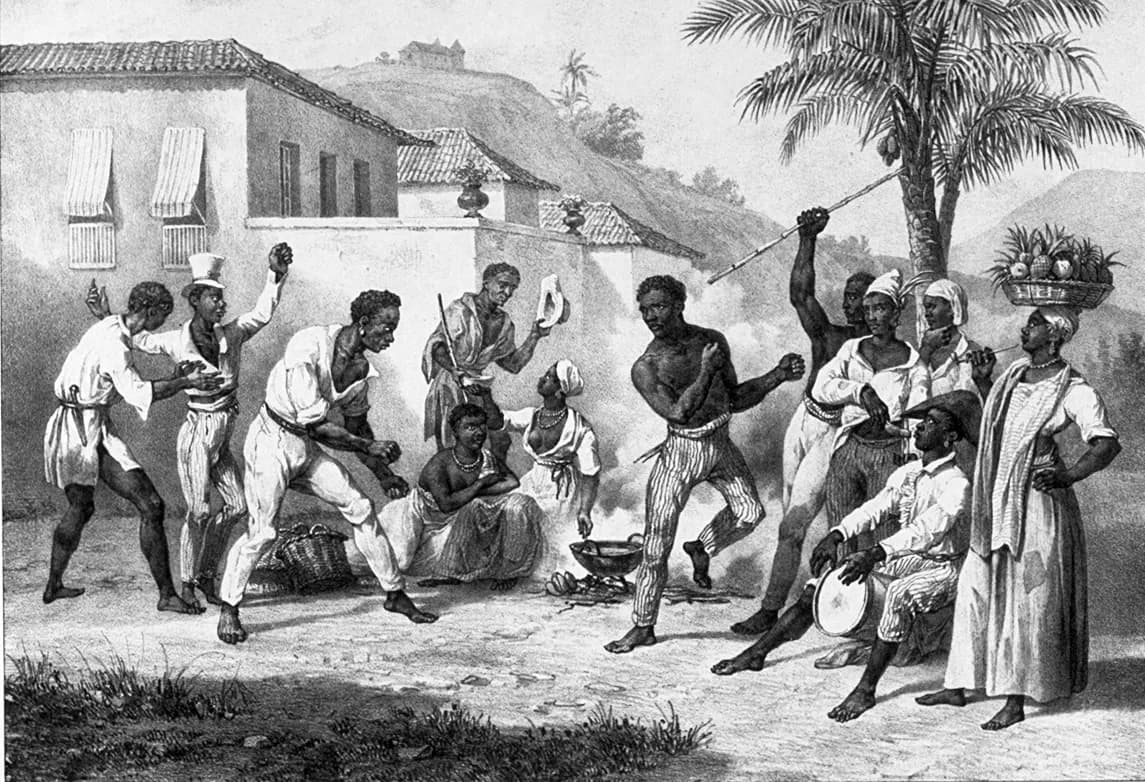
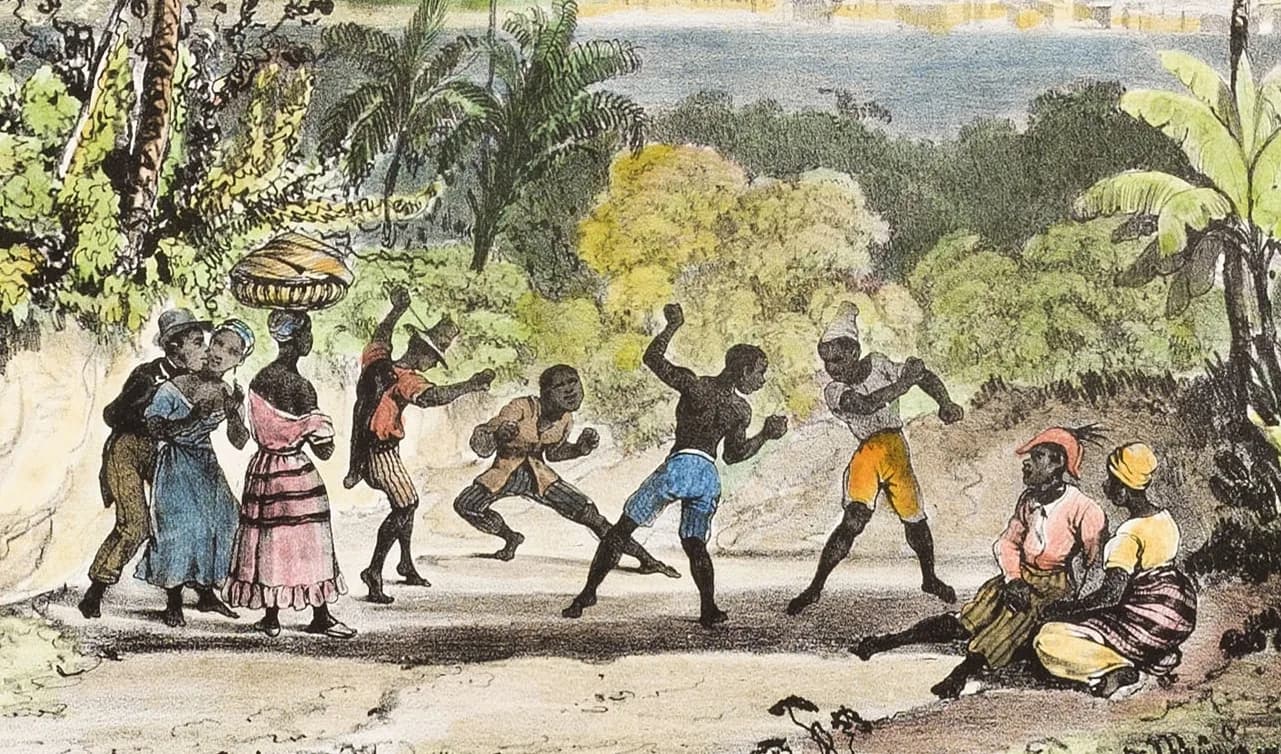
Photo: Jogar capoëra ou danse de la guerre by Johann Moritz Rugendas, 1835. Public domain, via Wikimedia Commons.
In this article
Timeline
- 16th–19th c.
Around five million enslaved Africans are brought to Brazil, most from Angola, Congo and West Africa. Their fighting games and dances are the raw material of capoeira.
- 1789
The earliest known written reference: a police record in Rio de Janeiro names a man arrested for capoeira.
- 1835
The German painter Johann Moritz Rugendas publishes the lithograph Jogar capoëra ou danse de la guerre – the first image of the art.
- 19th c.
Capoeira gangs, the maltas, dominate the streets of Rio; capoeiristas serve as bodyguards, hired muscle and, in the Paraguayan War, as soldiers.
- 1888
Slavery is abolished in Brazil, the last country in the Americas to do so.
- 1890
The Penal Code of the new republic makes capoeira a crime. Practitioners are jailed, deported or forced into hiding.
- 1932
Mestre Bimba opens the first capoeira academy in Salvador, teaching his Luta Regional Baiana; it is officially registered in 1937.
- 1941
Mestre Pastinha opens his Centro Esportivo de Capoeira Angola in Salvador to preserve the traditional game.
- 1953
President Getúlio Vargas watches Bimba's students and calls capoeira “the only truly Brazilian sport”.
- 1972
Capoeira is recognised as a sport by Brazil's national sports authority.
- 1970s
Brazilian masters begin teaching abroad; groups form in the United States and Europe.
- 2008
Brazil declares capoeira part of the national cultural heritage.
- 2014
UNESCO inscribes the capoeira circle (roda) on its list of Intangible Cultural Heritage of Humanity.
The first time anyone is known to have written the word down, it was in a police file. Rio de Janeiro, 1789: a record names a man arrested for capoeira. In 1835 a German painter called Johann Moritz Rugendas drew what the police had been arresting people for, two Black men in a crouching game inside a circle of onlookers, a drummer at the side, and gave the picture a title that hedges its bets: Jogar capoëra ou danse de la guerre, playing capoeira, or the war dance. He could not decide whether he was looking at a dance or a fight. Nobody has settled it since, and that is the point.
The short answer: capoeira was made by enslaved Africans in Brazil out of the fighting games and dances they carried with them. It was first recorded in Rio in 1789, banned by the new republic in 1890, and rescued in the 1930s and 1940s by two masters in Salvador, Mestre Bimba and Mestre Pastinha, whose academies gave it a legal home and two named styles. Fifty years on it was taught on every continent, and in 2014 UNESCO placed the capoeira circle on its list of the intangible heritage of humanity. This is the history of an art that survived because it looked like a game.
Key facts
- Origin
- Enslaved Africans in Brazil; Bantu (Angola–Congo) fighting games recombined
- First record
- Rio de Janeiro police document, 1789; first image by Rugendas, 1835
- Banned
- Penal Code of 1890, Article 402; enforced into the 1930s
- Styles
- Regional (Mestre Bimba, 1932) and Angola (Mestre Pastinha, 1941); contemporary blends
- Music
- Berimbau, pandeiro, atabaque, agogô, reco-reco; call-and-response songs
- Recognition
- Brazilian heritage 2008; UNESCO Intangible Heritage 2014
Five million people and what they carried
Between the 16th century and 1850 Portuguese and Brazilian ships carried around five million enslaved Africans to Brazil, more than to any other country in the Americas. Most came from the Bantu-speaking peoples of Angola and the Congo basin, and later from the Yoruba, Fon and Hausa regions of West Africa. They brought their religions, their music and what the body remembers: the wrestling and kicking games of Angola, above all engolo, a competitive dance of the southern Angolan highlands whose inverted kicks and sweeps look uncannily like capoeira's, and the circle games, drums and call-and-response singing of Central African festivals.
What became of those traditions in Brazil is the art's oldest argument. One side holds that capoeira is an African art preserved. The other holds that it was created in Brazil, by people from many African nations who had lost their specific traditions and built a new one in the plantation quarters, the senzalas, and in the cities. The historian Matthias Assunção, whose book is the standard account, comes down nearer the second: the ingredients were African, the recipe was Brazilian, and the mixing happened in the ports of Rio de Janeiro, Salvador and Recife, where enslaved and free Black people worked, gathered and fought.
Even the word will not sit still. In Portuguese capoeira is a cleared patch of forest, or a chicken coop. A Tupi origin, kaá-puêra, “the grass that was forest”, is often cited, and the link to the art may run through the places where it was played or through the porters who carried chickens to market and fought in the streets. The earliest known written use for the art is that Rio police record of 1789. By the time the word reached paper, it was already a crime.
The maltas of Rio and the law of 1890
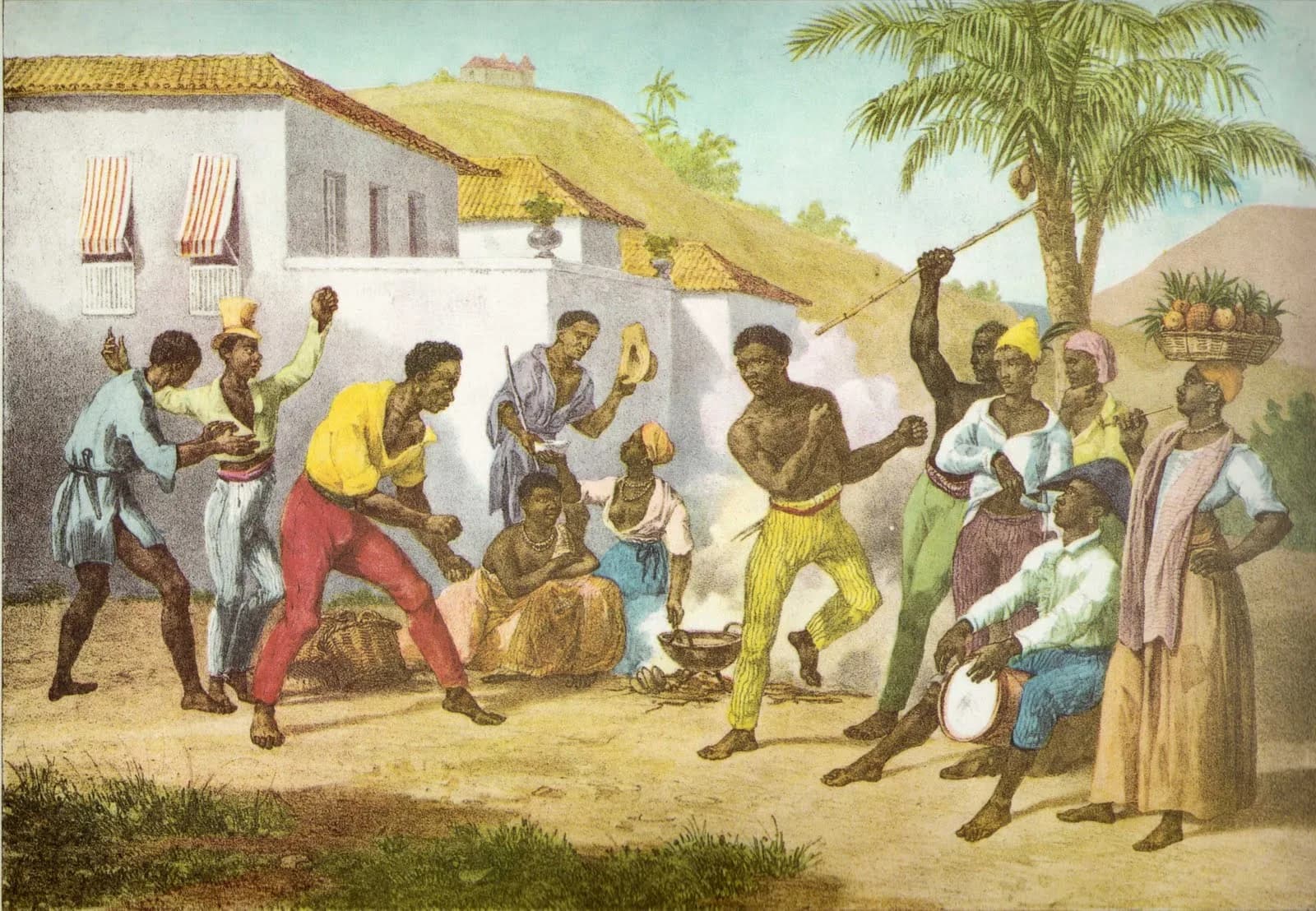
In 19th-century Rio de Janeiro, capital of the Brazilian Empire, capoeira was the art of the street. Gangs called maltas, organised by neighbourhood and known by their colours and nicknames, fought each other and the police, controlled territory, and worked as bodyguards and hired muscle for politicians. Their members were enslaved, freed and poor free men, Black and, increasingly, white. Their weapons were the razor, the knife and the head; their training was the game in the circle. Police records list thousands of arrests for capoeira in the decades before abolition, and travellers such as Johann Moritz Rugendas, whose 1835 lithograph Jogar capoëra ou danse de la guerre is the first known image of the art, described a thing that was dance and combat at once.
Capoeiristas fought in the Paraguayan War (1864–1870), in the units of Black soldiers raised for it, and the imperial government's political parties recruited them as enforcers at elections. Then the ground shifted under them. Slavery was abolished on 13 May 1888, the last abolition in the Americas; the Empire fell to a republican coup in 1889; and the new regime looked at the capoeira gangs and saw a relic of the old order and a threat to public order in one. The Penal Code of 1890 made the practice of capoeira in the streets a crime punishable by prison, and the Rio police chief Sampaio Ferraz used it to jail and deport hundreds of capoeiristas in a single year. The maltas were broken. The art went underground, to the port cities of the north-east and above all to Salvador da Bahia, where it lived on under nicknames and behind the disguise of a game.
Salvador: two men, two roads
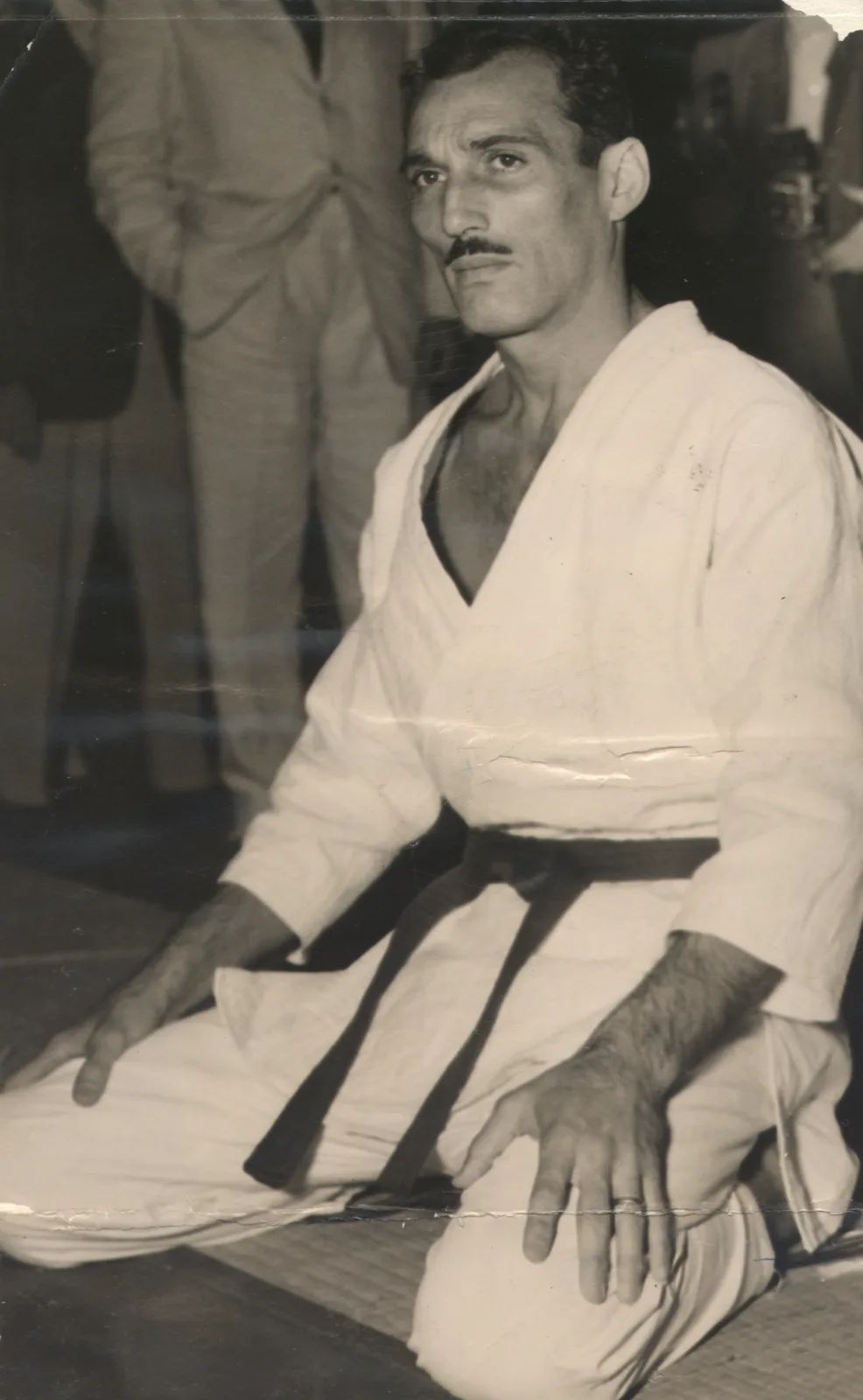
The art came out of hiding in Salvador in the 1930s, through two men who could hardly have been more different. Manuel dos Reis Machado, called Mestre Bimba (1899–1974), was a dock worker and a fighter, and he thought the capoeira of his day had become too playful to be taken seriously as combat. In 1932 he opened an academy and taught what he called Luta Regional Baiana, “Bahian regional fighting”: a systematic teaching sequence, a faster and more upright game, techniques borrowed from batuque, the Bahian leg-fighting game his father had practised, and, as he acknowledged, from other arts, and a graduation ceremony with coloured scarves. His students were often middle-class and white, which was part of the plan. In 1937 the academy was officially registered, the first legal capoeira school, and in 1953 Bimba's students performed for President Getúlio Vargas, who called capoeira “the only truly Brazilian sport”.
Vicente Ferreira Pastinha, Mestre Pastinha (1889–1981), took the opposite road. A painter, poet and philosopher of the art, he founded the Centro Esportivo de Capoeira Angola in 1941 to preserve the older game as he had learned it as a boy from an African named Benedito: low, slow, deceptive, ritualised, played with the malícia, the cunning, that he considered its essence. Pastinha gave the traditional style its name, Capoeira Angola, and its ethics, and he insisted that it was culture before it was anything else. He died blind and poor in 1981. His students, Mestre João Grande and Mestre João Pequeno among them, carried Angola into the revival of the 1980s.
The law catches up
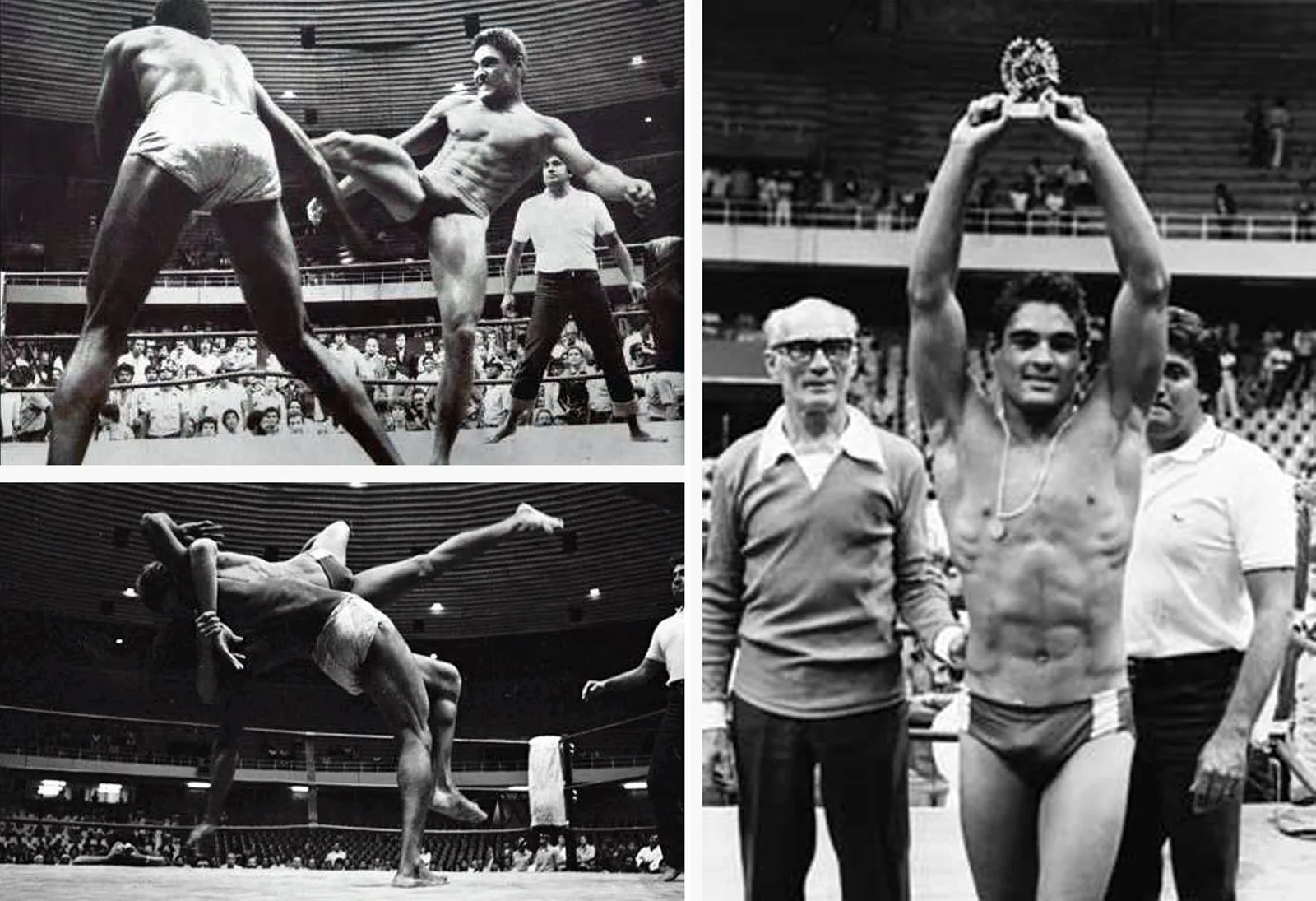
Once the academies existed, the law had to follow them. Capoeira was tolerated in Bahia from the 1930s, put into folkloric shows for tourists in the 1950s and 1960s, and recognised as a sport by Brazil's national sports authority in 1972, complete with a federation, rules and belts modelled on judo's, which many masters refused to accept. In Rio the Grupo Senzala, founded by young students in the 1960s, developed the athletic, acrobatic contemporary style that most groups now play, and the groups its graduates founded, Cordão de Ouro (1967), Abadá-Capoeira (1988) and others, became the multinational organisations of the art.
Export began in the 1970s. Brazilian masters moved to New York and California, then to Europe. Jelon Vieira taught in New York from 1975; Mestre Acordeon, a student of Bimba, settled in the United States in 1978 and wrote the first history of the art in English. By the 1990s there were groups in every major city of the world, films and video games had made the movements famous, and the music had entered Brazilian popular culture through the Tropicália and MPB of Gilberto Gil and Caetano Veloso. An art with African, Black and working-class roots now had a middle-class, international life, and the tension between the two has been a constant theme of its own debates ever since.
Heritage and today
Brazil declared the capoeira circle and the craft of its masters part of the national cultural heritage in 2008, and in November 2014 UNESCO inscribed the roda de capoeira on its Representative List of the Intangible Cultural Heritage of Humanity, describing it as a practice that “promotes social integration and the memory of resistance to historical oppression”. The recognition came with obligations. Brazil's heritage institute now supports the old masters, many of whom lived in poverty, and registers the practice in its Afro-Brazilian communities.
Today capoeira is played in more than 150 countries, in three broad currents, Angola, Regional and the contemporary blend, and with a vocabulary of movements that begins, in every academy on earth, with the ginga, the swaying base step from which everything else is thrown. Rugendas would know it at once. A circle, a drum, and two people playing at a fight.
Where to go next
- The capoeira discipline hub collects training articles, workouts and gear.
- Glossary: ginga.
- Another art shaped by Brazil: Brazilian Jiu-Jitsu: From Maeda to the Gracies.
- The conditioning capoeira demands: Jump Rope Conditioning.
Sources
- UNESCO – Capoeira circle, Intangible Cultural Heritage (2014)
- Matthias Röhrig Assunção, Capoeira: The History of an Afro-Brazilian Martial Art (Routledge, 2005)
- Maya Talmon-Chvaicer, The Hidden History of Capoeira: A Collision of Cultures in the Brazilian Battle Dance (University of Texas Press, 2008)
- Instituto do Patrimônio Histórico e Artístico Nacional (IPHAN) – Roda de Capoeira e Ofício dos Mestres
- Wikipedia: Capoeira
- Wikipedia: Mestre Bimba
- Wikipedia: Mestre Pastinha
- Wikipedia: Johann Moritz Rugendas
Frequently asked questions
- Is capoeira a dance or a martial art?
- Both, by design. It is played to music in a circle, with rhythm, song and acrobatics, and it contains kicks, sweeps, head-butts and evasions that work as fighting techniques. The music and the game disguised a fighting art under slavery and persecution, and the two sides have never been separated.
- Where does capoeira come from?
- From the enslaved Africans of Brazil, above all from the Bantu peoples of Angola and Congo, whose fighting games and dances – engolo is the most often cited – were recombined in the plantations and ports of Brazil into something new. Its earliest record is a Rio de Janeiro police document of 1789.
- Why was capoeira illegal?
- Because it was the fighting art of Black Brazilians and of the street gangs of Rio, the maltas. Two years after slavery was abolished, the Penal Code of 1890 made capoeira a crime; the law was applied for decades and shaped the art's secrecy and nicknames.
- What is the difference between Capoeira Angola and Capoeira Regional?
- Regional is the style Mestre Bimba created in the 1930s: faster, more upright, with a fixed teaching sequence and influences from other fighting arts. Angola, codified by Mestre Pastinha in the 1940s, keeps the older game: slow, low, playful and ritualised. Most modern groups play a contemporary blend.
- What instruments are used in capoeira?
- The berimbau, a single-string musical bow, leads the roda and sets the rhythm; it is joined by the pandeiro (tambourine), the atabaque (drum), the agogô (double bell) and the reco-reco (scraper), and by call-and-response singing in Portuguese.
- Is capoeira recognised as cultural heritage?
- Yes. Brazil listed the capoeira circle and the craft of its masters as national heritage in 2008, and UNESCO inscribed the roda on its Representative List of the Intangible Cultural Heritage of Humanity in 2014.