History
The History of Krav Maga: From the Streets of Bratislava to the IDF
How Imi Lichtenfeld turned street fighting against fascist gangs into the Israeli army’s combat system and the world’s best-known self-defence method.
7 min read · 20 September 2026 · updated 21 September 2026
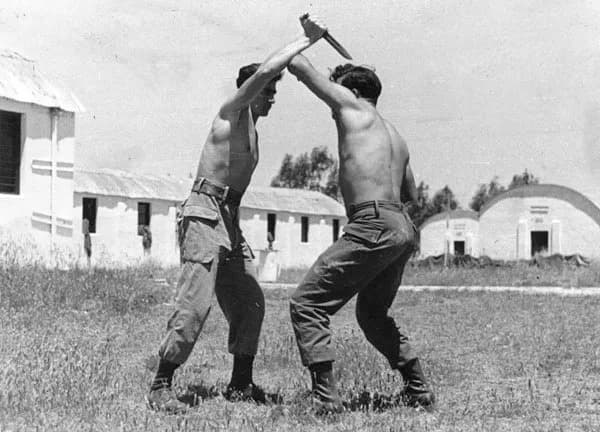
Photo: Israel Defense Forces hand-to-hand combat training, 1955. Public domain, via Wikimedia Commons.
In this article
Timeline
- 1910
Imrich Lichtenfeld, later Imi Sde-Or, is born on 26 May in Budapest and grows up in Bratislava, where his father runs a gym and trains police.
- 1928–1935
Imi competes in boxing, wrestling and gymnastics at national level in Czechoslovakia.
- 1936–1940
Anti-Semitic gangs attack Bratislava's Jewish quarter. Imi organises young Jews to defend it and learns that sport technique fails in street fights.
- 1940
He flees Europe on the refugee ship Pentcho, is shipwrecked, and reaches British Palestine in 1942 after serving with the Czech Legion.
- 1942–1948
Imi teaches fitness and close combat to the Haganah and the Palmach, the Jewish underground forces.
- 1948
The State of Israel is founded and the Israel Defense Forces are created; Imi becomes chief instructor for physical fitness and krav maga.
- 1964
Imi retires from the army and begins adapting the system for civilians, opening schools in Tel Aviv and Netanya.
- 1978
The Israeli Krav Maga Association is founded with Imi as president; a grading system with belts is introduced.
- 1981
The first instructor course for foreigners is held in Israel; Darren Levine brings the system to the United States.
- 1996
Eyal Yanilov founds the International Krav Maga Federation, the first of several global organisations.
- 1998
Imi Lichtenfeld dies in Netanya on 9 January, aged 87.
- 2000s
Krav maga spreads to police forces and civilian gyms worldwide; the name becomes a byword for practical self-defence.
In the late 1930s a national-level boxer and wrestler is standing in the Jewish quarter of Bratislava with a group of young men from the gym, waiting for a gang that has come to attack it. He knows more about fighting than anyone on the street. He has a champion's timing, a champion's conditioning and a champion's respect for the rules. In the next few minutes he learns that almost none of it is any use against several men at once, or against one man with a knife.
The short answer: that boxer was Imi Lichtenfeld (1910–1998), and krav maga has one founder and one origin, and both are him and that street. He carried what he learned there out of Europe in 1940, taught it to the Jewish underground in Palestine and then, for sixteen years, to the young Israeli army; after 1964 he rebuilt it for civilians. Krav maga, Hebrew for “contact combat”, is today the fighting system of the Israel Defense Forces and the most widely taught self-defence method in the world. What follows is the documented story, kept apart from the marketing that has grown around the name.
Key facts
- Founder
- Imi Lichtenfeld / Imi Sde-Or (1910–1998), Budapest-born, raised in Bratislava
- Origin
- Jewish self-defence against fascist gangs in Bratislava, 1936–1940
- Military phase
- Haganah and Palmach 1942–1948; IDF chief instructor 1948–1964
- Civilian phase
- Schools from 1964; Israeli Krav Maga Association 1978
- Principles
- Simplicity under stress, simultaneous defence and attack, vulnerable targets, retzev (continuous action)
- Global spread
- US from 1981; IKMF 1996, KMG 2010 and others
The gym was called Hercules
Imrich Lichtenfeld was born in Budapest on 26 May 1910 and grew up in Bratislava, then in Czechoslovakia, more or less inside a gym. His father, Samuel Lichtenfeld, was a police detective and a former circus strongman who owned a gym called the Hercules and used it to teach police officers how to defend themselves. Imi grew up among them. By his twenties he was competing at national level in boxing, wrestling and gymnastics and standing on Slovak championship teams, and he thought about fighting the way a champion does: rules, referees, fair play.
The 1930s took that away. From the middle of the decade, fascist and anti-Semitic gangs came into Bratislava's Jewish quarter, and Imi organised the young boxers and wrestlers he knew to hold it. He said later what those fights taught him. The techniques he had trained for competition were the wrong ones: too specialised, too dependent on rules, useless against several attackers or a man with a knife. What worked was simple, direct and aggressive, aimed at the attacker's most vulnerable points and delivered without hesitation. Twenty years later those observations would have a name.
A river boat called the Pentcho
By 1940 Imi was a marked man in a Slovak state allied with Nazi Germany, and he left by the only route open to him: aboard the Pentcho, an old river boat carrying more than 500 Jewish refugees down the Danube towards Palestine. The ship's boiler exploded in the Aegean. It ran aground on an Italian island, and Imi and the others were interned. He reached British-ruled Palestine in 1942, by way of the Czechoslovak Legion of the British army in North Africa and an ear infection that nearly killed him. He was 32. Most of his family had been lost in Europe.
Palestine had a use for him at once. The Jewish community's underground army, the Haganah, and its strike force, the Palmach, needed instructors who could teach young men and women with no fighting background to defend themselves quickly, which was precisely the problem Imi had been working on in Bratislava. Through the 1940s he taught physical fitness, swimming and a stripped-down close-combat method to Haganah and Palmach units. When the State of Israel was declared in May 1948 and the Israel Defense Forces were founded, the new army made him its chief instructor for physical fitness and hand-to-hand combat. He held the post for sixteen years.
Sixteen years of recruits
Every army has the same problem, and Imi now had the IDF's version of it: recruits arrive with a few weeks to learn, they will train exhausted and afraid, and years later, without practice, they must still be able to use what they were taught. His answer was a method rather than a catalogue. Techniques were chosen for simplicity, so they could be learned fast and performed under stress. They were built on natural reflexes, so that the flinch of a startled person became the first movement of a defence. Defence and counter-attack happened at the same time. And every technique went for targets that work on any attacker regardless of size: the eyes, the throat, the groin, the knees. Imi called it krav maga, “contact combat”, and organised it into a syllabus for the IDF's school of combat fitness at the Wingate Institute.
He took it from everywhere he had been. The punches came from boxing, the throws and holds from wrestling and judo, the knife and stick defences from the police classes in his father's gym, and the insistence on aggression and continuous movement, later named retzev, from the streets of Bratislava. The system was tested on the army's own recruits and refined for a quarter of a century, and it built the IDF's reputation for close combat, the one the world noticed after the wars of 1967 and 1973.
Two schools and a new name
Imi retired from the army in 1964 and, characteristically, kept working. The military system had been built for soldiers, who could injure an attacker without answering to a court; civilians needed defences against the common assaults, chokes, grabs, knife threats and sexual attacks, that could be taught to women, children and older people and that met the law's demand of proportionality. So he adapted the syllabus, opened two schools, in Tel Aviv and Netanya, and trained the first generation of civilian instructors. Several of them – Eli Avikzar, Haim Zut, Raphy Elgrissy and, from the late 1970s, Eyal Yanilov – would carry the system after him.
In 1978 the Israeli Krav Maga Association was founded with Imi as president, and the system acquired the trappings of a martial art it had never had: a grading syllabus, coloured belts borrowed from judo and, in 1981, the first instructor course for foreigners, paid for by an American philanthropist. One of its graduates was a Los Angeles prosecutor named Darren Levine, who went home, founded the Krav Maga Association of America and later Krav Maga Worldwide, and opened the door through which the system entered American police training in the 1980s and the fitness industry in the 1990s. Imi, who had by then taken the Hebrew name Sde-Or, “light field”, a translation of Lichtenfeld, taught into his eighties. He died in Netanya on 9 January 1998, aged 87.
The name and the method
Since 2000 the growth has been extraordinary and uneven. Krav maga is taught to every IDF recruit and to police and special forces in dozens of countries, from the French Gendarmerie to American federal agencies. It is the self-defence system of choice in civilian gyms across Europe and the Americas. And it has been marketed, franchised and diluted by schools that use the name for a kickboxing class with a knife-defence drill attached. The Israeli federations have answered with certification programmes and, in some cases, with court cases over who may use the name.
What the serious schools still share with the system Imi taught in 1948 is the method. There are no forms, no competitions and no rituals. Classes drill a few simple responses to common attacks, add fatigue, stress and surprise, and teach students to leave as soon as leaving is possible. It is not a martial art in the traditional sense, and Imi did not want it to be one. His stated aim, repeated by every organisation that claims him, was “so that one may walk in peace”.
Where to go next
- The krav maga discipline hub collects training articles, workouts and gear.
- The sports Imi competed in before he built the system: Boxing: From Bare Knuckles to the Queensberry Rules and The History of Wrestling.
- Conditioning for fighting under fatigue, which is where the method starts: Heavy Bag Intervals.
Sources
- Imi Sde-Or & Eyal Yanilov, Krav Maga: How to Defend Yourself Against Armed Assault (Dekel Publishing, 2001)
- Darren Levine & John Whitman, Complete Krav Maga (Ulysses Press, 2007)
- Israel Defense Forces – Krav Maga in the IDF
- Krav Maga Global – History of krav maga and Imi Lichtenfeld
- Wikipedia: Krav Maga
- Wikipedia: Imi Lichtenfeld
- Wikipedia: Haganah
Frequently asked questions
- What does krav maga mean?
- Hebrew for “contact combat” (krav, fight; maga, contact). The name describes a method rather than a style: close-range fighting aimed at ending a threat as quickly as possible.
- Who invented krav maga?
- Imi Lichtenfeld (1910–1998), a Hungarian-born Jewish boxer and wrestler from Bratislava who defended his community against fascist gangs in the 1930s, emigrated to Palestine, and trained the Haganah and then the Israel Defense Forces, where he was chief instructor from 1948 to 1964.
- Is krav maga a martial art or self-defence?
- It is a self-defence and combat system rather than a traditional martial art: there are no forms, no competitions and no sporting rules, and techniques are chosen for simplicity under stress. It borrows freely from boxing, wrestling, judo and other arts.
- Is krav maga used by the Israeli army today?
- Yes. All IDF recruits receive basic krav maga training, and combat units, police and special forces train it more intensively. The military syllabus differs from civilian krav maga, which was developed by Imi and his students after 1964.
- Why are there so many krav maga organisations?
- Imi founded the Israeli Krav Maga Association in 1978 but did not set up a single worldwide body. After his death in 1998 his senior students founded competing federations – IKMF, KMG, Krav Maga Worldwide and others – each claiming his lineage. They differ in details, not in principles.
- Can krav maga be used in competition?
- No. Its techniques target the eyes, throat and groin and are meant to end an attack, so there is no sporting version. Practitioners who want to compete usually cross-train in boxing, kickboxing or grappling.