History
Gladiators: The Real History of Rome’s Fighting Men
From three pairs at a funeral in 264 BC to the last bouts of the fifth century: who gladiators were, how fights worked and what modern combat sports kept.
11 min read · 21 September 2026 · updated 21 September 2026
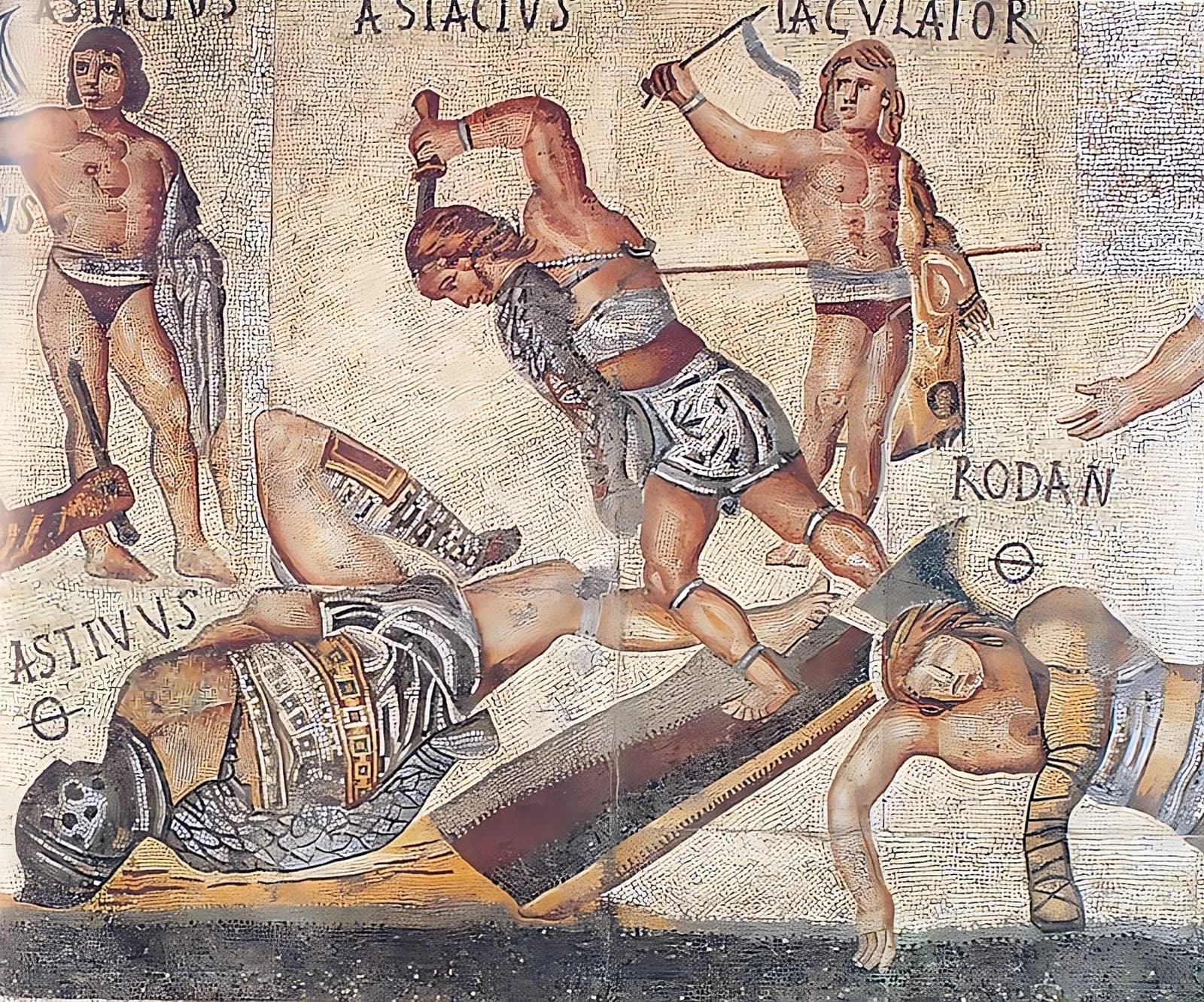
Photo: Borghese gladiator mosaic, c. AD 320. Public domain, via Wikimedia Commons
In this article
Timeline
- 4th century BC
Tomb paintings at Paestum in Campania show pairs of armed men duelling at funerals, the oldest evidence for the custom in Italy.
- 264 BC
The sons of Decimus Junius Brutus Pera stage the first recorded Roman munus, three pairs of gladiators, at their father's funeral in the Forum Boarium.
- c. 70 BC
Pompeii builds the earliest surviving stone amphitheatre.
- 73–71 BC
Spartacus and about 70 gladiators break out of a school at Capua; their revolt ends with Crassus's victory and 6,000 crucifixions along the Appian Way.
- 22 BC
Augustus regulates the games, limiting the number of gladiators a magistrate may present and later banning fights without the possibility of reprieve.
- AD 59
A riot between Pompeians and Nucerians at the Pompeii amphitheatre leads the Senate to ban games there for ten years.
- AD 80
Titus inaugurates the Flavian Amphitheatre, the Colosseum, with a hundred days of games.
- AD 107
Trajan celebrates his Dacian victory with 123 days of games in which, by Cassius Dio's count, 10,000 gladiators fought.
- AD 192
The emperor Commodus appears in the arena as a gladiator; he is assassinated at the end of the year.
- AD 200
Septimius Severus forbids women from fighting in the arena, evidence that they had been doing so for more than a century.
- AD 325
Constantine issues an edict from Beirut discouraging gladiatorial games, which nonetheless continue.
- AD 399
Honorius closes the imperial gladiator schools.
- AD 404
Traditional date of Honorius's ban on gladiatorial combat, linked by the church historian Theodoret to the death of the monk Telemachus in the arena.
- AD 430s
The last securely recorded gladiatorial combats in Rome; wild-beast hunts continue in the Colosseum until 523.
Somewhere in Sicily a stone records the career of a Syrian named Flamma. He fought 34 times, won 21, drew nine and lost four, and died at thirty. Four times he was offered the wooden sword that meant freedom, and four times he handed it back. His comrade-in-arms paid for the inscription. That is the whole of what we know about him, and it is more than we know about almost any other athlete of the ancient world.
The short answer: gladiators were professional fighters, mostly slaves, trained in schools, matched in pairs by armour class, refereed, sponsored by politicians and emperors, and watched by tens of thousands in purpose-built arenas for about seven hundred years. They did not usually fight to the death, though the death was always available. What the modern combat sports took from them is the shape of the event: two matched fighters, a man with a stick between them, a rule about when to stop, and a crowd.
Key facts
- First recorded Roman bout
- 264 BC, three pairs at a funeral in the Forum Boarium
- Origins
- Funeral games of Campania and Etruria; the Latin word munus means a duty owed to the dead
- Training
- The ludus, a school owned by a lanista; the Ludus Magnus in Rome fed the Colosseum by tunnel
- Main classes
- Retiarius, secutor, murmillo, thraex, hoplomachus, provocator, eques
- Referee
- The summa rudis, with a rod, assisted by a secunda rudis
- End
- Schools closed 399; ban traditionally dated 404; last recorded fights in the 430s
Three pairs in the cattle market
In 264 BC, the year Rome went to war with Carthage for the first time, two brothers named Marcus and Decimus Junius Brutus honoured their dead father by having three pairs of men fight beside his funeral in the Forum Boarium, the cattle market by the Tiber. Livy, writing two centuries later, treated this as the first such show in Rome. The idea was borrowed. The Romans themselves credited the Etruscans; modern historians point south, to Campania, where tomb paintings at Paestum from the fourth century BC show pairs of armed men duelling at funerals. Either way the Latin word for the show, munus, meant an obligation, a gift owed to the dead. The fight was a sacrifice with a scoreboard.
For its first two centuries the munus stayed a funeral custom of the aristocracy, and then it became politics. Ambitious men discovered that a large show bought votes, and the shows grew: Julius Caesar, as aedile in 65 BC, presented 320 pairs in silver armour in memory of a father who had been dead for twenty years. Augustus brought the whole business under the emperor's control after 22 BC, capping what a magistrate could present and reserving the great games for himself. From then on the biggest shows were imperial gifts, and the emperors who gave them were judged, in part, on how well they went.
The school and the man who owned it
A gladiator belonged to a familia, a troupe, and the troupe belonged to a lanista, a man who bought, trained and hired out fighters and whom Roman law ranked with pimps. His school was the ludus. The largest, the Ludus Magnus beside the Colosseum, was built under Domitian with its own practice arena and a tunnel into the amphitheatre. Recruits were prisoners of war, condemned men sentenced to the school, and slaves; a minority were free volunteers, the auctorati, who signed on for a fee and swore an oath, preserved by Petronius and Seneca, to be burned, bound, beaten and killed by the sword.
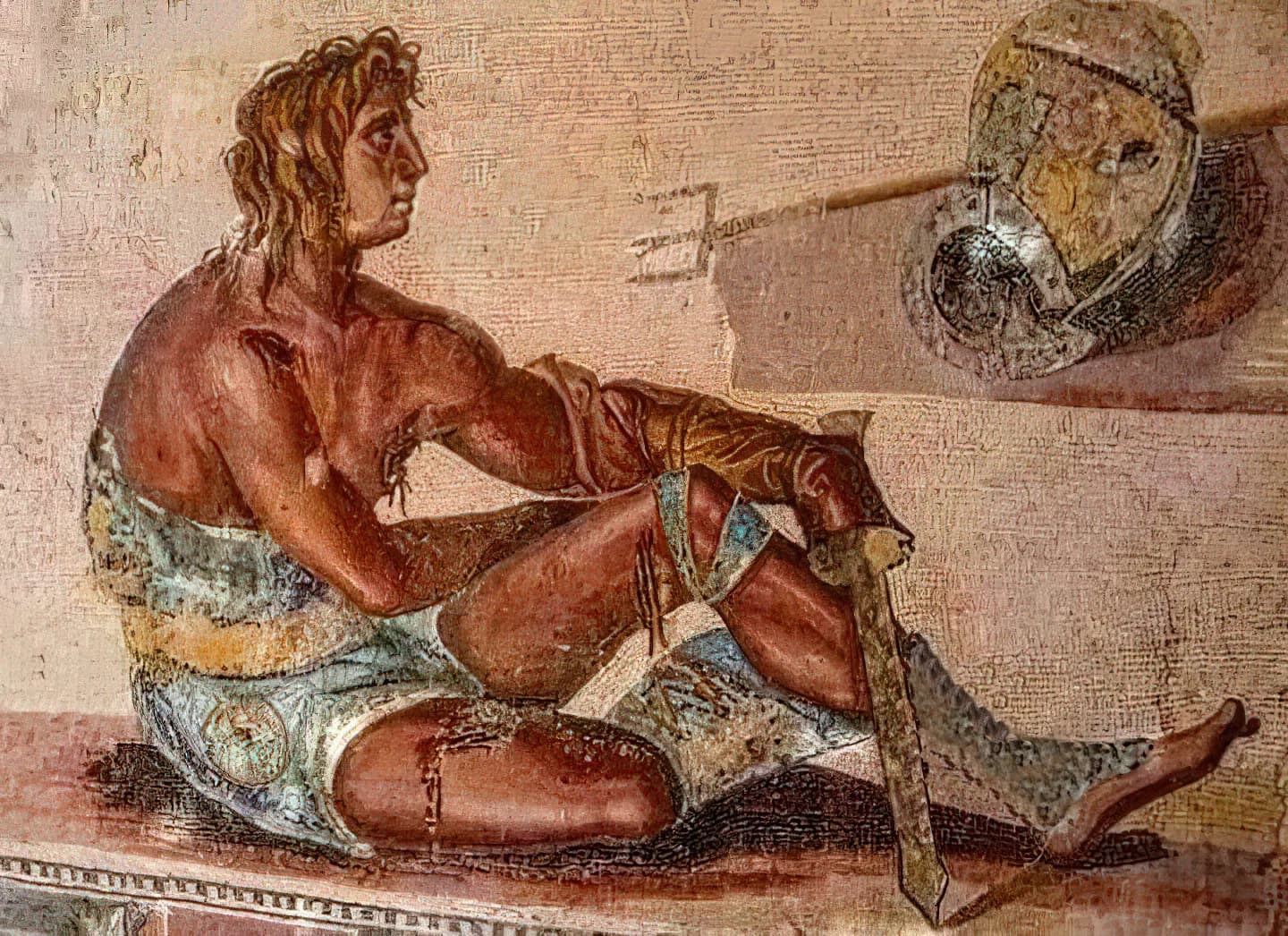
Inside the school life was closer to a modern fight camp than a prison. Trainers called doctores, usually retired gladiators, taught each armour class separately. Recruits learned on a wooden post, the palus, with weighted wooden weapons, and were graded in ranks, from the novice to the primus palus, the first man of the school. They had doctors: Galen, the most famous physician of antiquity, began his career treating the gladiators of Pergamon. They ate a great deal of barley and beans, which earned them the nickname hordearii, barley men, and the bones from a gladiator cemetery excavated at Ephesus confirm a diet heavy in plants and light in meat. A good fighter was expensive to make and worth keeping alive, which is the first thing to understand about the odds.
Net against helmet
The Romans did not match fighters by weight but by kit, and the kits were designed to be unequal in interesting ways. The retiarius had a net, a trident, a dagger and a shoulder guard, and nothing on his head; he was the fastest man in the arena and the most exposed. His opponent, the secutor, wore a smooth, rounded helmet with two small eyeholes that gave the net nothing to catch on and the man inside almost nothing to see through, plus a big shield and a short sword. One had to keep moving; the other could not breathe well for long.
| Class | Armed with | Usually matched against | The idea |
|---|---|---|---|
| Retiarius | Net, trident, dagger, shoulder guard; no helmet | Secutor | Speed and reach against armour |
| Secutor | Smooth helmet, large shield, short sword, one greave | Retiarius | Pressure before the air runs out |
| Murmillo | Fish-crested helmet, large shield, short sword, one greave | Thraex or hoplomachus | Heavy shield against a small one |
| Thraex | Griffin-crested helmet, small square shield, curved sica, two high greaves | Murmillo | A curved blade to reach round the shield |
| Hoplomachus | Small round shield, spear, dagger, two high greaves | Murmillo | The Greek hoplite, as Romans imagined him |
| Provocator | Breastplate, helmet with visor, medium shield, sword | Provocator | The one class matched against itself |
| Eques | Mounted with lance, then on foot with sword | Eques | Cavalry duel that ends on foot |
The murmillo, with his fish-crested helmet and heavy shield, was the standard heavyweight, and his usual opponents were the thraex, armed as a Thracian with a small shield and a curved sword to get round the murmillo's, and the hoplomachus, dressed as a Greek soldier with a spear. A programme, the libellus, listed the pairs in advance, with each man's record, and was sold in the streets.
The man with the stick
There were rules, and there was someone to enforce them. Mosaics show a figure in a white tunic with a long rod standing between the fighters: the summa rudis, the chief referee, with a secunda rudis as his assistant. He separated the pair, stopped the fight when a man was down or hurt, and, as inscriptions suggest, could be a former gladiator himself. Exactly what the rules said we do not know, because no rulebook survives, but the referees clearly had the power to halt a bout and restart it, and the fighters clearly obeyed them.
A bout ended in one of three ways. A fighter was killed or could not go on; or he raised his index finger, ad digitum, and asked for release; or, rarely, both were so good that they were sent off together standing, stans missus. On a raised finger the referee stopped the fight, and the decision passed to the editor, the man paying, who read the crowd. Whether the famous thumb gesture meant up, down or turned is genuinely unknown; the one poet who mentions it, Juvenal, does not say. A loser who had fought well was usually granted missio, release, and went back to the school to fight again. Augustus banned fights sine missione, without the possibility of reprieve, as excessive. The winner got a palm branch, prize money, and after enough wins the rudis, the wooden sword that Flamma kept refusing.
Seventy men and the kitchen knives
In 73 BC about seventy gladiators broke out of the school of Lentulus Batiatus at Capua, armed, Plutarch says, with knives and spits from the kitchen. Their leader was a Thracian named Spartacus. They camped on Vesuvius, beat the militia sent to fetch them, and within a year commanded an army of escaped slaves that ancient writers put at 70,000 or more and that defeated two consular armies in 72 BC. It took Marcus Licinius Crassus, the richest man in Rome, eight legions and a wall across the toe of Italy to end it. Spartacus died in the last battle in 71 BC; his body was never found. Crassus crucified 6,000 prisoners along the Appian Way from Capua to Rome and left them there.
A hundred days
The Flavian Amphitheatre, which the Middle Ages renamed the Colosseum after a nearby statue, was begun by Vespasian on the drained lake of Nero's palace and opened by his son Titus in AD 80 with a hundred days of games. Cassius Dio says 9,000 animals died in the inaugural shows; he does not count the men. It held perhaps 50,000 people, seated by rank, and it was the model for amphitheatres from Britain to Syria. Pompeii's, built about 70 BC, is the oldest that survives; in AD 59 a riot there between locals and visitors from Nuceria left enough dead that the Senate banned games in the town for ten years.
Women fought too. Nero and Domitian both staged bouts between women, and Juvenal sneered at society ladies training with the post. A marble relief from Halicarnassus, now in the British Museum, shows two of them in gladiator's kit, with their stage names, Amazon and Achillia, and a note that they were released standing. In AD 200 Septimius Severus banned female fights, which tells us they had lasted at least a century. And in 192 the emperor Commodus fought in the arena in person, as a secutor, against opponents who had been told not to win. His courtiers had him strangled in his bath on the last day of the year.
How likely were you to die
The French historian Georges Ville, working from first-century records, concluded that roughly one fighter in ten died in a given bout, most of them the losers whose release was refused, and that the odds worsened sharply in the later empire, when the crowd expected death more often. Other scholars put the first-century figure higher, around one in five, and note that a career of ten or more bouts was common on the tombstones and very common in the graffiti of Pompeii, where fans scratched fighters' records on the walls like batting averages. Flamma's 34 bouts were exceptional but not unique. Most gladiators fought only two or three times a year.
The economics did the rest. A trained gladiator cost the editor a large fee to hire and a much larger one to replace if he died, and lanistae wrote the replacement cost into the contract. A sponsor who let the crowd kill freely was paying for it. The cruelty was real, and so was the invoice.
The monk and the end
Christian emperors disliked the games and found them hard to stop. Constantine's edict of 325, sent from Beirut, called them distasteful and sent condemned men to the mines instead of the school; the games continued. Honorius closed the imperial schools in 399. The traditional date for the ban on combat itself is 404, tied by the church historian Theodoret to the story of Telemachus, a monk from the East who climbed into a Roman arena to separate the fighters and was killed by the crowd. Whether that scene happened as told is uncertain; what the record shows is that gladiatorial combats petered out in the West over the next generation, with the last securely dated bouts in Rome in the 430s. The hunts of wild animals, cheaper and less troubling to the church, lasted until 523. After that the Colosseum was a quarry.
What the ring kept
The gladiator left no school and no lineage; nobody taught the secutor's guard in 600. What survived was the format. A fight between two matched individuals, deliberately paired for contrast, is the gladiatorial idea, and it reappears in the weight classes of boxing and in the catchweight bouts of nineteenth-century wrestling. The referee with authority to stop the contest, the fighter's right to concede, the sponsor who pays and the crowd that judges, the published card with each man's record: all of it was in place in Rome by the first century and is in place at any fight night now. The sword, and the duel that went with it, took its own route through the fencing salles of Europe. Flamma would recognise a modern arena. He would want to know what the wooden sword was worth.
Where to go next
- The two arts that carry the format most directly: the wrestling hub and the boxing hub.
- How wrestling went from Greek palaestra to Olympic mat: The History of Wrestling.
- How the modern ring, the referee and the rounds were built: Boxing: From Bare Knuckles to the Queensberry Rules.
- The other line from the Roman sword: The History of Fencing.
Sources
- Thomas Wiedemann, Emperors and Gladiators (Routledge, 1992)
- Alison Futrell, The Roman Games: A Sourcebook (Blackwell, 2006)
- Donald G. Kyle, Spectacles of Death in Ancient Rome (Routledge, 1998)
- Georges Ville, La gladiature en Occident des origines à la mort de Domitien (École française de Rome, 1981)
- The British Museum – Relief of two female gladiators, Amazon and Achillia
- Encyclopaedia Britannica – Gladiator
- Wikipedia: Gladiator
Frequently asked questions
- Were gladiators slaves?
- Most were: prisoners of war, condemned criminals and slaves bought by a lanista for his school. A minority were free men, called auctorati, who signed a contract and swore the gladiator's oath for a fee. A few senators and one emperor, Commodus, fought as well, to the horror of their peers.
- Did gladiators fight to the death?
- Not usually. A bout ended when one fighter was killed, disabled or raised a finger to ask for release. The sponsor of the games then decided, with the crowd's advice, whether the loser lived. Estimates of how often a bout ended in death vary; most scholars put it well below half in the first century AD.
- What were the different types of gladiator?
- The armaturae, or armour classes. The best known are the retiarius with net and trident, the secutor with smooth helmet and big shield, the murmillo with fish-crested helmet, the thraex with a curved sword and small shield, and the hoplomachus with spear and round shield. Each type was normally matched against a particular other type.
- Who was Spartacus?
- A Thracian gladiator who led a breakout from a school at Capua in 73 BC. His army of escaped slaves defeated several Roman forces before Marcus Licinius Crassus destroyed it in 71 BC. He died in the final battle; 6,000 of his followers were crucified along the road from Capua to Rome.
- Were there female gladiators?
- Yes. Roman writers mention them under Nero and Domitian, a marble relief from Halicarnassus in the British Museum shows two named women, Amazon and Achillia, and the emperor Septimius Severus banned them in AD 200. They were rare and treated as a novelty.
- When did gladiator fights end?
- Gradually, in the late fourth and fifth centuries. Constantine discouraged them in 325, Honorius closed the schools in 399 and is traditionally said to have banned combats in 404. The last securely attested fights in Rome date from the 430s; wild-beast shows lasted another century.