History
The History of Aikido: Ueshiba Morihei and the Art of Peace
How a farmer's son from Tanabe learned Daitō-ryū from Takeda Sōkaku, found religion with Ōmoto-kyō, and built aikido, the Japanese art that refuses to compete.
8 min read · 20 September 2026 · updated 21 September 2026
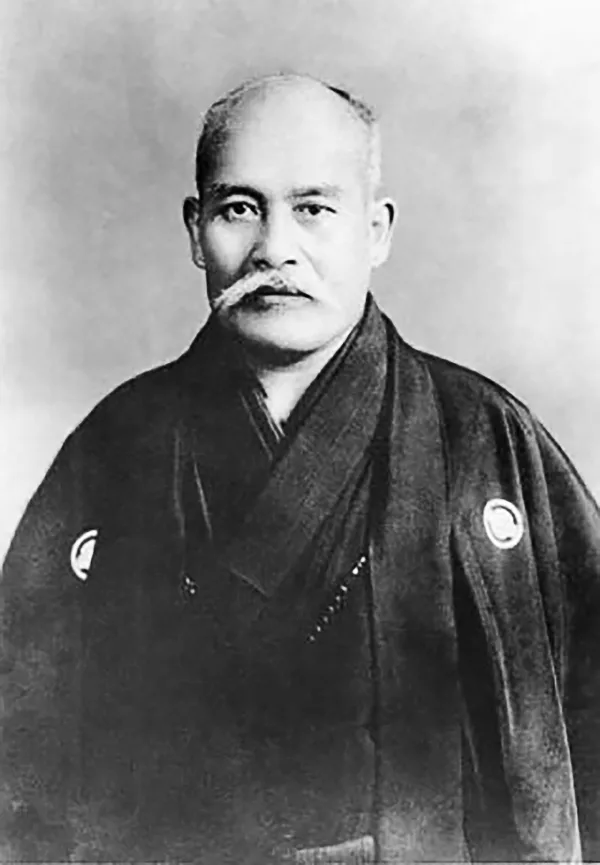
Photo: Ueshiba Morihei in 1939. Public domain, via Wikimedia Commons.
In this article
Timeline
- 1883
Ueshiba Morihei is born on 14 December in Tanabe, Wakayama Prefecture, the son of a farmer and local politician.
- 1901–1905
Ueshiba studies jujutsu and sword schools in Tokyo and Sakai, then serves as a soldier in the Russo-Japanese War.
- 1912
He leads a group of settlers from Tanabe to the frontier village of Shirataki in Hokkaido.
- 1915
In Hokkaido Ueshiba meets Takeda Sōkaku and begins studying Daitō-ryū aiki-jūjutsu, the technical root of aikido.
- 1919
Travelling to his dying father, he meets Deguchi Onisaburō of the Ōmoto-kyō religion in Ayabe and settles there in 1920.
- 1922
Takeda visits Ayabe and grants Ueshiba a teaching licence; Deguchi suggests the name aiki-bujutsu for what he teaches.
- 1924
Ueshiba accompanies Deguchi on a failed expedition to Mongolia; both narrowly escape execution.
- 1931
The Kōbukan dōjō opens in Tokyo, patronised by admirals, aristocrats and the founder of judo, Kanō Jigorō, who sends students.
- 1942
The name aikido is adopted through the Dai Nippon Butokukai; Ueshiba withdraws to the village of Iwama and farms.
- 1948
The Aikikai Foundation is recognised as the art's governing body; Ueshiba's son Kisshōmaru runs the Tokyo headquarters.
- 1953
Tōhei Kōichi teaches in Hawaii – the first aikido instruction outside Japan.
- 1955–1974
The major branches form: Yoshinkan (Shioda Gōzō, 1955), Shodokan with competition (Tomiki Kenji, 1967), Ki Society (Tōhei, 1974).
- 1969
Ueshiba dies in Tokyo on 26 April, aged 85. Kisshōmaru becomes the second Dōshu.
- 1976
The International Aikido Federation is founded; aikido is practised today in more than 130 countries.
In 1924, somewhere in Mongolia, Chinese troops lined up a party of Japanese travellers to be shot. One of them was Deguchi Onisaburō, the leader of a new religion, who had come to found a spiritual kingdom with the help of a local warlord. Beside him stood one of his followers, a short, stocky farmer from Wakayama who had spent five years on the Hokkaido frontier learning joint locks from the last of Japan's travelling masters. The Japanese consulate intervened in time. The farmer went home certain that something had been protecting him, and the art he taught for the rest of his life was built on that certainty.
The short answer: aikido is the life of one man, Ueshiba Morihei (1883–1969), and it has three sources. The Daitō-ryū aiki-jūjutsu he learned from Takeda Sōkaku in Hokkaido from 1915 supplied the techniques; the sword and spear methods he had studied since youth were the second source; and the religion of Ōmoto-kyō and its leader Deguchi Onisaburō turned a fighting art into what Ueshiba called the art of peace. The name was fixed in 1942, the Aikikai Foundation organised it after the war, and by the time Ueshiba died in 1969 his students had carried it to every continent. What follows is his story, which is the history of the art, with his students' legends kept apart from the record.
Key facts
- Founder
- Ueshiba Morihei (1883–1969), “Ō-Sensei”
- Technical root
- Daitō-ryū aiki-jūjutsu of Takeda Sōkaku, studied from 1915
- Spiritual root
- Ōmoto-kyō religion and Deguchi Onisaburō, from 1919
- Name
- Aikido, adopted 1942 (earlier aiki-bujutsu, aiki-budō)
- Organisation
- Aikikai Foundation (1948); International Aikido Federation (1976)
- Distinctive
- No competition (except Shodokan); techniques from blending, not clashing
A sickly boy who decided to be strong
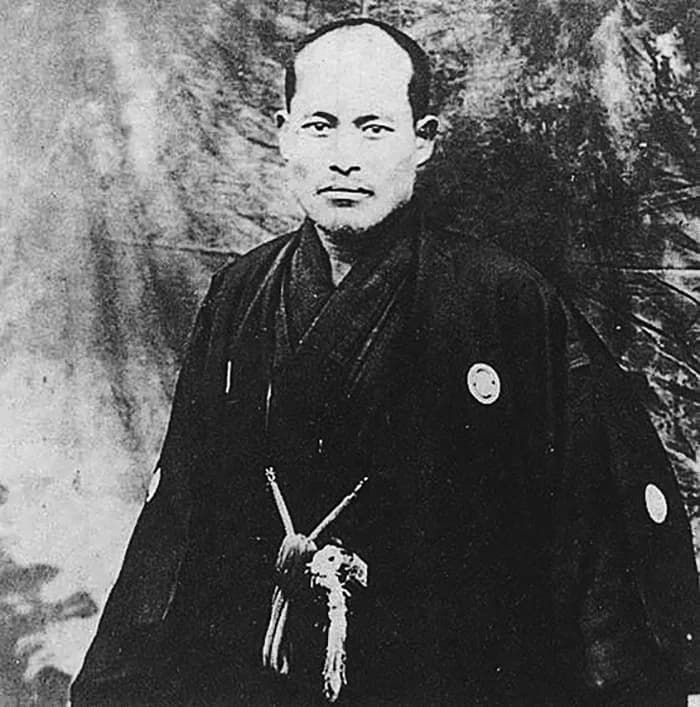
Ueshiba Morihei was born on 14 December 1883 in Tanabe, a coastal town in Wakayama Prefecture, the only son of a prosperous farmer and local politician. He was small and sickly, a child who read more than he played, and his father pushed him into sumo, swimming and running to put some body on him. His son tells the story that he resolved to become strong after seeing his father beaten by political thugs, and it may be true. What is certain is that by his twenties Ueshiba was short, immensely strong and obsessed with martial arts.
He collected them. Tokyo, 1901: Tenjin Shin'yō-ryū and Kitō-ryū jujutsu, the same schools Kanō Jigorō had built judo from. Sakai: the Yagyū Shingan-ryū. Then the Russo-Japanese War of 1904–1905 as an infantryman, and judo and sword work at home in Tanabe afterwards. In 1912 he led some eighty settlers from Tanabe to the frontier village of Shirataki in Hokkaido, Japan's northern island, where he farmed, built houses and became the man people went to. He was 31 when he met the man who would give him his art.
Takeda Sōkaku, who never let go
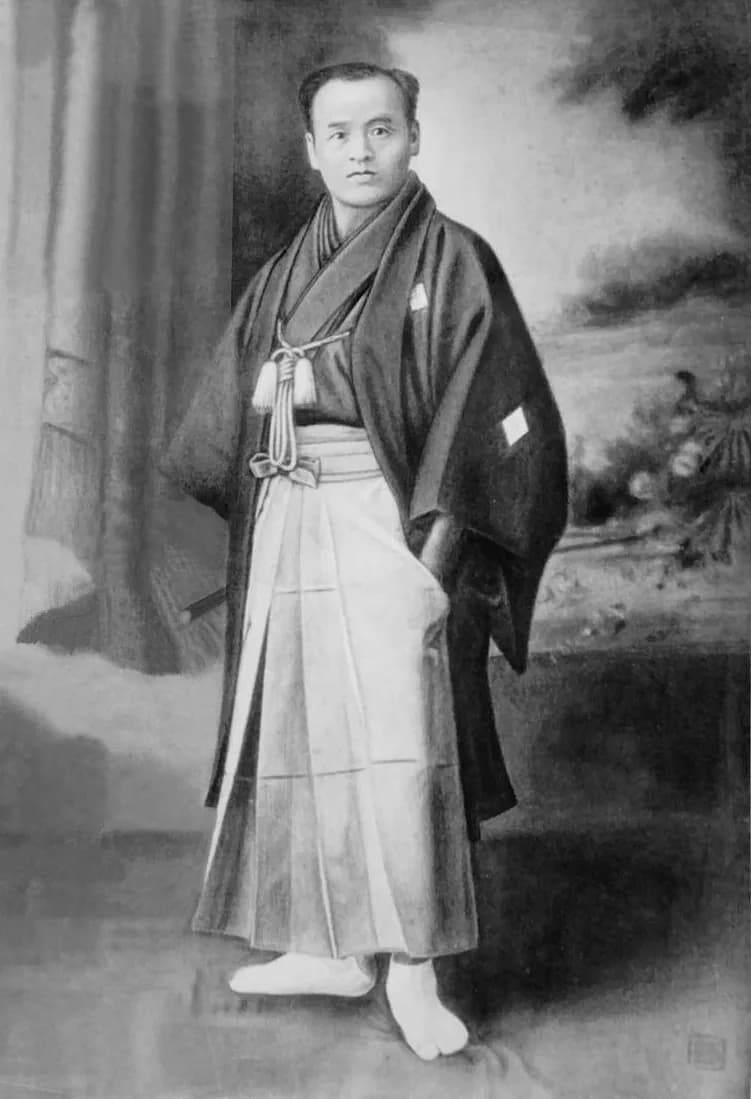
Takeda Sōkaku (1859–1943) was the last of the travelling martial-arts masters of old Japan: a small, fierce man from the Aizu domain who had trained in sword schools as a boy, fought duels, and taught a system of joint locks, throws and pins he called Daitō-ryū aiki-jūjutsu. He said it came down from the Minamoto clan and the secret teachings of Aizu. Historians can trace it no further back than Takeda himself, which makes it no less effective, and his students included police chiefs and judges. From February 1915 they included Ueshiba, who met him at an inn in Engaru, Hokkaido, was so impressed that he built Takeda a house, and studied with him for five years.
Daitō-ryū gave aikido its body. The numbered pins from ikkyō to gokyō, the wrist throws kote-gaeshi and shihō-nage, the entering movement irimi, and aiki itself, the moment of blending in which an attacker's force is turned against him: all of it is Takeda's, and Takeda's certificates in Ueshiba's name, from 1916 and a teaching licence in 1922, put the lineage beyond argument. The relationship was not an easy one. Takeda wanted money and deference, turned up unannounced at Ueshiba's dōjō for the rest of his life, and never accepted that his student had founded anything new. Aikido's official histories spent decades making him small. The research of Stanley Pranin and others has put him back where he belongs, at the root.
Ayabe, Mongolia and the turn to peace
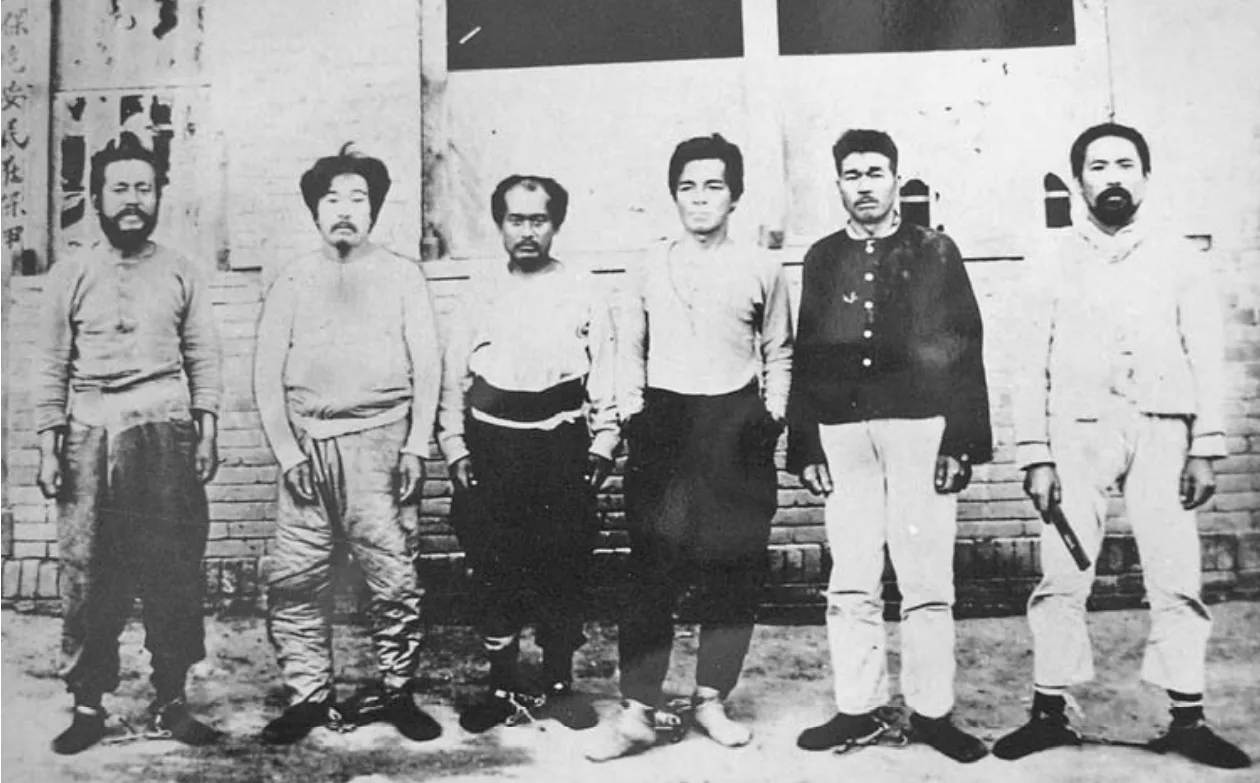
In late 1919 Ueshiba left Hokkaido to reach his dying father and, on the way, stopped at Ayabe near Kyoto, headquarters of Ōmoto-kyō, a new religion that preached the coming of a reformed world and the unity of all faiths. Its leader, Deguchi Onisaburō (1871–1948), a charismatic mystic, artist and organiser, captivated him, and in 1920 Ueshiba moved his family to Ayabe, where he farmed, meditated and chanted, and taught martial arts to the sect's members. Deguchi saw what he had. It was Deguchi who told Ueshiba that his art was a budō with a spiritual purpose, and Deguchi who gave it its first name, aiki-bujutsu.
Then came the strangest chapter of the life. In 1924 Ueshiba went with Deguchi on a secret expedition into Mongolia, where Deguchi meant to found a spiritual kingdom with the help of a local warlord. Chinese troops captured the party and lined them up for execution; the Japanese consulate intervened, and they lived. Ueshiba came home convinced that a higher power had protected him. From 1925 onwards he described spiritual experiences, of seeing the paths of attacks before they came, of the martial way as a means of harmonising with the universe, and those experiences became the philosophy of aikido, in the Ōmoto-tinged language that still fills his recorded lectures.
The Hell Dōjō
From 1927 Ueshiba taught in Tokyo, first privately to naval officers and aristocrats, and from 1931 in a dōjō of his own, the Kōbukan in Wakamatsu-chō. His students nicknamed it the “Hell Dōjō”, and they meant the training. His patrons were remarkable: Admiral Takeshita Isamu, who introduced him at court and in the navy; Prince Konoe; and Kanō Jigorō, the founder of judo, who watched a demonstration in 1930, reportedly said “this is my ideal budō”, and sent two of his best students to learn it. The pre-war Kōbukan produced the men who would lead aikido's branches, Shioda Gōzō, Tomiki Kenji, Mochizuki Minoru, and its teaching reached military and police academies.
The art still had no fixed name. Ueshiba called it aiki-bujutsu, aiki-budō, or simply Ueshiba-ryū. In 1942, when the government's Dai Nippon Butokukai reorganised the martial arts under wartime control, the name aikidō, “the way of harmonising spirit”, was adopted for its section. The same year Ueshiba, in poor health and disillusioned with the war his art had been serving, withdrew to the village of Iwama in Ibaraki Prefecture. There he farmed, built the Aiki Shrine and, according to his students, finished turning Daitō-ryū's hard locks into aikido's flowing circles. The Iwama years, from 1942 to about 1955, are the ones in which the aikido now taught in most dōjō took shape. The name came from wartime bureaucracy. The art came from a farm.
Kisshōmaru, the branches and the world
Japan's post-war ban on martial arts was lifted for aikido early, in 1948, when the Aikikai Foundation was recognised as the art's governing body, with Ueshiba as founder and his son Kisshōmaru (1921–1999) running the Tokyo headquarters. Kisshōmaru was the organiser his father never was. He rebuilt the dōjō, wrote the first books on the art, opened it to the public and the universities, and standardised the syllabus that the Aikikai's hundreds of thousands of members practise today. Ueshiba himself, the Ō-Sensei, taught, moved between Iwama and Tokyo, and gave the demonstrations, filmed in the 1950s and 1960s, on which his reputation as an almost supernatural martial artist rests.
The art went abroad with his students, and each of them took a different piece of it. Tōhei Kōichi taught in Hawaii in 1953, the first aikido instruction outside Japan, rose to chief instructor of the Aikikai, and left in 1974 over the emphasis on ki to found his own Ki Society. Shioda Gōzō founded the Yoshinkan in 1955 and kept the hard, precise pre-war style that the Tokyo police still train. Tomiki Kenji, a judo 8th dan, built Shodokan aikido at Waseda University with competitive randori, the only branch with tournaments, to Ueshiba's displeasure. Saitō Morihiro, the founder's closest student at Iwama, preserved the weapons work of those years. French, British and American aikido began in the 1950s and 1960s under instructors the Aikikai sent, the International Aikido Federation followed in 1976, and Steven Seagal's films gave the art a decade of Hollywood fame from 1988.
Ueshiba died of liver cancer in Tokyo on 26 April 1969, aged 85. Kisshōmaru succeeded him as second Dōshu, and Kisshōmaru's son Moriteru has led the Aikikai since 1999. The art they inherited is practised in more than 130 countries, and it has kept, more stubbornly than any other modern martial art, its founder's refusal to turn it into a sport. Tomiki's tournaments are the exception. Everyone else is still not competing.
Where to go next
- The aikido discipline hub collects training articles, workouts and gear.
- The art Kanō Jigorō built from the same jujutsu schools: Judo: Kanō Jigorō and the Gentle Way.
- Another Japanese way that renounced competition's excesses: The History of Kendo.
- Mobility and control for joint-lock arts: Kettlebell Strength for Fighters.
Sources
- Aikikai Foundation – History of aikido and the founder
- Stanley Pranin, Aikido Pioneers: Prewar Era (Aiki News, 2010)
- John Stevens, Abundant Peace: The Biography of Morihei Ueshiba, Founder of Aikido (Shambhala, 1987)
- Ueshiba Kisshōmaru, A Life in Aikido: The Biography of Founder Morihei Ueshiba (Kodansha, 2008)
- Wikipedia: Morihei Ueshiba
- Wikipedia: Aikido
- Wikipedia: Daitō-ryū Aiki-jūjutsu
- Wikipedia: Sokaku Takeda
Frequently asked questions
- Who founded aikido?
- Ueshiba Morihei (1883–1969), known in aikido as Ō-Sensei, “great teacher”. He built the art on the Daitō-ryū aiki-jūjutsu he learned from Takeda Sōkaku from 1915, on sword and spear methods, and on the religious ideas of Ōmoto-kyō, which gave aikido its ethic of harmony.
- What does aikido mean?
- Ai (harmony, joining), ki (spirit, energy) and dō (way): “the way of harmonising energy”. The name was adopted in 1942 in place of earlier names such as aiki-budō and Ueshiba-ryū.
- Is aikido effective for self-defence?
- It depends on the school and the training. Aikido's joint locks and throws come from Daitō-ryū and work when applied with commitment against realistic attacks; most schools train cooperatively and without resistance, which builds skill slowly and can leave students untested. Styles such as Yoshinkan and Shodokan, and cross-training, address the gap.
- Why is there no competition in aikido?
- Ueshiba rejected competition on principle: aikido, in his view, was about resolving conflict rather than defeating an opponent. The exception is Shodokan (Tomiki) aikido, founded by the judo teacher Tomiki Kenji in 1967, which holds tournaments with a rubber knife and randori.
- What is the relationship between aikido and Daitō-ryū?
- Daitō-ryū aiki-jūjutsu, taught by Takeda Sōkaku, supplied almost all of aikido's techniques: the pins ikkyō to gokyō, the wrist throws, the entering movements. Ueshiba changed the emphasis – larger circular movements, blending rather than breaking – and removed the striking and the harshest locks, but the technical core is Takeda's.
- How many aikido styles are there?
- The Aikikai, led by Ueshiba's descendants, is by far the largest. Independent branches include Yoshinkan (hard, precise, used by the Tokyo police), Shodokan (competitive), Ki Society (Tōhei's ki emphasis), Iwama style (weapons-based, from Saitō Morihiro) and several smaller organisations.