History
The Samurai and Their Martial Arts: From Bujutsu to Budō
How Japan’s warrior class rose with the bow, ruled with the sword, lost both to rifles and a law, and left behind judo, kendo and aikido.
10 min read · 21 September 2026 · updated 21 September 2026
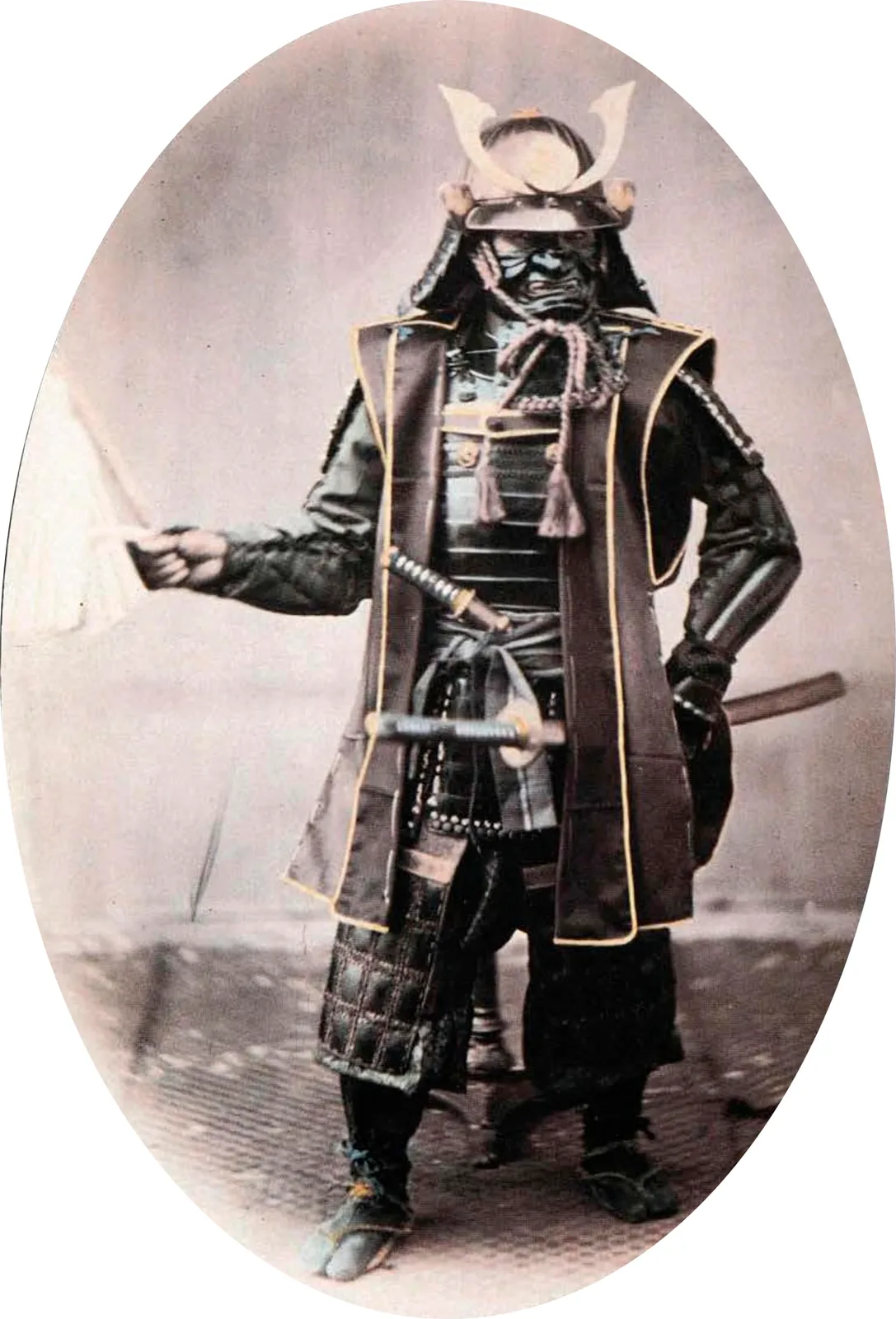
Photo: Felice Beato, 1860s. Public domain, via Wikimedia Commons
In this article
Timeline
- c. 900–1100
Provincial warrior families in Heian Japan take on the policing and fighting the court no longer does; the bushi emerge as a class.
- 1180–1185
The Gempei War between the Minamoto and Taira clans ends at the sea battle of Dan-no-ura; Minamoto no Yoritomo becomes shogun in 1192.
- 1274 and 1281
Two Mongol invasion fleets land at Hakata Bay in Kyushu; both are beaten off with the help of storms later called kamikaze.
- 1543
Portuguese traders shipwrecked on Tanegashima bring matchlock arquebuses to Japan; local smiths copy them within months.
- 1575
At Nagashino, Oda Nobunaga and Tokugawa Ieyasu use massed arquebusiers behind palisades to destroy the Takeda cavalry.
- 1588
Toyotomi Hideyoshi's sword hunt disarms the peasantry and fixes the samurai as a hereditary armed class.
- 1600
Tokugawa Ieyasu wins the battle of Sekigahara and is named shogun in 1603, beginning two and a half centuries of peace.
- c. 1645
Miyamoto Musashi completes the Book of Five Rings in a cave near Kumamoto shortly before his death.
- 1750s
Nakanishi Chūta popularises the bamboo shinai and padded armour, making full-contact sword practice possible.
- 1868
The Meiji Restoration ends the Tokugawa shogunate and, with it, the samurai's monopoly on arms and office.
- 1876
The Haitōrei edict forbids the wearing of swords in public; samurai stipends are commuted to bonds the same year.
- 1877
The Satsuma Rebellion under Saigō Takamori is crushed by the conscript army at Shiroyama on 24 September.
- 1882
Kanō Jigorō opens the Kōdōkan in Tokyo and calls his reformed jūjutsu judo, the first bujutsu to become a budō.
- 1919
The Dai Nippon Butokukai adopts the name kendo in place of kenjutsu; aikido takes its name in 1942.
- 1964
Judo is contested at the Tokyo Olympics, the first Japanese martial art in the Games.
On the morning of 24 September 1877, on a hill called Shiroyama above the town of Kagoshima, a few hundred men in old-fashioned dress waited for an army of about 30,000 conscripts armed with modern rifles and artillery. Their leader, Saigō Takamori, had been one of the architects of the government now attacking him. By mid-morning he was dead, and the men who had followed him down the hill with swords were dead too. Newspapers in Tokyo called it the end of the samurai. For once the newspapers were right.
Here is what actually happened over the seven hundred years before that morning, and what came after. The samurai rose as mounted archers, ruled Japan as a hereditary class, fought their greatest battles with spears and guns, spent two and a half centuries of peace turning their fighting techniques into schools, and were legislated out of existence within a decade of the Meiji Restoration. Their arts survived them by changing their name: from bujutsu, martial technique, to budō, the martial way. Judo, kendo and aikido are what that change produced.
Key facts
- Class emerges
- Heian period, roughly the tenth to twelfth centuries; bushi means warrior
- First weapon
- The bow, from horseback; the sword became the symbol only in the Tokugawa peace
- Decisive battles
- Dan-no-ura 1185, Nagashino 1575, Sekigahara 1600, Shiroyama 1877
- Schools
- Koryū: Katori Shintō-ryū (15th c.), Shinkage-ryū, Ittō-ryū, Takenouchi-ryū jūjutsu (1532)
- End of the class
- Conscription 1873, sword ban 1876, Satsuma Rebellion 1877
- Legacy
- Judo (1882), kendo (named 1919), aikido (named 1942)
The horse and the bow
The word samurai comes from a verb meaning to serve, and the first men called by it, in the Heian period, were provincial landowners who did the fighting an elegant court in Kyoto no longer wanted to do itself. Their skill was kyūba no michi, the way of horse and bow. A samurai of the eleventh century was an archer on horseback, wearing a box-like armour of laced iron and leather, shooting a bow more than two metres (seven feet) long from the saddle at a gallop. The sword he carried was a sidearm. The ritual of yabusame, still performed at shrines today, in which riders loose arrows at three wooden targets down a straight track, is the last living trace of what the class was for.
Two clans of such men, the Taira and the Minamoto, fought for control of the court in the Gempei War of 1180 to 1185. It ended at sea, at Dan-no-ura in the straits between Honshu and Kyushu, with the Taira fleet destroyed and the child emperor drowned in his grandmother's arms. The Minamoto leader, Yoritomo, did not take the throne. He took something more durable: in 1192 the court named him shogun, and he governed from his own camp at Kamakura while the emperor reigned in Kyoto. Warriors would rule Japan in that arrangement for the next 676 years.
Wind from the gods
In 1274 and again in 1281 the Mongol emperor Kublai Khan sent invasion fleets to Hakata Bay in Kyushu. The Japanese were used to a war of individual challenges, a mounted archer calling out his name and lineage before shooting; the Mongols answered with massed infantry, poisoned arrows and explosive bombs thrown by catapult. The samurai held the beaches, built a stone wall along the bay between the invasions, and were saved twice by storms that wrecked the fleets, storms later named kamikaze, the divine wind.
The lesson stuck. Over the following century Japanese warfare shifted from the horseman's bow towards infantry, and the weapons of the foot soldier, the spear and the glaive called naginata, rose with it. The sword grew longer and more curved, to be drawn and cut with in one motion on foot. By the time of the great civil wars the samurai ideal was still the archer, but the samurai's day was spent with a spear.
Three thousand guns at Nagashino
Japan fell into a century of war after 1467, the Sengoku or Warring States period, in which the shogun's authority collapsed and regional lords fought for the pieces. Into this arrived, in 1543, a Chinese junk carrying Portuguese traders, wrecked on the island of Tanegashima. They had matchlock arquebuses. The local lord bought two, his swordsmith copied them, and within a generation Japanese gunsmiths were producing firearms in quantities that Europe would have envied.
The decisive demonstration came at Nagashino in 1575. Oda Nobunaga and his ally Tokugawa Ieyasu put their arquebusiers behind wooden palisades on a river bank and let the cavalry of the Takeda clan charge into their volleys. The chronicles give Nobunaga 3,000 guns; historians suspect fewer, but the result is not in doubt. The Takeda were destroyed as a power. A samurai army was now a combined force of gunners, spearmen and archers with a few horsemen in armour at the front, and war was decided by who could raise, arm and feed the most peasants. Nobunaga's successor Toyotomi Hideyoshi understood the implication. His sword hunt of 1588 confiscated the weapons of the countryside and left arms to the samurai alone, which turned a profession into a caste.
Two hundred and fifty years without a war
Tokugawa Ieyasu won the last great battle, at Sekigahara in 1600, and was named shogun in 1603. After the fall of Osaka Castle in 1615 and the crushing of a peasant revolt at Shimabara in 1638, Japan had no war at all for more than two centuries. This is the paradox at the centre of samurai history: the fighting arts were codified by men who never fought.
They codified them thoroughly. The ryū, schools headed by a master and passed down through licensed successors, had existed since the fifteenth century; Iizasa Chōisai Ienao founded the Katori Shintō-ryū around 1447, and Kamiizumi Nobutsuna the Shinkage-ryū in the following century. Under the Tokugawa they multiplied into the hundreds. The Yagyū branch of the Shinkage-ryū became the official sword school of the shoguns; the Ittō-ryū, the one-sword school, was the other. Grappling in armour, taught as yawara or jūjutsu, had its own lines, the oldest being the Takenouchi-ryū of 1532, and from these the schools that Kanō Jigorō would later study, the Kitō-ryū and the Tenjin Shin'yō-ryū, descended.
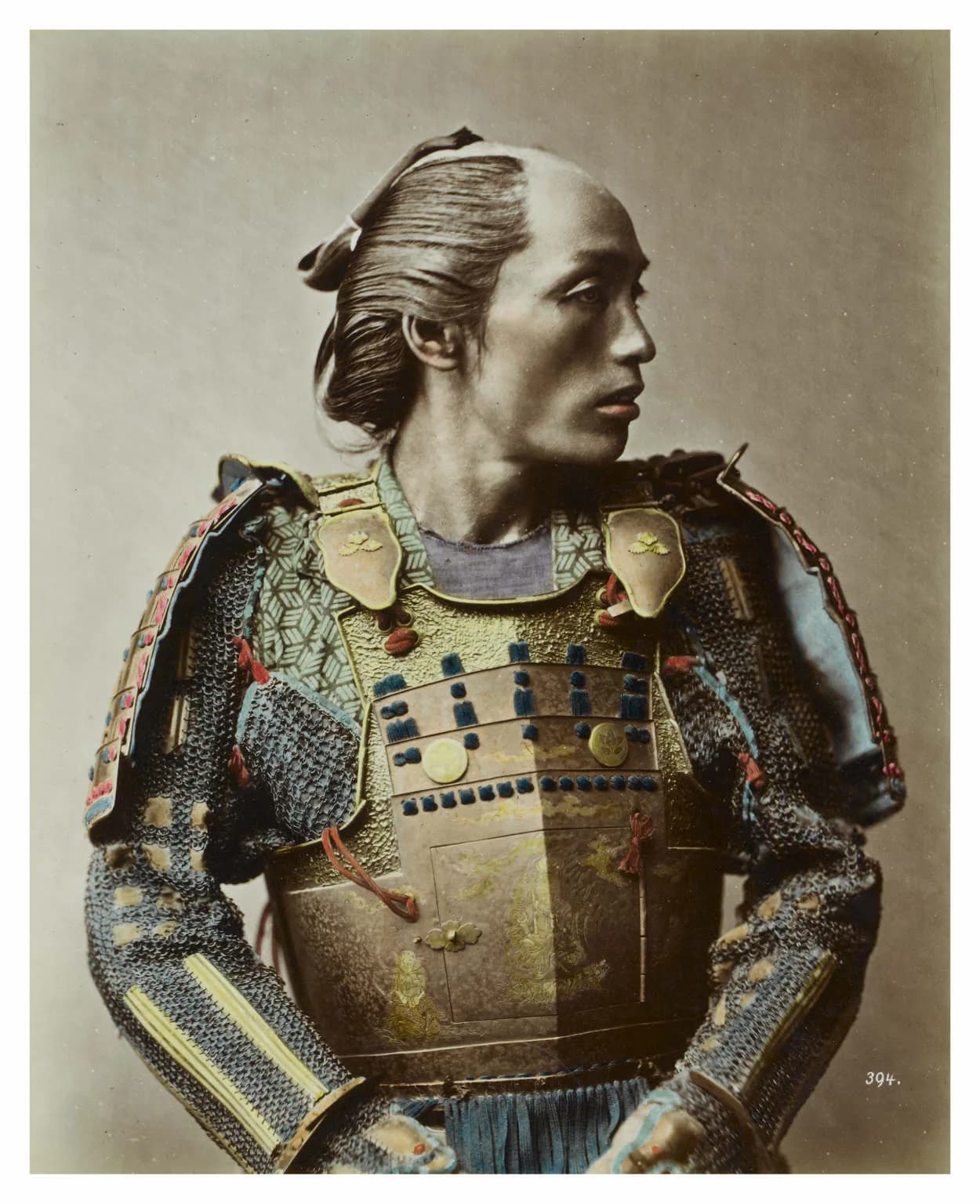
The most famous swordsman of the period was a man who belonged to no school. Miyamoto Musashi (c. 1584–1645) claimed in his own account to have fought more than sixty duels without defeat before he turned thirty, the last and best known against Sasaki Kojirō on the island of Ganryūjima in about 1612, where he is said to have arrived late and armed with a wooden sword carved from an oar. What is certain is what he wrote. In a cave outside Kumamoto, in the last months of his life, he completed the Book of Five Rings, a manual on strategy and the two-sword method of his Niten Ichi-ryū that is still read by fencers.
The peace also changed how the sword was practised. Training in the koryū meant paired forms with wooden swords, stopped short of contact, and a school that wanted to test its students had a problem. In the early eighteenth century Naganuma Shirōzaemon of the Jikishinkage-ryū devised a face mask and body armour, and in the 1750s Nakanishi Chūta of the Ittō-ryū popularised them together with the shinai, a sword of split bamboo. For the first time two swordsmen could hit each other as hard as they liked and walk home. Kendo was born in those halls, a century before it got the name.
The sword ban
The peace ended with the American squadron that anchored in Edo Bay in 1853 and the political crisis it set off. In 1868 a coalition of southern domains overthrew the shogunate in the name of the young Meiji emperor, and the men who had led it, many of them samurai, set about dismantling their own class. Conscription in 1873 gave the new state an army of peasants with rifles. In 1876 the Haitōrei edict forbade anyone but soldiers and police to wear a sword in public, and the same year the stipends on which samurai families had lived were commuted into government bonds. A class of about two million people, with their dependants, lost their income, their weapon and their reason for existing in twelve months.
Saigō Takamori, who had commanded the imperial army in 1868 and resigned from the government in 1873, led the revolt of the samurai of Satsuma in 1877. It lasted from February to September and ended at Shiroyama. The conscripts beat the finest swordsmen in Japan with artillery and Snider rifles, and then buried them with honours. The government pardoned Saigō posthumously in 1889 and put up a statue of him in Ueno Park, where it still stands, in civilian dress, walking a dog.
From jutsu to dō
The samurai were gone; their arts were not, though for a time they were close. Fencing survived the 1870s partly as show business, when a former shogunal instructor, Sakakibara Kenkichi, staged public bouts for paying crowds from 1873. Jūjutsu masters taught in back rooms to dwindling classes. It was a small, sickly, brilliant student of two of them who found the way out.
Kanō Jigorō was 21 when he opened the Kōdōkan in a Tokyo temple in 1882 with a handful of students and a training hall of twelve mats. He had studied the Tenjin Shin'yō-ryū and the Kitō-ryū, and what he did with them was new in kind rather than degree: he removed the techniques that could not be practised safely at full speed, built a syllabus around free sparring, and changed the last syllable of the name. Not jūjutsu, the technique of pliancy, but judo, the way of it. The point was no longer to win on a battlefield that no longer existed but to make a person, and the state agreed. Judo entered the schools, the police and, in 1964, the Tokyo Olympics.
Fencing followed. The Dai Nippon Butokukai, the Greater Japan Martial Virtue Society founded in Kyoto in 1895, standardised shinai fencing across the schools and in 1919 adopted the name kendo, the way of the sword. Ueshiba Morihei, a landowner's son from Wakayama who had studied the Daitō-ryū jūjutsu of Takeda Sōkaku from 1915, gave his own art the name aikido in 1942. Kendo was banned and judo removed from the schools by the Allied occupation in 1945 as militarist; both were back within a decade, taught as sports and as ways.
The change of syllable did a great deal of work. A jutsu was a set of techniques for killing a man; a dō was a discipline for improving one. The techniques were largely the same. What the samurai left the modern world was not a code, which was mostly written after the fact, nor a weapon, which was banned, but a habit of practising fighting as a form of education. Kanō would have said that was the point all along.
Where to go next
- The hubs for the three arts that came out of this story: kendo, judo and aikido.
- Kanō's own story in full: Judo: Kanō Jigorō and the Gentle Way.
- How the shinai halls became a modern sport: The History of Kendo, and how one student of Daitō-ryū became a founder: The History of Aikido.
- The Japanese sword against the European one: Kendo vs Fencing.
Sources
- Karl F. Friday, Samurai, Warfare and the State in Early Medieval Japan (Routledge, 2004)
- Stephen Turnbull, The Samurai: A Military History (Routledge, 1996)
- G. Cameron Hurst III, Armed Martial Arts of Japan: Swordsmanship and Archery (Yale University Press, 1998)
- Miyamoto Musashi, The Book of Five Rings, translated by Thomas Cleary (Shambhala, 1993)
- Encyclopaedia Britannica – Samurai
- The Metropolitan Museum of Art – Arms and Armor of the Samurai
- Wikipedia: Samurai
Frequently asked questions
- What martial arts did the samurai practise?
- Mounted archery (kyūjutsu) first of all, then swordsmanship (kenjutsu), the spear (sōjutsu), the glaive (naginata), grappling in armour (jūjutsu and its relatives) and, from 1543, firearms. Training was organised in schools called ryū, each with its own curriculum.
- Was the sword really the main weapon of the samurai?
- Not for most of their history. Until the fourteenth century the samurai was defined as a mounted archer, and in the Sengoku wars the spear and the arquebus did most of the killing. The sword became the symbol of the class during the Tokugawa peace, when it was the weapon a samurai actually carried every day.
- What is the difference between bujutsu and budō?
- Bujutsu means martial technique, skills for winning a fight; budō means martial way, training the same skills for character, health and sport. Kanō Jigorō's judo (1882) was the first modern budō, and kendo and aikido followed the same path in the twentieth century.
- When did the samurai class end?
- Between 1868 and 1877. The Meiji Restoration removed the shogunate in 1868, conscription in 1873 ended the samurai monopoly on soldiering, the Haitōrei of 1876 forbade them to wear swords, and the defeat of the Satsuma Rebellion in 1877 ended armed resistance to the new order.
- Did Miyamoto Musashi really fight sixty duels?
- That is his own claim, made in the Book of Five Rings, where he says he fought more than sixty times without defeat before the age of thirty. Only a few of the duels, including the one against Sasaki Kojirō on Ganryūjima in about 1612, are documented outside his writings.
- Are judo, kendo and aikido samurai arts?
- They descend from samurai arts. Judo was built from two jūjutsu schools, kendo from the shinai fencing of the late Tokugawa schools, and aikido from the Daitō-ryū jūjutsu that Ueshiba Morihei learned from Takeda Sōkaku. All three were reshaped after 1868 for people who would never fight a war.