History
The History of Hapkido: Korea's Art of Locks, Throws and Kicks
How Choi Yong-sool brought a Japanese joint-lock art to Daegu in 1946, how Ji Han-jae added Korean kicks and a name, and how hapkido spread worldwide.
6 min read · 20 September 2026 · updated 21 September 2026
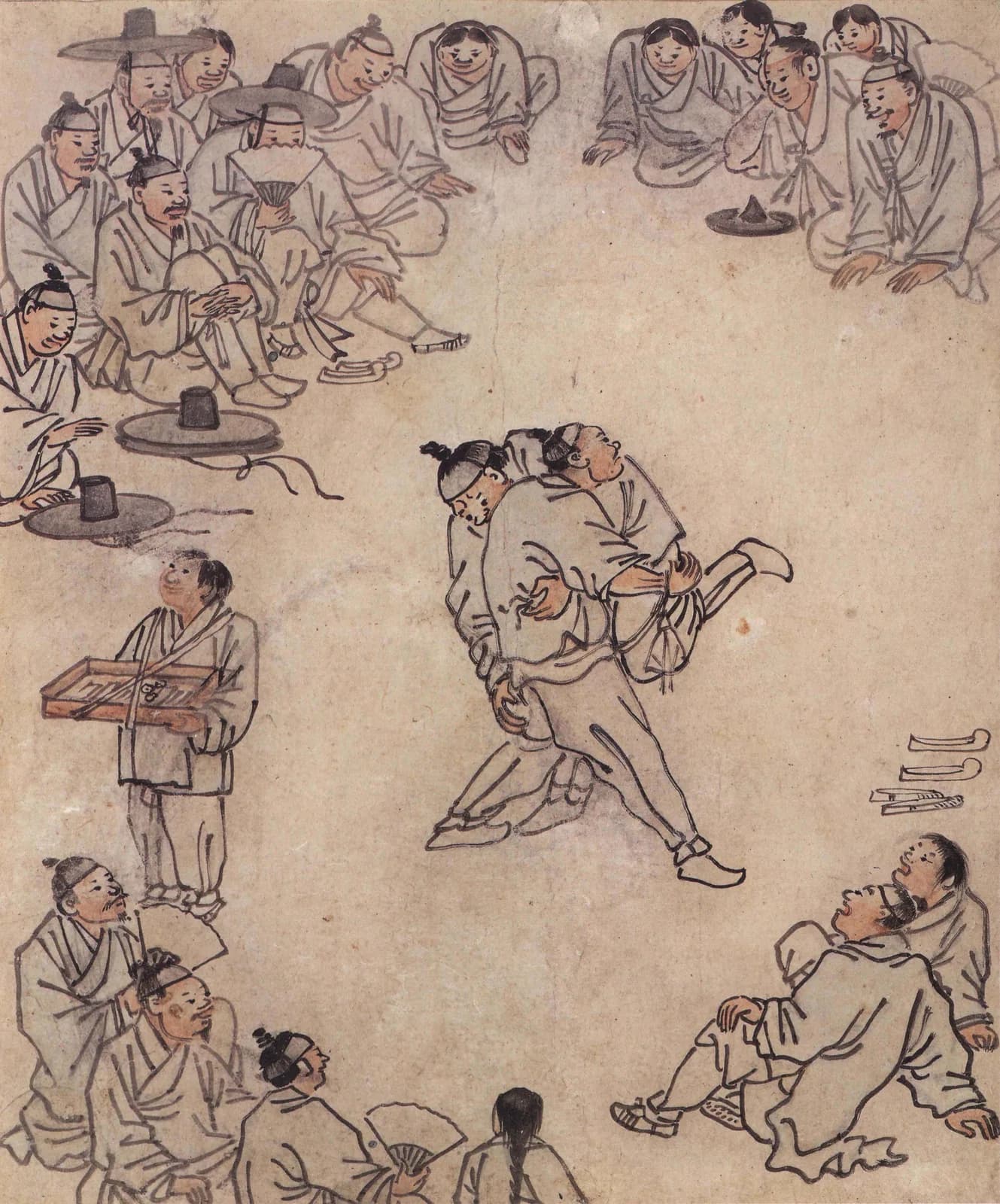
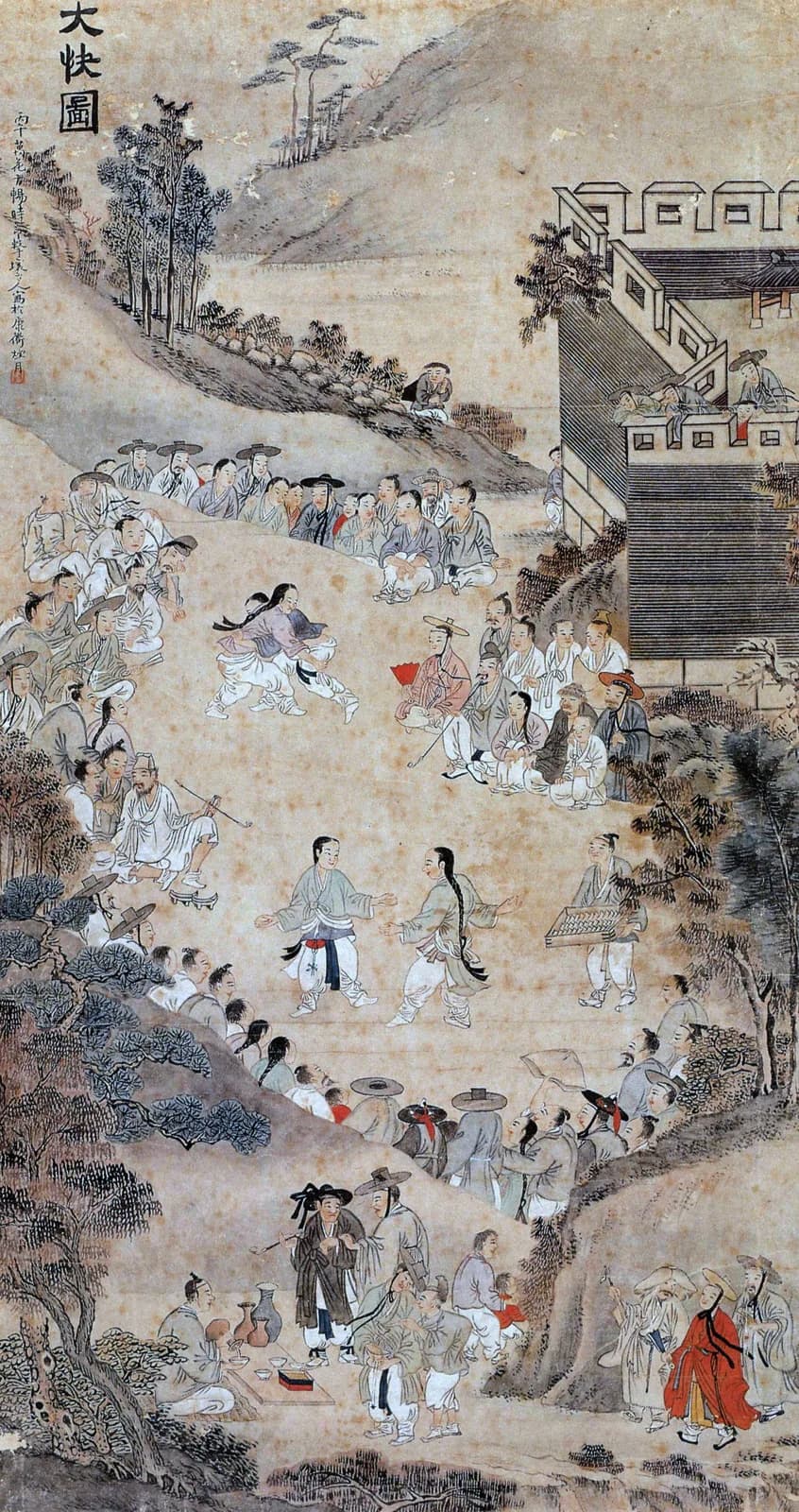
Photo: Ssireum, Korean wrestling, painted by Kim Hong-do in the late 18th century – the older Korean grappling culture that hapkido's founders invoked. Public domain, via Wikimedia Commons.
In this article
Timeline
- 1904
Choi Yong-sool is born in Chungcheong Province, Korea, then under growing Japanese control.
- 1912–1945
Choi lives in Japan. By his own account he serves Takeda Sōkaku, the Daitō-ryū master, for thirty years; Takeda's records do not mention him.
- 1946
Choi returns to Korea after the liberation and begins teaching in Daegu, calling his art yu kwon sul and later yu sul.
- 1951
Suh Bok-sub, a judo black belt and Choi's first student, opens the first formal school with Choi in Daegu.
- 1950s
Ji Han-jae and Kim Moo-hong train under Choi; they add kicks and weapons and move the art towards its modern form.
- 1957
Ji Han-jae opens the Sung Moo Kwan in Seoul; the name hapkido comes into use around 1959.
- 1961
Ji Han-jae's students teach the presidential bodyguards and the army after Park Chung-hee's coup; hapkido gains state patronage.
- 1965
The Korea Hapkido Association is founded, the first of several competing national bodies.
- 1971
Han Bong-soo's fight scenes in the film Billy Jack introduce hapkido to American audiences.
- 1984
Ji Han-jae, now in the United States, founds Sin Moo Hapkido; Myung Jae-nam founds Hankido in Korea.
- 1986
Choi Yong-sool dies in Daegu on 15 June, aged 82.
Takeda Sōkaku kept books. The Daitō-ryū master recorded who enrolled and who paid, meticulously, for decades, and his students remembered one another. Choi Yong-sool said he lived in that household for thirty years, serving and training under the Japanese name Yoshida Asao, until Takeda died in 1943. No Yoshida Asao appears in the books. No Korean servant appears in anyone's memory. And yet the man who came back to Daegu in 1946 knew Daitō-ryū's locks and throws so well that nobody has ever seriously doubted where they came from.
That is hapkido's history in one paragraph: a certain technique with an uncertain story attached. The short answer runs like this. Choi Yong-sool brought the joint locks, throws and pins of Daitō-ryū aiki-jūjutsu – or something very like them – from Japan to Daegu after Korea's liberation. His students, above all Ji Han-jae, added the kicks, the weapons and, around 1959, the name. After 1961 the South Korean state put the art into the presidential guard, the army and the police, and from there it went to the world. Its history is short, its documents thin and its lineage disputed, so this article says which parts are certain and which are the founders' word.
Key facts
- Founder
- Choi Yong-sool (1904–1986), teaching in Daegu from 1946
- Technical root
- Daitō-ryū aiki-jūjutsu, claimed from Takeda Sōkaku; unverified
- Modern form
- Ji Han-jae's Sung Moo Kwan, Seoul, 1957; name hapkido c. 1959
- Meaning
- Hap (harmony), ki (energy), do (way) – the same characters as aikido
- Content
- Locks, throws, pressure points, kicks, strikes, cane and stick
- Organisation
- Korea Hapkido Association 1965; many rival federations since
Thirty years that are not in the ledger
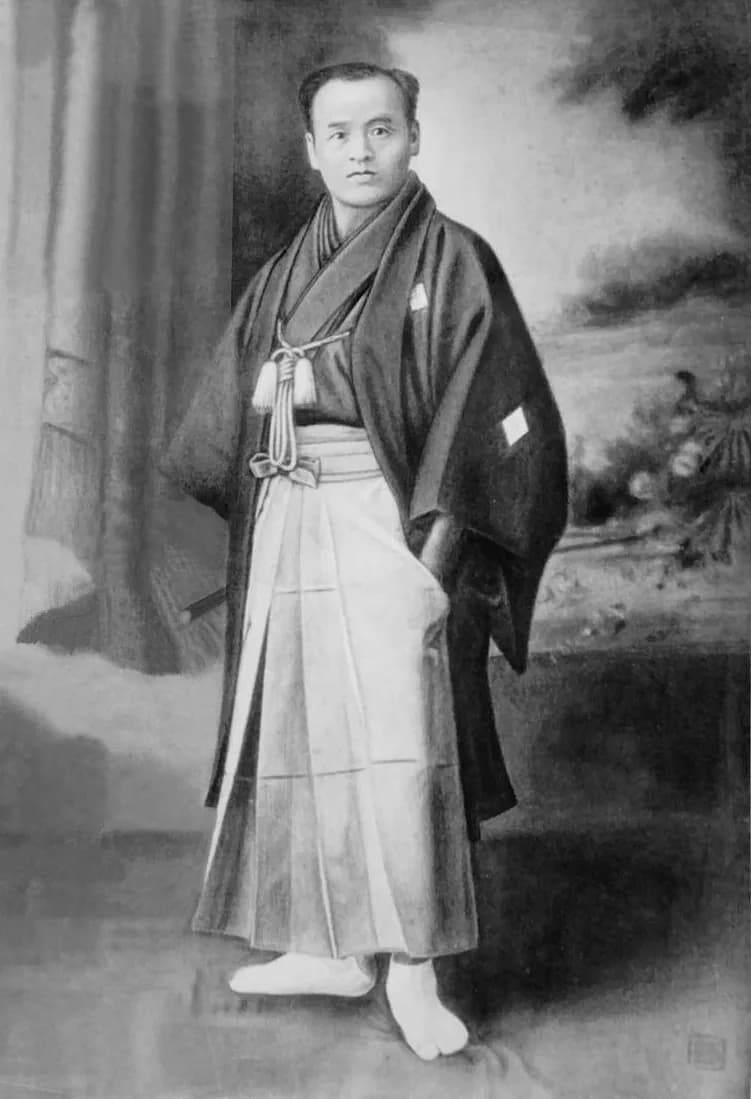
Choi Yong-sool was born in 1904 in Chungcheong Province, in a Korea that Japan would formally annex six years later. Around 1912 he was taken to Japan as a boy – kidnapped by a sweet-seller, by his own account – and from here on the story is his. He said he was placed in a Buddhist temple, then in the household of Takeda Sōkaku, master of Daitō-ryū aiki-jūjutsu and teacher of aikido's founder Ueshiba Morihei, and that he served and trained under Takeda for thirty years as Yoshida Asao until Takeda's death in 1943. Takeda kept meticulous enrolment and payment books. No Yoshida Asao or Choi is in them, and Takeda's students did not remember a Korean servant.
Historians and senior hapkido masters have argued about this for decades, and the honest summary has two halves. The techniques Choi taught – the joint locks, the throws from grabs, the pins – match Daitō-ryū so closely that a connection is certain. The details of how he came by them cannot be checked. Whether he studied with Takeda, with one of Takeda's students, or in another Japanese jujutsu school, he came back to Korea in 1946 with a complete grappling system that no one else in the country had. What he did not yet have was a student.
A rice-cake seller outside a brewery
Choi returned to Daegu after the liberation and sold rice cakes. The story goes that Suh Bok-sub, a judo black belt who owned a brewery, saw Choi defend himself against several men outside his office and took notice. Suh became the first student in 1948, and in 1951 the two opened a formal school in the brewery. Choi called the art yu kwon sul (“soft fist art”), later yu sul (“soft art”) or hapki yu kwon sul. Take the Korean names away and it was Daitō-ryū: locks and throws taught from grabs and strikes, with few kicks.
The kicks arrived with the students. Through the 1950s young men who had trained in the Korean striking arts came to Daegu, and the most important of them, Ji Han-jae (born 1936), joined Choi around 1953. Ji brought a large repertoire of kicks, drawn from the kwans of what was becoming taekwondo and, he said, from a Taoist teacher and a mysterious “Grandma” who taught him older Korean methods; he added weapons – the cane, the short stick, the rope – and a practice of meditation and breathing. In 1957 he opened the Sung Moo Kwan in Seoul, and around 1959 he and his circle settled on the name hapkido, written with the same three characters as the Japanese aikido, which Ueshiba's art had taken in 1942. Choi accepted the name for his own school in the 1960s. The modern art is his technique in Ji's frame.
The bodyguards, then the federations
Hapkido's rise was political. After Park Chung-hee seized power in 1961, Ji Han-jae's students taught the presidential security service and the army, and Ji himself became head instructor of the bodyguard corps. The police adopted the art; so did units sent to the Vietnam War; and for a decade the state's preference gave hapkido the same official standing as taekwondo. Organisation followed, by multiplication. The Korea Hapkido Association was founded in 1965, the Korea Kido Association by a different faction in the same decade, and dozens of associations, federations and kwans have issued ranks since. Choi built no organisation of his own. He taught in Daegu until shortly before his death on 15 June 1986.
The teachers left early. Han Bong-soo, a student of Choi and Ji, moved to California in 1967 and choreographed and appeared in the film Billy Jack (1971), whose hapkido fight scenes did for the art in America what Bruce Lee's films were about to do for kung fu. Ji Han-jae left Korea in 1984, after imprisonment in a political case, and founded Sin Moo Hapkido in the United States; the same year Myung Jae-nam, who had exchanged techniques with a Japanese aikido teacher, founded Hankido in Korea with a softer, aikido-like style. Schools opened across the Americas, Europe and Australia, usually as the self-defence complement to a taekwondo class, and the mix of hard kicks and soft locks made hapkido, for many students, the most complete of the Korean systems.
Hapkido today
No single governing body, no unified competition rules, no Olympic ambitions. That has kept hapkido what its founders made it: a self-defence art taught by lineage. Its schools run from grappling-centred traditionalists close to Choi's yu sul to acrobatic kicking schools closer to taekwondo, and its federations in Korea and abroad number in the dozens. What they share is the technical core Choi brought from Japan, the frame Ji gave it, and an argument about origins that, three generations on, still divides the art into those who believe the founder's story and those who check the records. Takeda's books have not changed.
Where to go next
- The hapkido discipline hub collects training articles, workouts and gear.
- The Japanese art with the same name and a shared root: The History of Aikido.
- The Korean striking art that supplied hapkido's kicks: The History of Taekwondo.
- Joint locks and throws also built judo: Judo: Kanō Jigorō and the Gentle Way.
Sources
- Kimm He-young, Hapkido II (Andrew Jackson College Press, 1994) and History of Korea and Hapkido (2008)
- Korea Hapkido Federation – History
- Stanley Pranin, Aikido Journal – interview with Choi Yong-sool (1982) and articles on Daitō-ryū in Korea
- Wikipedia: Hapkido
- Wikipedia: Choi Yong-sool
- Wikipedia: Ji Han-jae
- Wikipedia: Daitō-ryū Aiki-jūjutsu
Frequently asked questions
- Is hapkido the same as aikido?
- They share a name – the same three characters, meaning “the way of harmonising energy” – and a probable common root in Daitō-ryū aiki-jūjutsu, but they developed separately. Aikido is Ueshiba Morihei's Japanese art of blending and throwing without competition; hapkido is Korean, adds kicks, strikes and weapons to its joint locks, and is taught as a practical self-defence system.
- Who founded hapkido?
- Choi Yong-sool (1904–1986) brought the joint-lock techniques to Korea in 1946 and is honoured as the founder. His students, above all Ji Han-jae, added the kicks, weapons and name that define the modern art, so hapkido is usually described as Choi's technique with Ji's structure.
- Did Choi Yong-sool really train with Takeda Sōkaku?
- He said so, describing thirty years as Takeda's servant and student in Japan under the name Yoshida Asao. Takeda kept detailed records of his students, and Choi's name is not in them. Most historians accept that Choi learned Daitō-ryū or something close to it in Japan – the techniques prove that – but the details of his account cannot be verified.
- What does hapkido training include?
- Joint locks and pressure points, throws, breakfalls, a large repertoire of kicks including spinning and jumping kicks, hand strikes, defences against grabs and weapons, and weapons of its own – the cane, short stick, rope and sword. Schools vary widely in emphasis.
- Why are there so many hapkido federations?
- Because the art was never unified. Choi did not build an organisation; his students founded rival associations from 1965, split again in the 1970s and 1980s, and emigrated to found their own. The Korea Hapkido Federation, the Korea Kido Association and dozens of international bodies all issue ranks.
- Is hapkido a sport?
- Mostly not. Some federations hold tournaments in sparring and technique demonstration, but hapkido has no unified competition rules and no Olympic ambitions. It is taught primarily for self-defence and, in Korea, to police and military units.