History
The History of Kendo: The Way of the Sword After the Sword
How the samurai fencing schools invented armour and the bamboo sword, survived the end of their class, and became kendo, practised by millions.
7 min read · 20 September 2026 · updated 21 September 2026
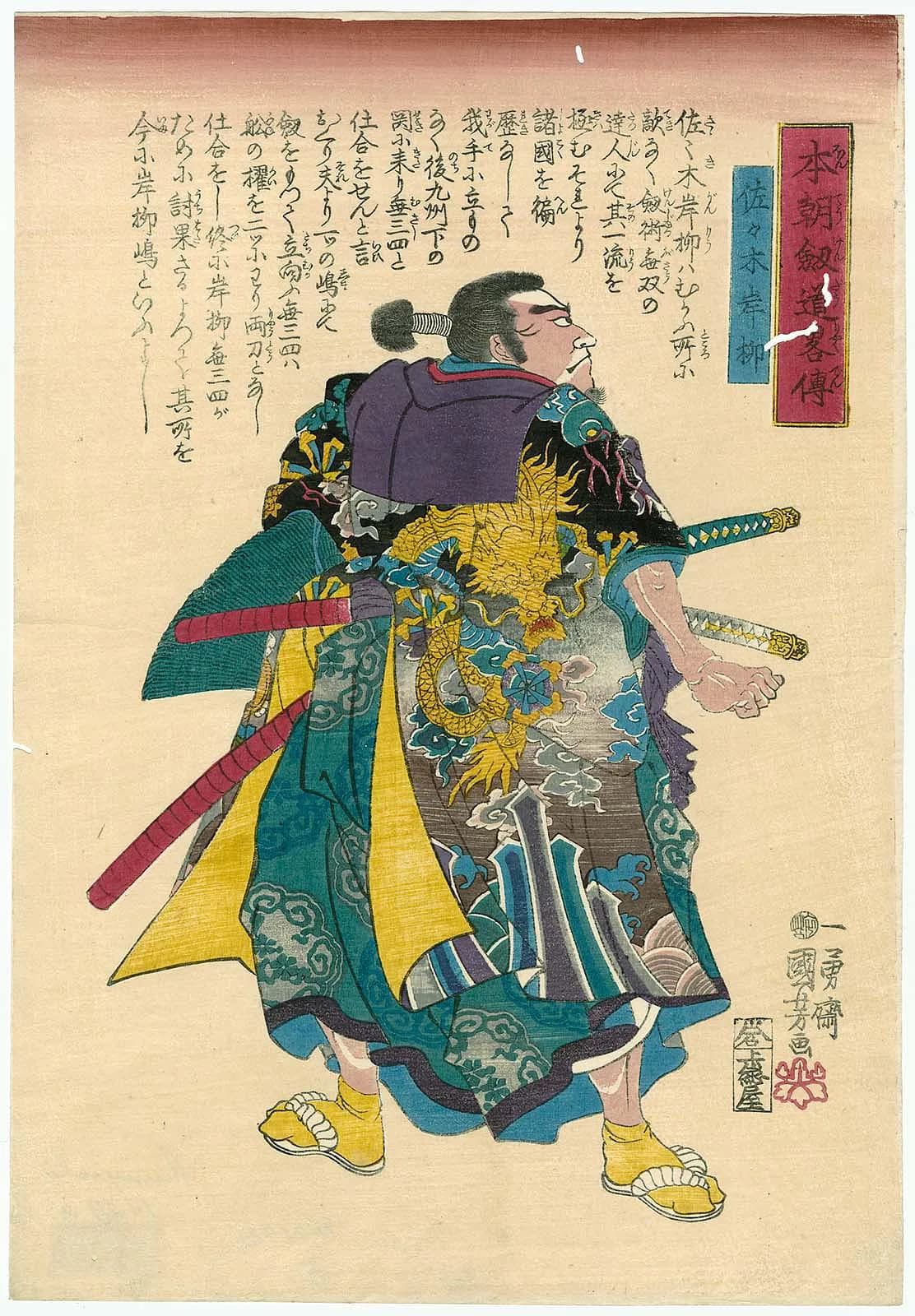
Photo: Sasaki Kojirō by Utagawa Kuniyoshi, 1845. Public domain, via Wikimedia Commons.
In this article
Timeline
- 15th c.
The oldest surviving sword schools are founded: Tenshin Shōden Katori Shintō-ryū (c. 1447) and Kashima Shintō-ryū; kenjutsu becomes a teachable art with named traditions.
- 1600–1868
The Tokugawa peace. Hundreds of ryū teach the sword to a samurai class that no longer fights; kata and wooden swords are the standard practice.
- c. 1711–1715
Naganuma Shirōzaemon of the Jikishinkage-ryū develops protective armour and a bamboo practice sword so that students can strike each other at full speed.
- c. 1750
Nakanishi Chūzō of the Ittō-ryū improves the armour and popularises the shinai; full-contact fencing spreads through the schools of Edo.
- 1868
The Meiji Restoration abolishes the samurai class. Sword schools lose their students; in 1876 the wearing of swords is banned.
- 1873
Sakakibara Kenkichi stages public gekiken exhibitions to keep swordsmen employed; the shows are popular and controversial.
- 1879
The Tokyo Metropolitan Police adopts sword training under Kawaji Toshiyoshi – the institution that saves the art.
- 1895
The Dai Nippon Butokukai is founded in Kyoto to preserve and standardise the martial arts, fencing among them.
- 1912
The Nihon Kendō Kata, ten forms drawn from the old schools, is published as a common syllabus; the term kendō is adopted officially in 1920.
- 1945
The Allied occupation bans kendo in schools and public institutions as militaristic.
- 1952
The All Japan Kendo Federation is founded after the ban is lifted; kendo returns to schools in 1957.
- 1970
The International Kendo Federation is founded and the first World Kendo Championships are held in Tokyo.
In 1873 Sakakibara Kenkichi, a master of the Jikishinkage-ryū and once fencing instructor to the shogun, did something no swordsman of his standing had done before. He sold tickets. His gekiken kōgyō put swordsmen in front of paying crowds to fence in armour with bamboo swords, staged like sumo, complete with rankings, prizes and advertising. The samurai had ceased to exist as a class five years earlier, and the masters who fenced for Sakakibara had no pupils and no income. Purists were appalled. The public loved it, and the shows kept dozens of masters fed for a decade.
The short answer: kendo is the strange case of a martial art that flourished after its weapon became useless. The samurai schools taught the sword through forms with wooden blades; in the 18th century two men invented armour and a bamboo sword so that students could hit each other at full speed; when the samurai vanished, show business, the police and the schools carried the art long enough for it to be renamed kendō. Banned by the Allied occupation in 1945, back in 1952, it is now practised by around two million people in Japan and hundreds of thousands abroad. This is how the way of the sword outlived the sword.
Key facts
- Root
- Kenjutsu schools of the samurai, from the 15th century
- Key inventions
- Bōgu armour and shinai, c. 1711–1750 (Naganuma, Nakanishi)
- Crisis
- Meiji Restoration 1868; sword ban 1876; revival via police (1879) and Butokukai (1895)
- Modern form
- Nihon Kendō Kata 1912; name kendō official 1920
- Governing bodies
- All Japan Kendo Federation 1952; International Kendo Federation 1970
- Targets
- Men, kote, dō, tsuki – scored as ippon with spirit, sword and body as one
The sword schools of the samurai
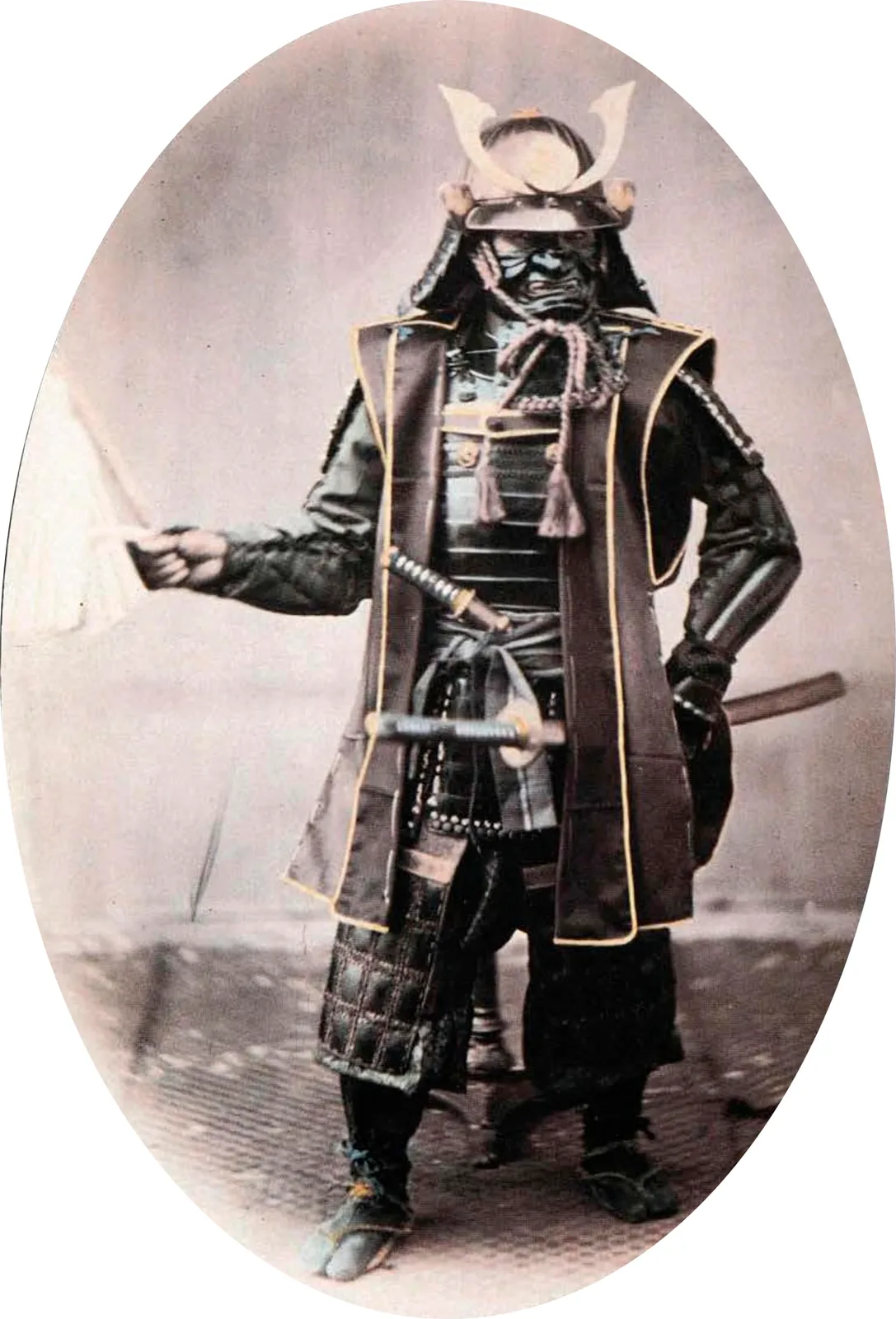
The Japanese sword was a battlefield weapon for a thousand years, but the sword schools – traditions with a founder, a curriculum and a name – belong to the 15th century, the age of civil war. Tenshin Shōden Katori Shintō-ryū, founded around 1447 by Iizasa Chōisai, and the Kashima traditions of the same region are the oldest that survive. The 16th century added the Shinkage-ryū of Kamiizumi Nobutsuna, the Ittō-ryū of Itō Ittōsai and dozens more, each teaching kenjutsu, the art of the sword, through kata: pre-arranged sequences practised with wooden swords, bokutō, or blunted blades. The duellists of the period supplied the legends. Chief among them is Miyamoto Musashi, whose 1612 duel with Sasaki Kojirō is the most famous fight in Japanese history, and whose opponent Kuniyoshi was still drawing in 1845.
Then the wars ended. The Tokugawa shogunate, established in 1603, gave Japan two and a half centuries of peace, and the samurai became administrators who still wore two swords and were still expected to master them. Hundreds of ryū taught the sword to men who would never draw it in anger, and the art turned inward – towards form, towards philosophy, towards the Zen-influenced writings of Yagyū Munenori and Takuan Sōhō on the sword as a way of self-cultivation. Kata practice was safe, and it was profound. It had one flaw that every student felt in his hands: you could never find out whether your technique worked.
Armour and the bamboo sword
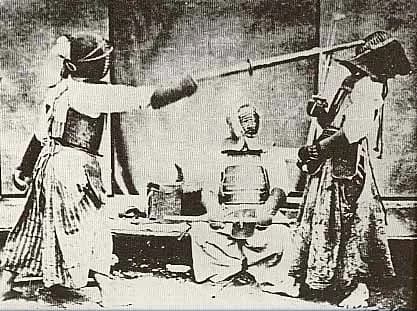
The answer arrived in the 18th century, and it is the reason kendo exists. Somewhere between 1711 and 1715 Naganuma Shirōzaemon Kunisato of the Jikishinkage-ryū built protective equipment – a helmet, gauntlets and a breastplate – and a practice sword of split bamboo covered in leather, the fukuro shinai, so that his students could strike each other with full force. Around 1750 Nakanishi Chūzō of the Ittō-ryū improved both the armour and the sword. His four-slat shinai is the ancestor of the one in every kendo bag today, and his school made full-contact practice – gekiken, or shinai-geiko – its main method. Traditionalists said it was a game, not swordsmanship. Students voted with their feet, and by the early 19th century the largest schools in Edo, such as the Hokushin Ittō-ryū of Chiba Shūsaku with its thousands of pupils, ran on armoured fencing, matches between schools and a ranking of strikes that you would recognise on a kendo court now.
By the 1850s, when the arrival of American warships threw Japan into crisis, the sword schools were at their height. The shogunate's own military academy, the Kōbusho, taught gekiken, and swordsmen from all over Japan came to Edo to test themselves against one another. It was the last flowering of the samurai sword. It lasted a decade.
Meiji: the sword without a class
The Meiji Restoration of 1868 abolished the samurai as a class, and with them the reason for the sword schools. Stipends stopped, the new conscript army carried rifles, and in 1876 the Haitōrei edict banned the wearing of swords in public. Masters who had taught hundreds of students found themselves with no pupils and no income, and the art could have gone the way of the samurai topknot.
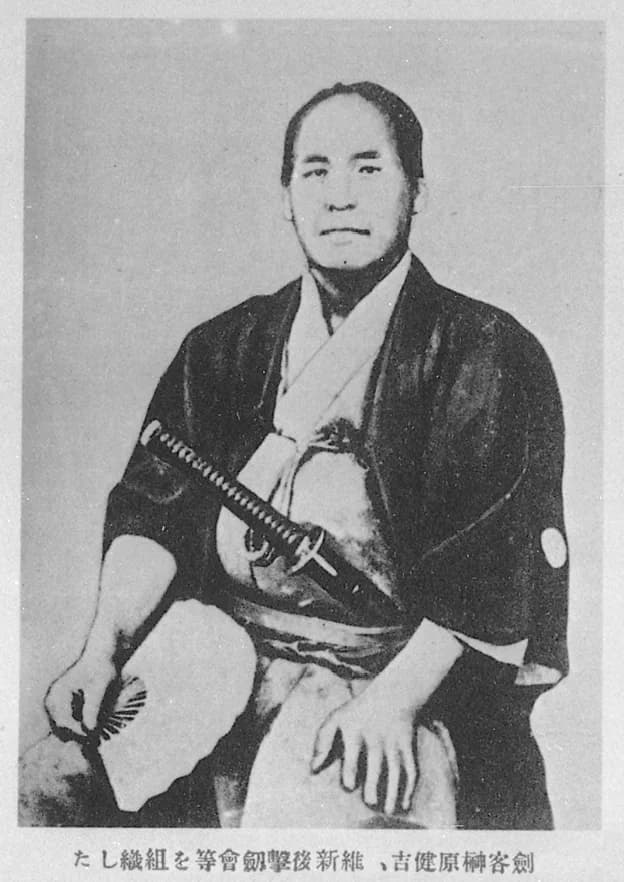
Three institutions caught it. The first was show business, which is where this article began: Sakakibara's exhibitions of 1873, which kept the masters fed while the purists complained. The second was the police. In 1879 Kawaji Toshiyoshi, the founder of the modern Japanese police, having noted how well police swordsmen had fought in the Satsuma Rebellion of 1877, made sword training part of police instruction. The Tokyo Metropolitan Police became the largest employer of swordsmen in Japan, and it remains one of kendo's strongholds. The third was the school. Fencing entered the curriculum of Japanese middle schools in 1911, alongside judo. The state that had abolished the samurai now taught their art to every boy in the country.
Kendō: the way of the sword
The art needed one common form, and it got it from the Dai Nippon Butokukai, founded in Kyoto in 1895 under imperial patronage to preserve and standardise Japan's martial arts. The Butokukai held tournaments, awarded ranks and titles, and in 1912 published the Nihon Kendō Kata: ten forms distilled from the old schools by a committee of masters, so that fencers from any lineage would share a foundation. In 1920 it officially adopted the name kendō, “the way of the sword”, in place of gekiken and kenjutsu, following judo's example in framing the art as a discipline of character rather than a method of fighting. The competition rules – four targets, the ippon awarded only for a strike delivered with correct posture, spirit and follow-through, three referees – took their present shape in the 1920s and 1930s.
They took shape in the wrong decade. Japan's militarist governments of the 1930s made kendo compulsory in schools and used it, with judo, to train the nation for war; the Butokukai became an arm of the state, and kendo's language of spirit and sacrifice was turned into propaganda. When Japan surrendered in 1945 the Allied occupation banned the martial arts from schools and public institutions and dissolved the Butokukai. Kendo spent the next seven years under an alias: shinai kyōgi, a de-Japanised “bamboo sword sport” in Western-style clothing, invented in 1950 to get round the ban.
Rebirth and the world
The ban ended with the occupation in 1952, and the All Japan Kendo Federation was founded the same year with a new brief: kendo as education and sport, stripped of militarism, with its Concept of Kendo formalised in 1975 as “to discipline the human character through the application of the principles of the katana”. Kendo returned to schools in 1957, the All Japan Championship became the sport's annual peak, and the police and the universities produced its champions. The grades run from kyū through the dan ranks to the eighth dan, whose examination has a pass rate below one per cent and is regarded as the hardest test in Japanese martial arts.
The art travelled with Japanese emigrants to Brazil and the United States, and to Korea, where a Korean form, kumdo, grew up under Japanese rule and continues today. In 1970 the International Kendo Federation was founded and the first World Kendo Championships were held in Tokyo; they have run every three years since, and Japan has won almost every men's team title, with Korea its persistent challenger. The federations have refused to pursue the Olympics, arguing that Olympic competition, with its need for spectator-friendly rules and electronic scoring, would damage what kendo is for. So practitioners still fence in the armour Nakanishi Chūzō designed, still strike the four targets the Butokukai fixed, and still shout the kiai that turns a hit into a point. The sword has been useless for a century and a half. The way of the sword is doing fine.
Where to go next
- Training articles, workouts and gear for the art are collected in the kendo discipline hub.
- Kendo's sister art, remade in the same decades and by the same logic: Judo: Kanō Jigorō and the Gentle Way.
- Another sword art that became a sport: the fencing discipline hub.
- Solo practice with a purpose: Shadow Boxing With Purpose.
Sources
- All Japan Kendo Federation – History of kendo
- International Kendo Federation (FIK) – About kendo
- Alexander Bennett, Kendo: Culture of the Sword (University of California Press, 2015)
- Nippon Budokan, Budō: The Martial Ways of Japan (Nippon Budokan Foundation, 2009)
- Wikipedia: Kendo
- Wikipedia: Kenjutsu
- Wikipedia: Sakakibara Kenkichi
- Wikipedia: Dai Nippon Butoku Kai
Frequently asked questions
- What is the difference between kendo and kenjutsu?
- Kenjutsu is the sword art of the samurai schools, taught through kata with wooden or blunt swords and aimed at killing. Kendo, “the way of the sword”, is the modern form created after 1868: full-contact fencing with a bamboo sword and armour, standardised rules, scored strikes and an explicit goal of character development.
- Why do kendo practitioners shout?
- The kiai, the shout that accompanies a strike, is required for a valid point. It expresses spirit and commitment and is part of ki-ken-tai-ichi – spirit, sword and body acting as one – which the judges look for before they award ippon.
- What is a shinai made of?
- Four slats of bamboo bound with leather and a cord, developed in the 18th century so that swordsmen could strike each other at full speed without serious injury. Modern shinai have regulated lengths and weights by age group.
- Is kendo an Olympic sport?
- No, and its federations have never sought it. The International Kendo Federation holds world championships every three years but has argued that Olympic competition would damage kendo's character as a way rather than a sport.
- How many people practise kendo?
- The All Japan Kendo Federation estimates around 1.5 to 2 million practitioners in Japan, where it is taught in schools and by the police, and several hundred thousand abroad, with strong communities in Korea, the United States, Brazil and Europe.
- What are the targets in kendo?
- Four: men (the head, through the helmet), kote (the wrist), dō (the trunk) and tsuki (a thrust to the throat guard). A point, ippon, requires a correct strike on a target with proper posture, spirit and follow-through, judged by three referees.