History
The History of MMA: From Pankration and Vale Tudo to the UFC
How mixed martial arts grew from ancient pankration and Brazilian vale tudo through Japanese shoot wrestling to the UFC, the Unified Rules and a global sport.
8 min read · 20 September 2026 · updated 21 September 2026
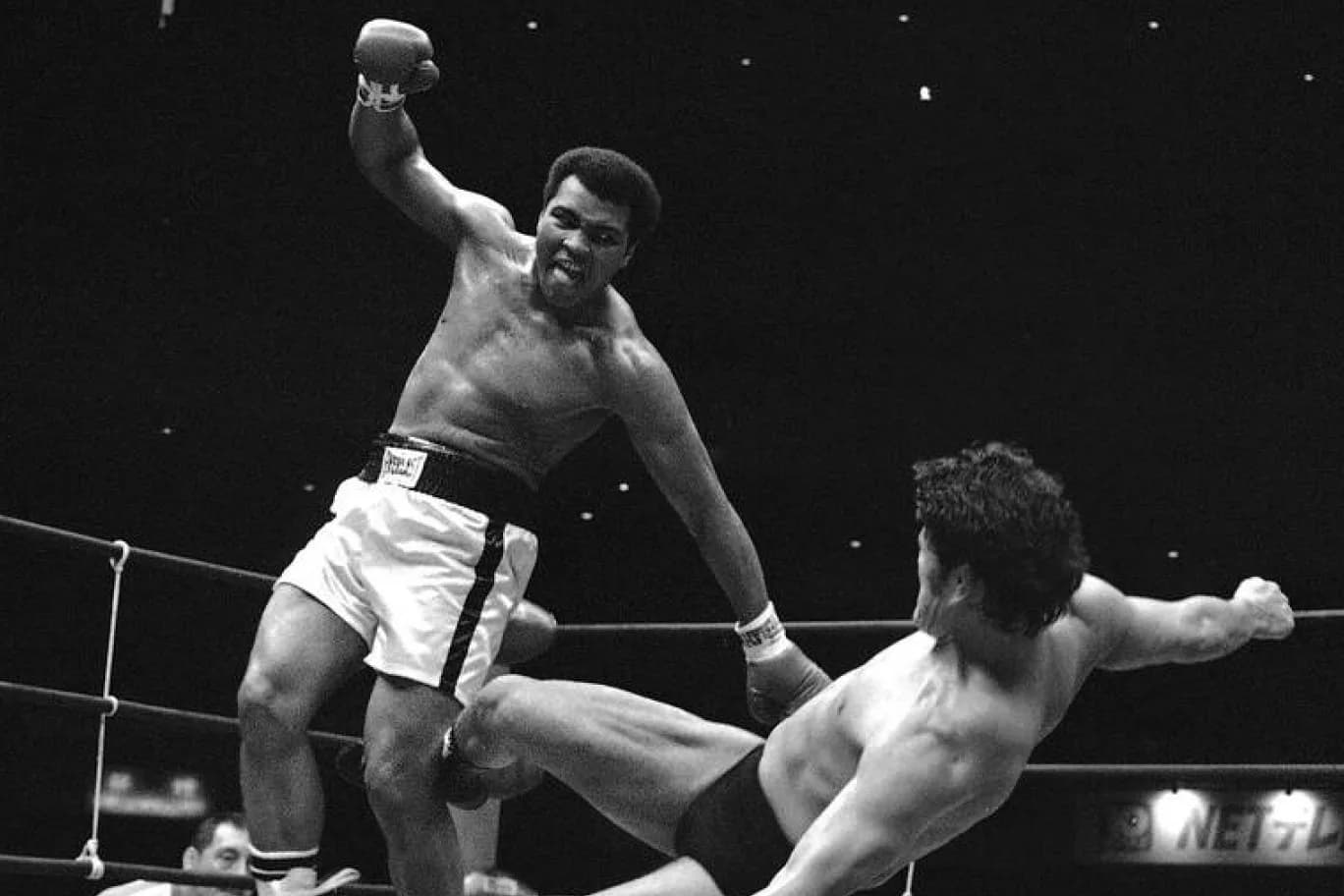
Photo: Antonio Inoki against Muhammad Ali, Tokyo, 26 June 1976. Public domain, via Wikimedia Commons.
In this article
Timeline
- 648 BC
Pankration, combining wrestling and striking with almost no rules, joins the ancient Olympic Games.
- 1900s
Mixed-style challenge matches – judoka against wrestlers and boxers – tour Europe and the Americas; Maeda Mitsuyo fights hundreds of them.
- 1920s
Vale tudo (“anything goes”) fights begin in Brazil; the Gracie family issues its standing challenge to all styles.
- 1951
Hélio Gracie fights the judoka Kimura Masahiko at the Maracanã in Rio; the bout is the most famous vale tudo match of its era.
- 1976
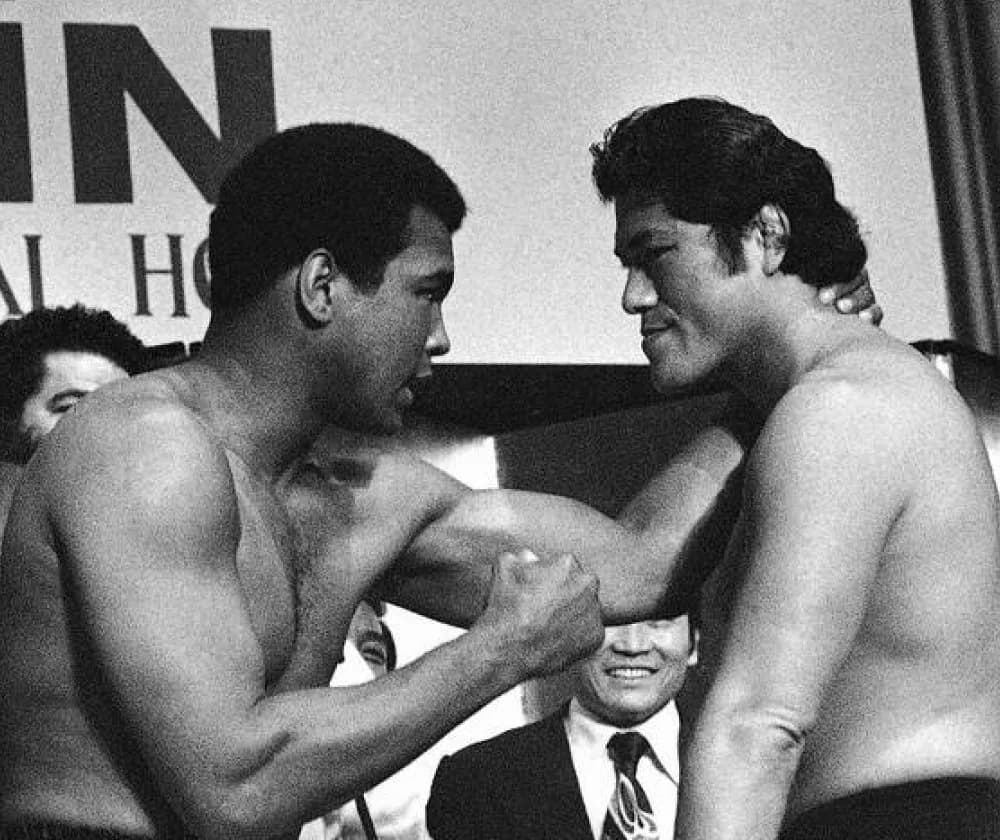
Antonio Inoki wrestles the boxer Muhammad Ali to a fifteen-round draw in Tokyo – a box-office failure that plants the idea of mixed rules in Japan.
- 1985
Sayama Satoru founds Shooto, the first organisation with rules written for mixed fighting; its first professional event follows in 1989.
- 1993
Pancrase opens in Japan in September; the first Ultimate Fighting Championship is held in Denver on 12 November – Royce Gracie wins.
- 1997
PRIDE Fighting Championships begins in Tokyo with Takada Nobuhiko against Rickson Gracie.
- 2000
New Jersey adopts the Unified Rules of Mixed Martial Arts; Nevada follows in 2001. Weight classes, rounds, gloves and fouls become standard.
- 2001
Zuffa buys the near-bankrupt UFC for two million dollars; Dana White becomes president.
- 2005
The Ultimate Fighter reality show and the Forrest Griffin–Stephan Bonnar final on 9 April bring MMA to cable television.
- 2007
The UFC buys PRIDE. The centre of the sport moves from Japan to the United States.
- 2013
Ronda Rousey headlines UFC 157 – the first women's bout in the promotion.
- 2016
New York legalises MMA, the last US state to do so; the UFC is sold for about four billion dollars.
On 26 June 1976, in a ring in Tokyo, the heavyweight boxing champion of the world spent fifteen rounds standing over a man who would not get up. Muhammad Ali had agreed to fight Antonio Inoki, Japan's biggest professional wrestler and a genuine grappler trained by Karl Gotch, under mixed rules negotiated so hastily that they forbade Inoki almost everything except kicking from the ground. So Inoki lay on his back and kicked Ali's legs. The crowd booed, the bout was declared a draw, and Ali's legs were damaged badly enough to put him in hospital.
Here is what that evening actually did. It was a failure at the box office and a failure as a fight, and it proved there was an audience for style against style. Mixed martial arts, the sport of fighting under rules that allow striking, throwing and grappling on the ground, is both very old and very new: the Greeks fought pankration at the Olympic Games from 648 BC, Brazilians staged vale tudo matches between styles from the 1920s, Japanese wrestlers wrote the first mixed rule sets in the 1980s, and on 12 November 1993 the first Ultimate Fighting Championship in Denver asked the question every martial artist had argued over and answered it in one night. The two decades after that turned a no-holds-barred spectacle into a professional sport with unified rules, weight classes and a global audience. This is that road.
Key facts
- Ancient ancestor
- Pankration, Olympic Games from 648 BC
- Brazilian root
- Vale tudo and the Gracie challenge, 1920s onwards
- Japanese root
- Shoot wrestling: Shooto (1985), Pancrase (1993), PRIDE (1997)
- Modern start
- UFC 1, Denver, 12 November 1993 – Royce Gracie
- Rule set
- Unified Rules of MMA, New Jersey 2000 / Nevada 2001
- Governance
- State and national commissions; IMMAF (amateur) founded 2012
The Greeks asked first
Every generation of fighters has asked which style wins, and the Greeks answered with a sport. Pankration, “all power”, entered the Olympic Games in 648 BC and joined the wrestling of pale to the striking of pygmachia. Only biting and gouging were banned, matches went to submission or unconsciousness, and the pankratiast was regarded as the complete athlete. Its champions were as famous as any boxer: Arrhichion, who won a title while dying in a chokehold, and Sostratos, who broke fingers. Then the ancient Games ended, the sport went with them, and the question stayed open for fifteen centuries.
It came back with the age of martial-arts travel. From the 1890s, judoka, jujutsu men, wrestlers and boxers toured the music halls and fairgrounds of Europe and the Americas, taking on all comers under whatever rules could be agreed. Maeda Mitsuyo, whose story is told in our Brazilian jiu-jitsu article, fought hundreds of such matches before he settled in Brazil in 1914. He brought the habit with him.
Brazil: anything goes

In Brazil the mixed match stopped being a novelty and became a tradition. Vale tudo, “anything goes”, was fought in circuses and gyms from the 1920s, usually a jiu-jitsu fighter against a challenger from boxing, capoeira, wrestling or judo, with no gloves, no time limit and few rules. The Gracie family made the format their own. The Gracie challenge, an open invitation to come to the academy and fight, produced bouts through the 1930s and 1940s and then, on 23 October 1951, the most famous of them all: Hélio Gracie against the judo champion Kimura Masahiko, at the Maracanã stadium in Rio. Kimura won with a shoulder lock. It has carried his name ever since.
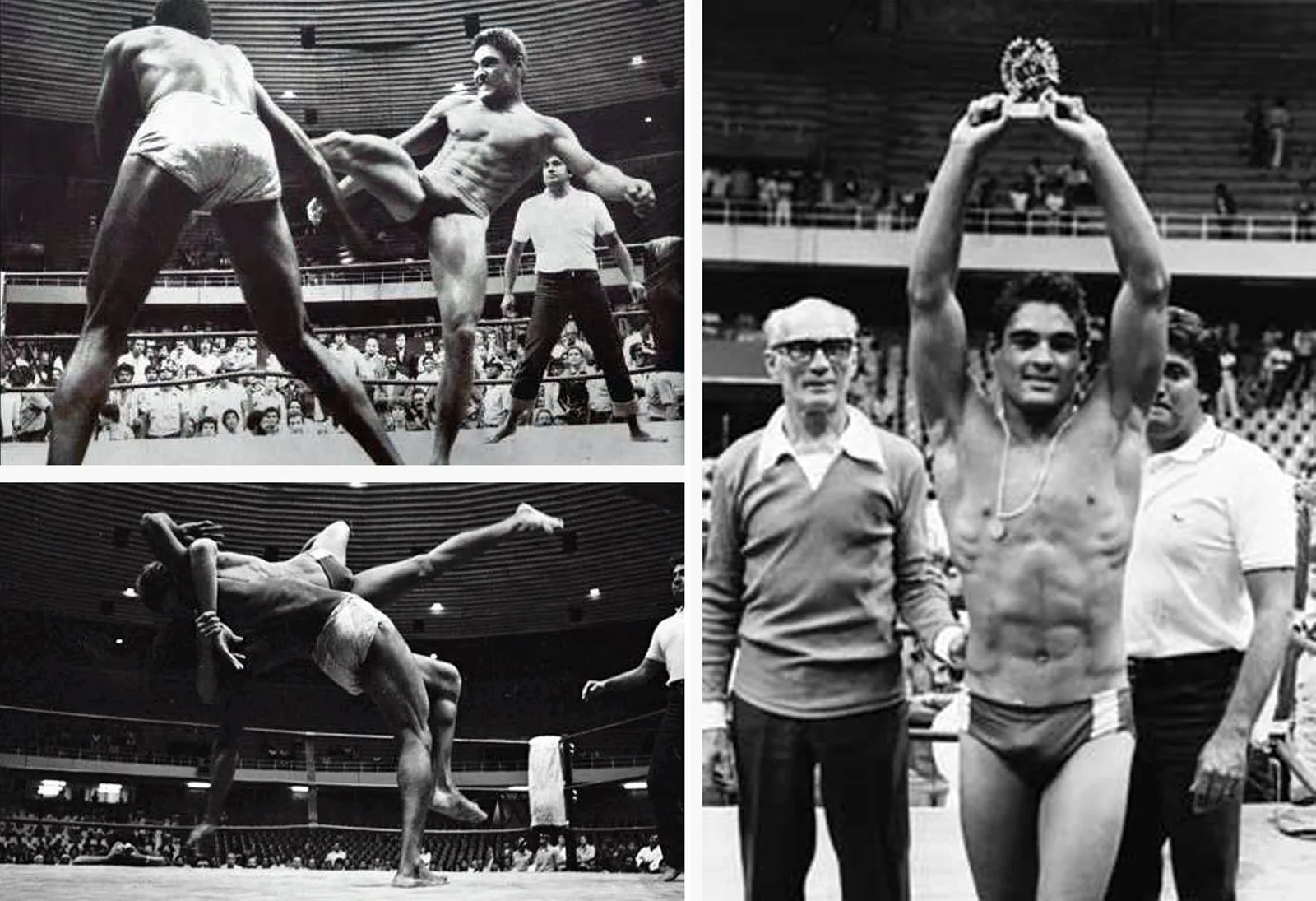
Vale tudo reached Brazilian television in the late 1950s with the programme Heróis do Ringue and was pushed off it again after an arm was broken on air. It went back to the gyms and the regional promotions, where Carlson Gracie's team, the Luta Livre wrestlers and, in the 1980s and 1990s, Marco Ruas, Vitor Belfort and the Nogueira brothers learned their trade. The rivalry between jiu-jitsu and the no-gi grappling style Luta Livre produced the Desafio events of the early 1990s, fought in Rio under rules any pankratiast would have recognised.
Japan: the wrestlers wanted it real
Japan's route ran through professional wrestling, and it began with the fiasco of 1976. Inoki against Ali was a box-office failure and an artistic one, and it started everything: there was, plainly, an audience for style against style, and a generation of Japanese wrestlers came away wanting a version that was real.
They built it in stages. The Universal Wrestling Federation of 1984 introduced “shoot-style” wrestling: worked matches that looked like real fights. Sayama Satoru, the original Tiger Mask, went further and founded Shooto in 1985, the first organisation with rules written for genuine mixed fighting, amateur at first and professional from 1989. Shooto's rules, with their small gloves and points for takedowns, became the model for everything after. In September 1993 two of the UWF's stars, Suzuki Minoru and Funaki Masakatsu, founded Pancrase, where the fights were real but open-hand strikes and rope escapes kept a wrestling flavour; Ken Shamrock and Bas Rutten were among its early champions. Pancrase held its first event two months before the UFC held its own.
Denver, 12 November 1993
The American version came from Brazil by way of a garage in California. Rorion Gracie, Hélio's eldest son, had taught jiu-jitsu in Torrance since 1978 and wanted a national audience to see what the Gracie challenge showed in private. With the advertising man Art Davie and Bob Meyrowitz's pay-per-view company SEG, he built a one-night, eight-man tournament: no weight classes, no rounds, no gloves required, only biting and eye-gouging forbidden, and an eight-sided cage designed to look dangerous on television. The first Ultimate Fighting Championship took place at the McNichols Arena in Denver on 12 November 1993, in front of about 7,800 people in the building and 86,000 pay-per-view buyers at home.
Rorion's brother Royce Gracie, 79 kilograms in a gi, submitted the boxer Art Jimmerson, the Pancrase fighter Ken Shamrock and the savate champion Gérard Gordeau in less than five minutes of total fighting time. The lesson – a grappler beats a striker who cannot grapple – reorganised martial arts in the United States within a few years. Royce won UFC 2 and UFC 4 as well. Then Dan Severn, an Olympic-level wrestler, and Mark Coleman showed in 1995 and 1996 that wrestling with ground strikes beat jiu-jitsu, and the sport began moving towards the fighter who trained every phase.
It also nearly died. Sold as “no holds barred” and “there are no rules”, the UFC caught the attention of Senator John McCain, who called it “human cockfighting” in 1996 and campaigned to have it banned. Cable operators dropped it, 36 states outlawed it, and by 2000 SEG was close to bankruptcy. The only way out was to become a sport.
New Jersey writes the rules, Las Vegas pays the bills
The rules came from New Jersey. In 2000 the state's athletic control board, working with promoters, wrote a rule set with weight classes, three or five five-minute rounds, four-ounce gloves, a list of fouls and boxing's ten-point scoring; in April 2001 the Nevada State Athletic Commission adopted it, and the Unified Rules of Mixed Martial Arts became the standard most of the world now uses. In January 2001 the casino owners Lorenzo and Frank Fertitta bought the UFC for two million dollars through their company Zuffa and installed their friend Dana White as president. They then spent four years and about 44 million dollars losing money on it.
The sport's peak, meanwhile, was in Japan. PRIDE Fighting Championships, founded in 1997 with a bout between the wrestler Takada Nobuhiko and Rickson Gracie, filled the Tokyo Dome and the Saitama Super Arena with crowds of up to 70,000, allowed soccer kicks and knees to a grounded opponent, and produced the fighters most experts still rank among the greatest: Fedor Emelianenko, Nogueira Antônio Rodrigo, Wanderlei Silva, Mirko Cro Cop and Kazushi Sakuraba, the “Gracie Hunter”, who beat four members of the family between 1999 and 2001.
The UFC's turn came on 9 April 2005. Zuffa had paid to produce a reality show, The Ultimate Fighter, on the cable channel Spike, in which prospects lived together and fought for a contract. In the finale, Forrest Griffin and Stephan Bonnar fought three rounds of such violence and heart that the audience doubled while the bout was on, and the network signed a long-term deal. Pay-per-view sales exploded, Chuck Liddell and Randy Couture became household names, and in March 2007 Zuffa bought PRIDE, whose Japanese television deal had collapsed in a scandal. The centre of the sport was now in Las Vegas.
No single style wins
The years since have been growth and consolidation. Weight classes multiplied. Strikeforce, Bellator and later ONE Championship in Asia offered alternatives. The UFC's fighters became genuinely mixed: Georges St-Pierre, Anderson Silva, Jon Jones and Khabib Nurmagomedov each combined wrestling, striking and submissions at the highest level. Women's MMA entered the UFC in February 2013 when Ronda Rousey headlined UFC 157; Conor McGregor became the sport's first global celebrity in 2015 and 2016 and its first two-division champion. New York, the last American holdout, legalised MMA in 2016, the same year the Fertittas sold the UFC for about four billion dollars, then the largest sale in sports history. Two million in, four billion out.
The amateur sport organised itself under the International Mixed Martial Arts Federation in 2012 and holds world championships; France, which had banned MMA, legalised it in 2020. The sport's problems are the ones you would expect – brain injury, weight-cutting, fighter pay, the power of a single promotion – and they are argued about in every gym. But the question the Greeks asked, and the Gracies answered on a Denver night in 1993, has been settled. No single style wins. The fighter who trains all of them does.
Where to go next
- The MMA discipline hub collects training articles, workouts and gear for the sport.
- The two grappling bases of MMA: Brazilian Jiu-Jitsu: From Maeda to the Gracies and The History of Wrestling.
- Its striking bases: The History of Muay Thai and Boxing: From Bare Knuckles to the Queensberry Rules.
- Cutting weight for a bout, done safely: Weight-Cut Basics.
Sources
- Jonathan Snowden, Total MMA: Inside the Ultimate Fighting Championship (ECW Press, 2008)
- Clyde Gentry III, No Holds Barred: The Complete History of Mixed Martial Arts in America (Triumph Books, 2011)
- Association of Boxing Commissions – Unified Rules of Mixed Martial Arts
- International Mixed Martial Arts Federation – About IMMAF
- Wikipedia: Mixed martial arts
- Wikipedia: Vale tudo
- Wikipedia: Ultimate Fighting Championship
- Wikipedia: Pride Fighting Championships
Frequently asked questions
- When was MMA invented?
- Fighting under mixed rules is ancient – Greek pankration dates from 648 BC – and mixed-style matches were staged throughout the 20th century in Brazil and Japan. Modern MMA as an organised sport with its own rules dates from Shooto (1985), Pancrase and the first UFC (1993), and the Unified Rules of 2000–2001.
- Who invented the UFC?
- Rorion Gracie, the advertising executive Art Davie and the producer Bob Meyrowitz's company SEG created the first event in 1993 to test styles against each other. Zuffa – Lorenzo and Frank Fertitta with Dana White – bought it in 2001 and built it into the sport's dominant promotion.
- What is vale tudo?
- Portuguese for “anything goes”: the Brazilian tradition of fights between styles with almost no rules, staged from the 1920s in circuses, gyms and later on television, and closely tied to the Gracie family's challenge matches. It is the direct ancestor of the first UFC.
- What are the Unified Rules of MMA?
- The rule set drafted in New Jersey in 2000 and adopted by Nevada in 2001, now used by almost every major promotion: weight classes, five-minute rounds, four-ounce gloves, a list of fouls (no head-butts, eye gouging, groin strikes, strikes to the back of the head or to a grounded opponent's head with knees) and ten-point-must scoring.
- Which martial arts are used in MMA?
- The proven bases are wrestling and Brazilian jiu-jitsu for grappling, boxing and Muay Thai for striking, with judo, sambo, karate and taekwondo contributing techniques and champions. Modern fighters train all phases from the start rather than one style.
- Is MMA legal everywhere?
- It is regulated in most countries, usually by boxing commissions or national federations. It was banned in several US states until the Unified Rules were adopted and in New York until 2016; France legalised it in 2020, and a few countries still restrict or prohibit it.