History
The History of Savate: French Boxing from the Streets of Paris to the World Games
How Paris street kicking and Marseille chausson were tamed by Casseux, mixed with English boxing by Lecour, codified by the Charlemonts and revived.
7 min read · 20 September 2026 · updated 21 September 2026
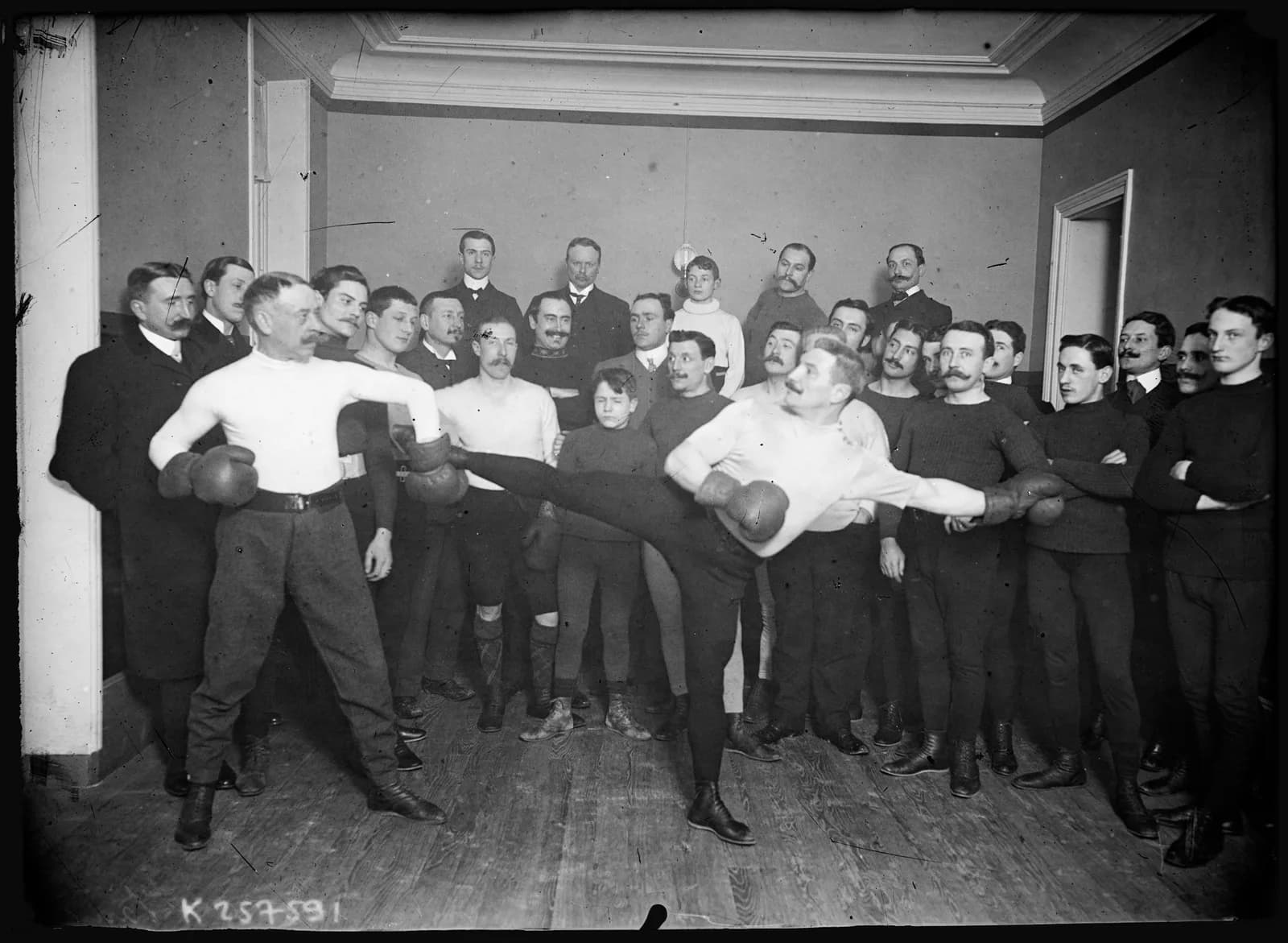
Photo: Castérès demonstrates a coup de pied de flanc, 1906. Bibliothèque nationale de France, public domain, via Wikimedia Commons.
In this article
Timeline
- c. 1800
Savate, named after an old shoe, is the kicking brawl of Paris street fighters; in Marseille sailors practise chausson, high kicks with the hands on the deck.
- 1825
Michel Casseux opens the first salle in Paris and codifies savate as a method with named kicks and open-hand strikes.
- 1830s
Charles Lecour, Casseux's student, loses to an English boxer, learns boxing in London and combines punches with savate kicks: boxe française is born.
- 1845
Lecour's system, with gloves and boxing punches, is taught to Parisian gentlemen; the Duke of Orléans and writers such as Théophile Gautier train.
- 1877
Joseph Charlemont publishes his treatise on boxe française and canne, the standard codification of the art.
- 1899
Charles Charlemont beats the English boxer Jerry Driscoll in Paris under mixed rules with a kick to the body – the great match of the era.
- 1924
Boxe française is a demonstration sport at the Paris Olympics.
- 1939–1945
The Second World War kills or scatters most of the art's masters; savate nearly dies out.
- 1965
Count Pierre Baruzy, a pre-war champion, founds the Comité National de Boxe Française and leads the revival.
- 1975
The French federation is formally established; the coloured-glove grading system organises the art.
- 1985
The Fédération Internationale de Savate (FISav) is founded; the first World Championships follow.
- 2013
Savate is contested at the World Games in Cali, Colombia.
On 28 October 1899 Charles Charlemont stepped into a Paris ring to meet the English boxer Jerry Driscoll under rules that let each man use everything he knew: gloves, rounds, punches and kicks. In the eighth round Charlemont put a kick into Driscoll's body and the fight was over. The English called it a foul. The French called it a chassé. The bout was reported across Europe, and for French readers it settled a question the art had carried since the day Charles Lecour lost to an English boxer: whether feet can beat fists.
The short answer: savate, or boxe française, is the French art of boxing with the feet, punches taken from English boxing and kicks delivered with the shoe, fought in a ring in gloves and light boots. It began around 1800 as the brawling of Paris alleys and the deck fighting of Marseille sailors. Michel Casseux wrote it down in 1825, Charles Lecour married it to English boxing in the 1830s, Joseph and Charles Charlemont turned it into a gentleman's sport that was demonstrated at the 1924 Olympics, the Second World War all but killed it, and Count Pierre Baruzy rebuilt it from 1965 into a world sport with a federation, coloured-glove grades and a place at the World Games. This is the oldest Western kickboxing, from the gutter to the podium.
Key facts
- Origin
- Paris street fighting (savate) and Marseille sailors' chausson, c. 1800
- Codified
- Michel Casseux, Paris, 1825; boxing punches added by Charles Lecour, 1830s
- Classic era
- Joseph Charlemont's treatise 1877; Charles Charlemont v. Driscoll 1899
- Near death and revival
- Second World War; Pierre Baruzy's committee 1965, federation 1975
- World body
- Fédération Internationale de Savate, 1985; World Games 2013
- Forms
- Assaut (light contact, technical) and combat (full contact); canne de combat as sister art
A worn-out shoe and a rope to hold
The word savate means a worn-out shoe, and the art began as exactly what the word suggests: fighting with the feet, in heavy shoes, in the alleys of Paris. The savate of the early 1800s was a brawler's method. Low kicks to the shins and knees, stamps, open-hand slaps, and very little from the fists, because a bare-knuckle punch to the head broke the hand about as often as it broke the head. It belonged to the city's toughs and, if the police reports are to be believed, to its criminals. Down in Marseille, meanwhile, the sailors had chausson, named after the soft slipper worn on deck: high, sweeping kicks thrown with the hands gripping a rope or resting on the boards, developed, tradition says, so that a fight aboard ship did not count as the illegal use of the fist. A kick, apparently, was a different matter.
By the 1820s both had caught the eye of men with time and money. Duelling had been driven underground, fencing belonged to the aristocracy, and the young men of Paris wanted some way to defend themselves in a city with no reliable police. The first man to sell it to them ran a salle in the Rue de Buci.
Casseux writes it down, Lecour goes to London
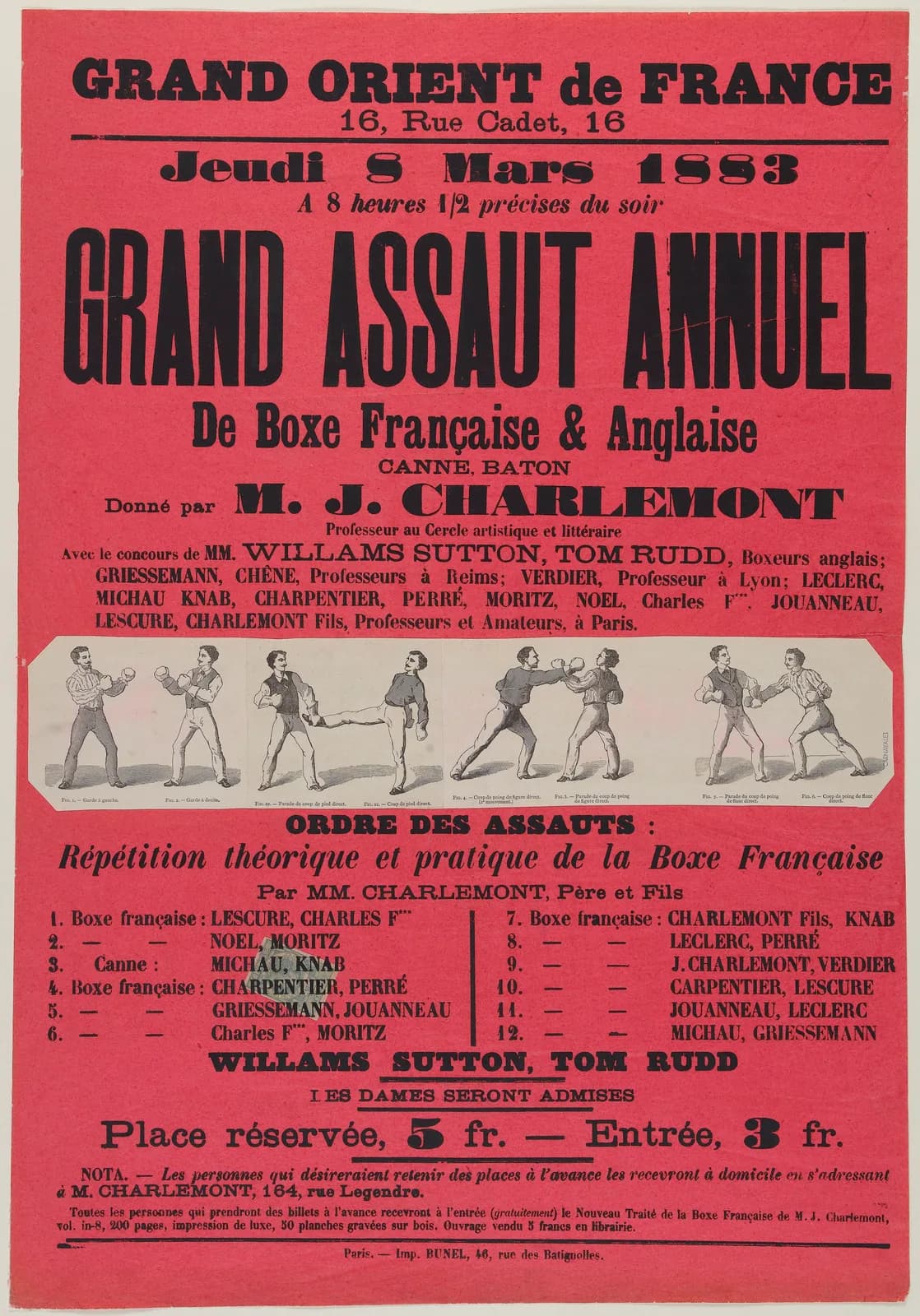
Michel Casseux (1794–1869), known as Pisseux, opened the first known savate school in Paris in 1825 and did for the street art what Broughton had done for English boxing. He wrote the techniques down, gave the kicks names, threw out the worst of the old methods – the head-butt, the attack to the eyes, the stamp on a man already down – and taught what was left as self-defence to paying students, among them, if the memoirs of the day are right, members of the nobility. One thing he kept was the open hand. His savate slapped where it might have punched, and that was its weakness.
His student Charles Lecour (1808–1894) found the weakness out the hard way. In the early 1830s Lecour fought a friendly bout with Owen Swift, an English boxer visiting Paris, and was beaten by punches he had no answer to. So he went to London, spent two years learning English boxing, and came home to put the two arts together. The result, taught from about 1832 and named boxe française, was savate's kicks with the fists of the prize ring, and it changed the art's social class. Lecour's pupils included the sons of the Duke of Orléans, the poet Théophile Gautier, who wrote about it, and the novelist Alexandre Dumas. By mid-century the fighters wore gloves, the bouts had rules, and boxe française sat beside fencing and the cane as one of the fashionable sports of the Parisian gymnasium. In one generation the worn-out shoe had acquired a title.
The Charlemonts, and the kick the English called a foul
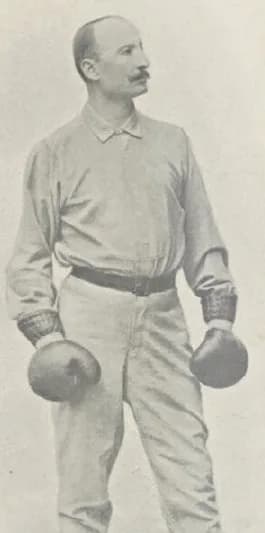
Joseph Charlemont (1839–1929), a former soldier who had learned from Lecour's generation of teachers, gave the art its theory. His treatise of 1877, Traité théorique et pratique de boxe française et de canne, arranged the kicks – the low coup de pied bas, the round fouetté, the thrusting chassé, the reverse revers – and the punches into one complete system, added the canne, the walking-stick fencing of the Parisian gentleman, as a sister discipline, and laid out a method of teaching that the French army adopted. His academy in Paris was the centre of the art for fifty years. His son Charles Charlemont (1862–1944) became its greatest champion, and the Driscoll fight of 1899 was the proof.
The years around that fight were the art's classic era. At the turn of the century boxe française had salles in every French city, an annual season of assauts, exhibition bouts scored on technique rather than damage, a literature of its own and a role in the army. In 1924 it was demonstrated at the Paris Olympics. That is the closest it has ever come to the Games, and within a generation there would be fewer than a hundred people left to try again.
Fewer than a hundred
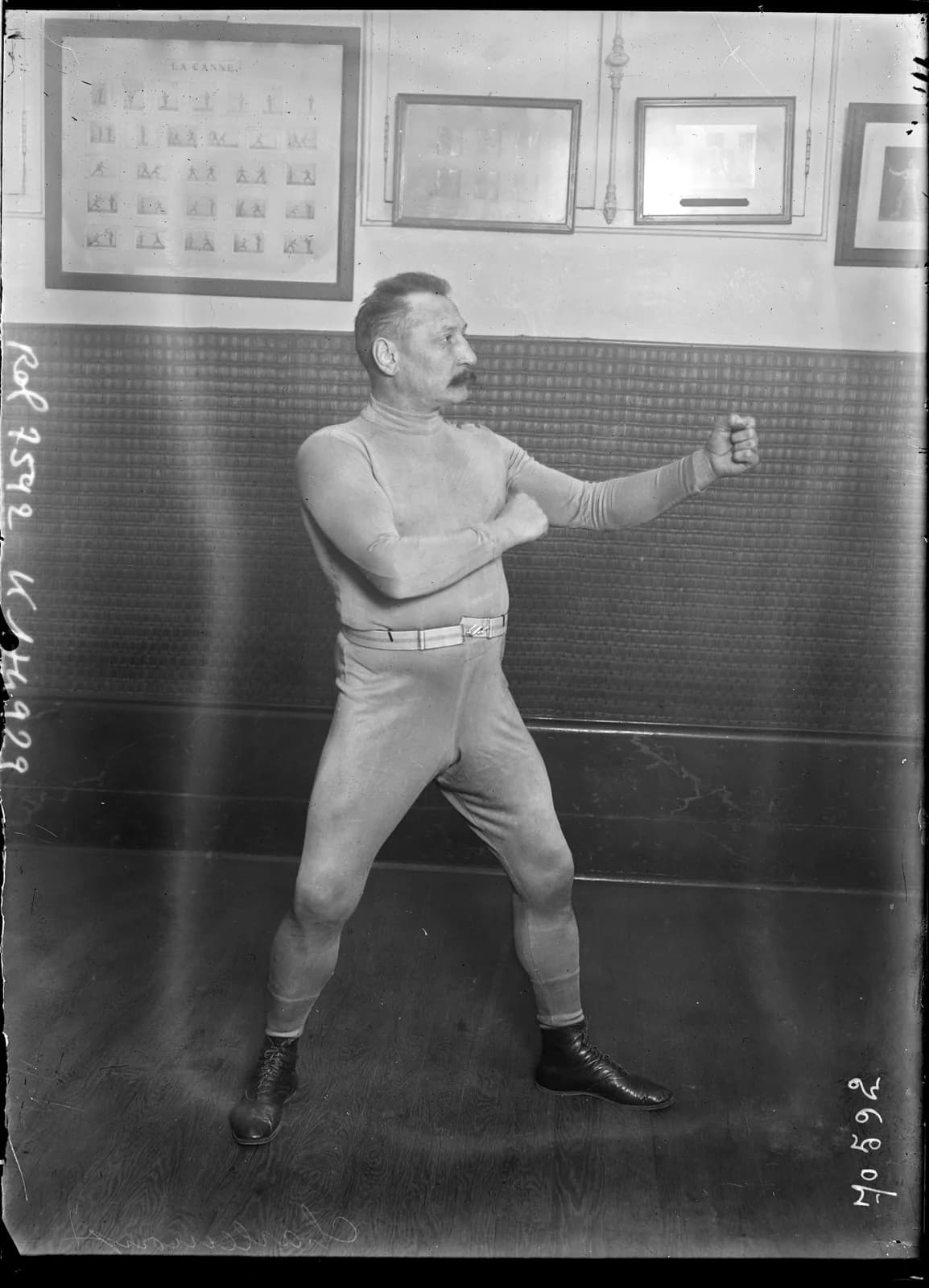
The art's weakness was that it was French. In the same decades English boxing conquered the world, boxe française stayed a Parisian and provincial pastime, and two world wars killed or scattered the generations who carried it. By the survivors' own count there were fewer than a hundred practitioners left after 1945, most of them old. The Charlemont academy had closed. What remained was a handful of salles in Paris, Marseille and Lyon and the memories of men who had been champions before the war.
One of those champions saved it. Count Pierre Baruzy (1897–1994), a pre-war champion of France in boxe française and a student of the Charlemont line, spent the 1950s and 1960s finding the survivors, teaching and lobbying. In 1965 he founded the Comité National de Boxe Française, in 1975 the Fédération Nationale, and between them he built the modern structure: a grading system that uses coloured gloves – blue, green, red, white, yellow, silver – where other arts use belts; two competition forms, assaut, light contact scored on technique, and combat, full contact with knockouts; and a place for the art in French schools and universities. By the time Baruzy died in 1994 the number of licensed practitioners in France had passed fifty thousand. He had started with fewer than a hundred.
Savate in a world of kickboxing
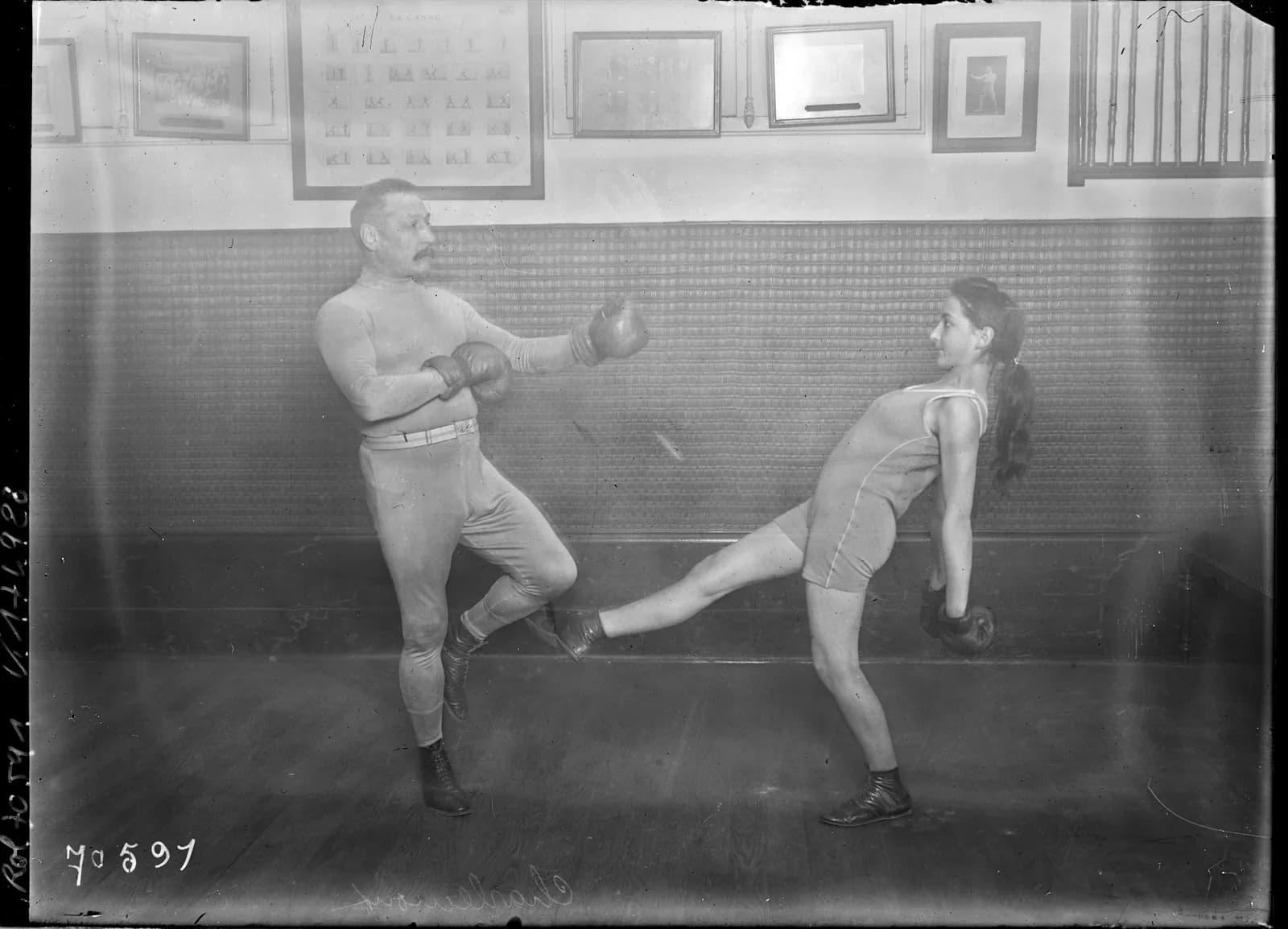
The Fédération Internationale de Savate (FISav) was founded in 1985, and world championships in assaut and combat followed. The sport is strongest in France, Italy, Belgium, Britain and Eastern Europe, and its fighters have crossed into kickboxing and, now and then, into mixed martial arts: the savate champion Gérard Gordeau fought in the first UFC in 1993. Savate was recognised by the International World Games Association and contested at the World Games in Cali in 2013, and its federation still campaigns for the Olympic place that the 1924 demonstration never turned into.
What sets it apart in a world full of kickboxing is the technique. Savate kicks are delivered with the foot, in a boot, at long range and with precision – the whipping fouetté, the piercing chassé, the sweeping revers – and shins, knees and elbows are forbidden. Its footwork and its sense of distance come from fencing, and an assaut between two good fighters looks more like a duel than a brawl. The street fighters of 1800 would not recognise it. Charlemont would.
Where to go next
- The savate discipline hub collects training articles, workouts and gear.
- The English half of boxe française: Boxing: From Bare Knuckles to the Queensberry Rules.
- The other great kicking art of the ring: The History of Muay Thai.
- Footwork and distance, the savateur's foundation: Jump Rope Conditioning.
Sources
- Fédération Française de Savate, Boxe Française et Disciplines Associées – Histoire
- Fédération Internationale de Savate – History
- Joseph Charlemont, Traité théorique et pratique de boxe française et de canne (Paris, 1877)
- Jean-François Loudcher, Histoire de la savate, du chausson et de la boxe française, 1797–1978 (L'Harmattan, 2000)
- Wikipedia: Savate
- Wikipedia: Charles Lecour
- Wikipedia: Joseph Charlemont
- Wikipedia: Michel Casseux
Frequently asked questions
- What is savate?
- The French kickboxing art, also called boxe française: punches from English boxing combined with kicks delivered with the shoe, fought in a ring with gloves and light boots. It has two competition forms, assaut (light contact, scored on technique) and combat (full contact).
- Where does the name come from?
- Savate is an old French word for a worn-out shoe or slipper, and by extension for a kick. The early street fighters of Paris fought in heavy shoes, and the name stuck to their method even after it became a gentleman's sport.
- Is savate the same as kickboxing?
- It is the oldest Western kickboxing and looks similar, but it has its own rules: kicks must be delivered with the foot, shin kicks and knees are forbidden, competitors wear boots, and the technique emphasises precise, long-range kicks such as the fouetté and chassé rather than Thai-style low kicks.
- Who created boxe française?
- Michel Casseux codified street savate in 1825; his student Charles Lecour added English boxing punches in the 1830s and created boxe française; Joseph Charlemont and his son Charles refined and taught it from the 1870s to the 1920s. The modern sport was rebuilt by Count Pierre Baruzy after 1965.
- Was savate an Olympic sport?
- It was a demonstration sport at the 1924 Paris Olympics and has never been on the official programme. It is recognised by the International World Games Association and was contested at the World Games in 2013.
- What are the coloured gloves in savate?
- Savate's grading system uses glove colours instead of belts: blue, green, red, white, yellow and silver for technical grades, with further silver grades for competitors and instructors. They were introduced with the revival of the 1960s and 1970s.