History
Muhammad Ali: The Life and Fights of the Greatest
From a stolen bicycle in Louisville to Rome, Liston, exile, Kinshasa and Manila: the documented life of Muhammad Ali, three-time heavyweight champion.
11 min read · 21 September 2026 · updated 21 September 2026
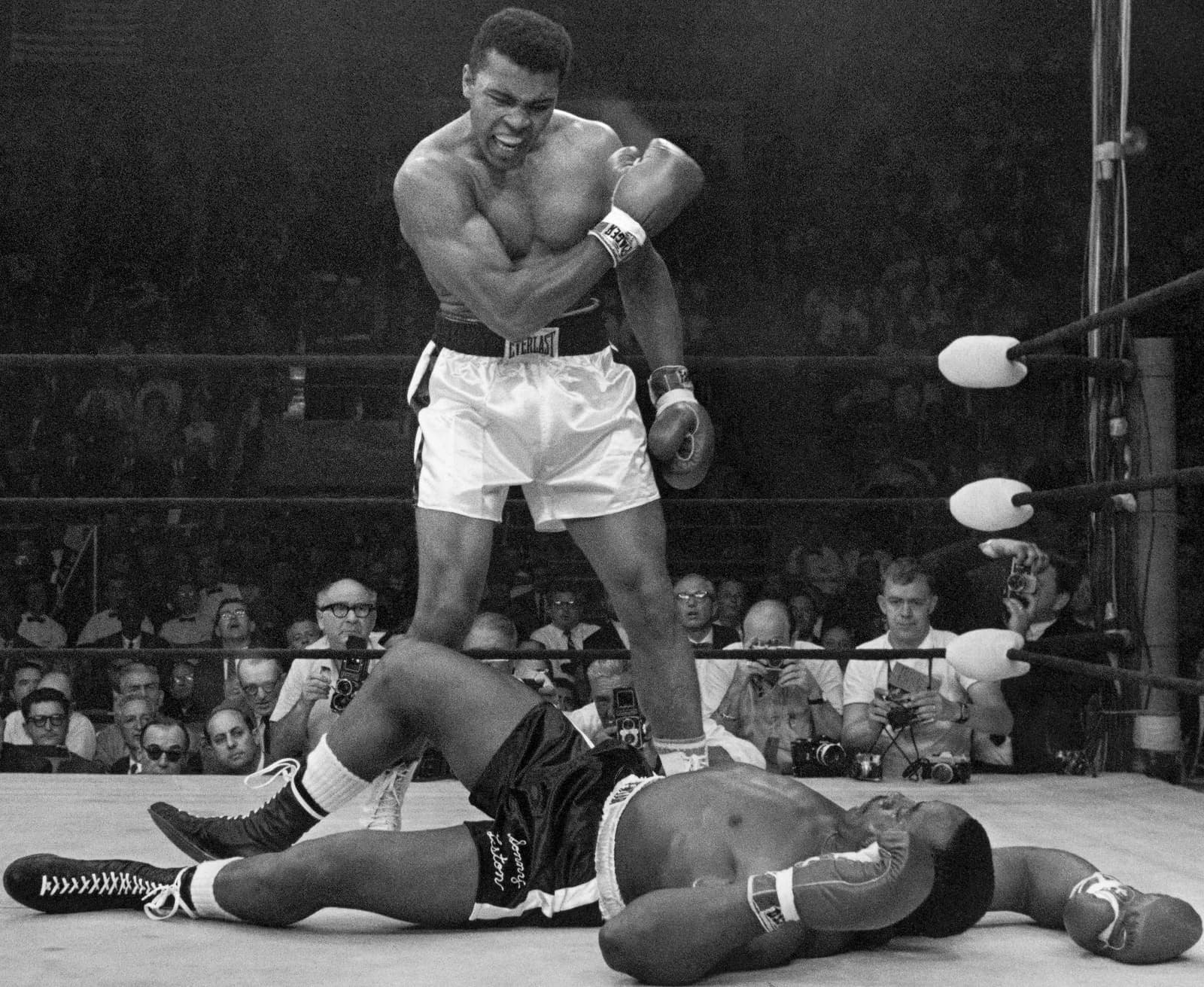
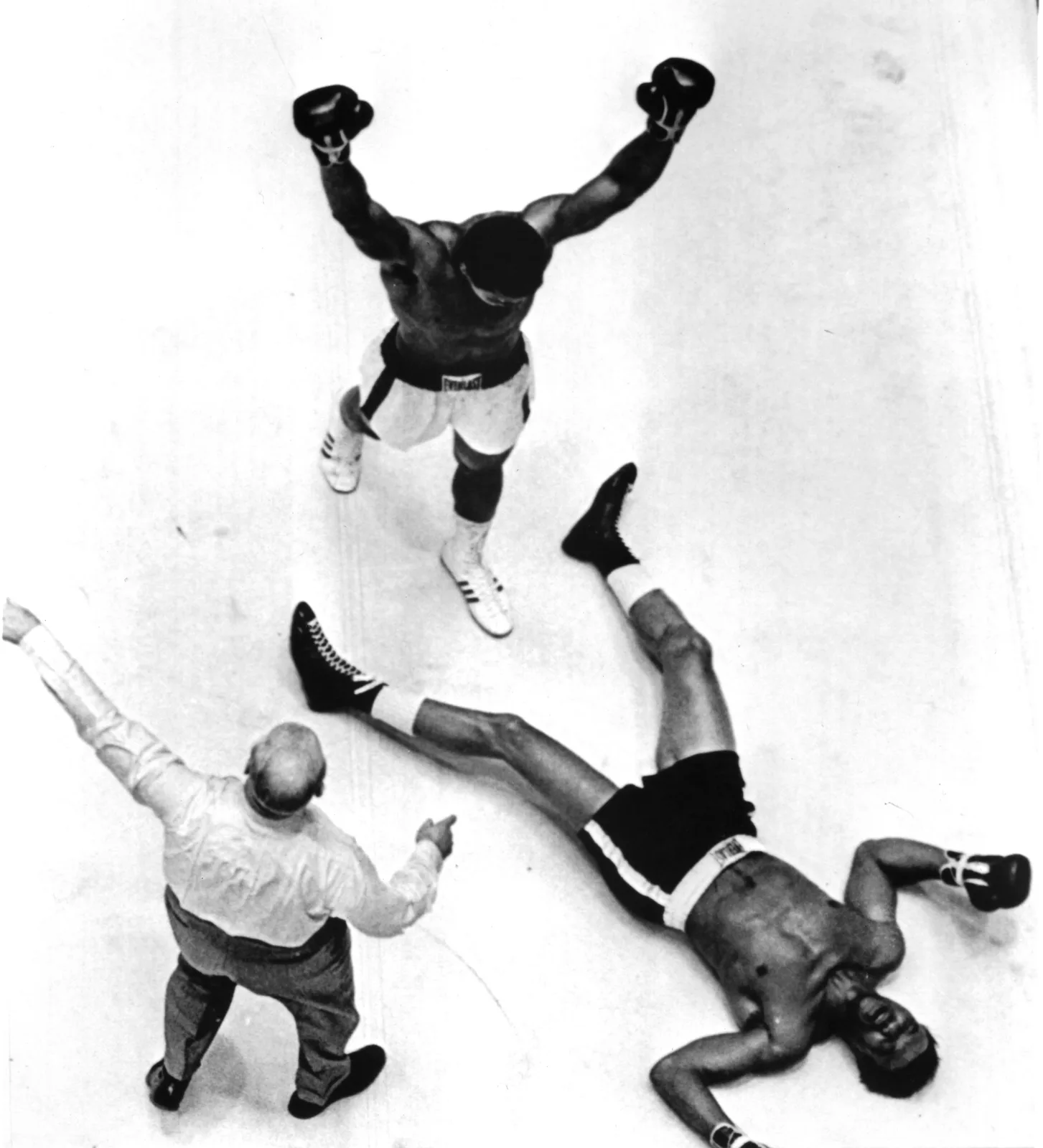
Photo: Ali standing over Sonny Liston, Lewiston, Maine, 25 May 1965. John Rooney, 1965. Public domain, via Wikimedia Commons.
In this article
Timeline
- 1942
Cassius Marcellus Clay Jr. is born on 17 January in Louisville, Kentucky, the son of a sign painter and a domestic worker.
- 1954
His bicycle is stolen outside the Columbia Auditorium. The police officer he reports it to, Joe Martin, runs a boxing gym and starts training him; he is twelve.
- 1960
Wins Olympic gold at light heavyweight in Rome on 5 September, beating Zbigniew Pietrzykowski of Poland in the final. Professional debut on 29 October in Louisville: a six-round decision over Tunney Hunsaker, a police chief from West Virginia.
- 1964
Beats Sonny Liston in Miami Beach on 25 February when Liston stays on his stool before round seven. Days later he announces his membership of the Nation of Islam and takes the name Muhammad Ali.
- 1965
Knocks Liston out in the first round of the rematch in Lewiston, Maine, on 25 May, with a punch many in the arena did not see.
- 1966
Defends the title five times in one year, including a third-round stoppage of Cleveland Williams before 35,460 at the Houston Astrodome on 14 November.
- 1967
Refuses induction into the US Army in Houston on 28 April, is stripped of his title and licence the same day, and is convicted of draft evasion in June. He does not box for three and a half years.
- 1971
Loses to Joe Frazier on points in the Fight of the Century at Madison Square Garden on 8 March. On 28 June the Supreme Court overturns his conviction 8–0.
- 1974
Knocks out George Foreman in the eighth round in Kinshasa, Zaire, on 30 October, the Rumble in the Jungle, and regains the title at 32.
- 1975
Beats Frazier for the second time when Frazier’s corner stops the Thrilla in Manila after fourteen rounds on 1 October.
- 1978
Loses the title to Leon Spinks on 15 February and wins it back on 15 September in New Orleans, becoming the first man to win the heavyweight championship three times.
- 1980–1981
Returns from retirement and is stopped by Larry Holmes after ten rounds on 2 October 1980; loses his last fight to Trevor Berbick in Nassau on 11 December 1981. Final record 56–5, 37 knockouts.
- 1984
Diagnosed with Parkinson’s syndrome, a condition he lives with for the next three decades.
- 1996
Lights the Olympic cauldron at the opening ceremony in Atlanta on 19 July.
- 2016
Dies in Scottsdale, Arizona, on 3 June, aged 74, and is buried in Louisville.
In the autumn of 1954 a twelve-year-old boy comes out of a fair at the Columbia Auditorium in Louisville, Kentucky, and finds that his new red-and-white Schwinn is gone. He is crying and angry, and someone points him downstairs, where a white police officer named Joe Martin runs a boxing gym in the basement. The boy tells Martin what he is going to do to whoever took the bike. Martin tells him he had better learn to fight first.
The short answer to who that boy became is in the title. Cassius Clay became Muhammad Ali: Olympic champion at 18, heavyweight champion at 22, exile at 25, champion again at 32 and a third time at 36, and the most famous athlete of the twentieth century. This is his life as the record has it. For the sport itself, the site’s history of boxing tells the longer story.
Key facts
- Born
- Cassius Marcellus Clay Jr., 17 January 1942, Louisville, Kentucky
- Amateur peak
- Olympic light heavyweight gold, Rome 1960
- Professional record
- 56–5, 37 KO (1960–1981)
- World titles
- Heavyweight champion 1964–1967, 1974–1978, 1978–1979
- Exile
- March 1967 to October 1970, for refusing induction into the US Army
- Died
- 3 June 2016, Scottsdale, Arizona, aged 74
The bicycle and the basement
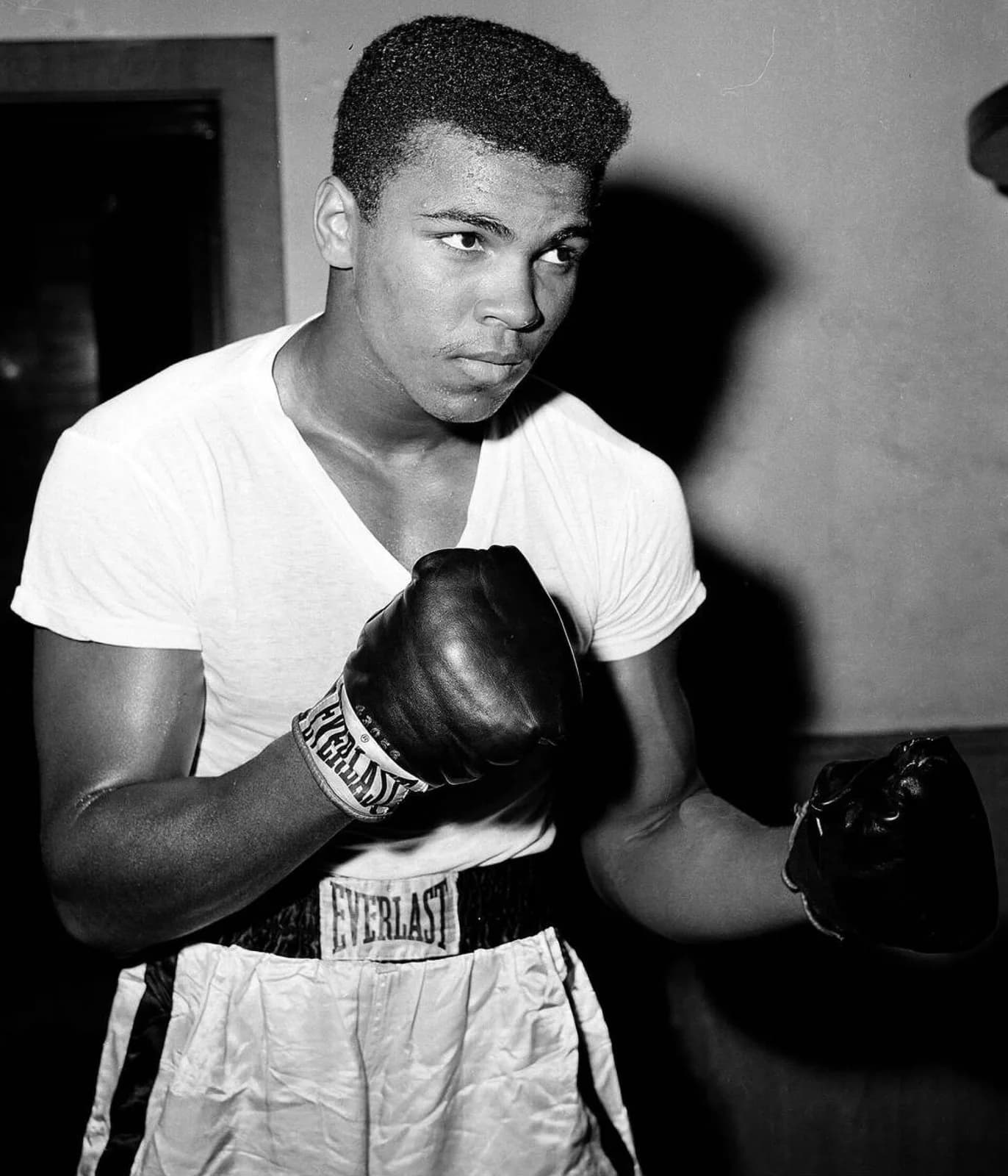
Cassius Marcellus Clay Jr. was born on 17 January 1942 in a segregated Louisville. His father, Cassius Clay Sr., painted signs and church murals; his mother, Odessa Grady Clay, cleaned houses. The name came from a Kentucky abolitionist. Their son would come to hate it.
Martin’s gym gave him a routine and a stage, and he was fast in a way heavyweights were not supposed to be. Between 1954 and 1960 he won six Kentucky Golden Gloves titles, two national Golden Gloves titles and two national AAU championships at light heavyweight, 81 kg (178 lb).
In September 1960 he flew to the Olympic Games in Rome wearing a parachute bought at an army surplus store, because he was afraid of flying. He beat Zbigniew Pietrzykowski of Poland in the final on 5 September and wore the gold medal for days. It did not get a Black man served in a Louisville restaurant.
Eleven millionaires and a man in Miami
The Louisville Sponsoring Group, eleven local businessmen, paid him a bonus and a salary in return for half of his purses. His debut, on 29 October 1960 in Louisville, was a six-round decision over Tunney Hunsaker, the police chief of Fayetteville, West Virginia. Two months later he was in Miami with Angelo Dundee, who would work his corner for twenty-one years.
Dundee left the style alone. Clay carried his hands low, leaned away from punches instead of slipping them and stayed on his toes for fifteen rounds, all the things a coach correcting your jab tells you not to do, and all of them working because his feet and eyes were faster than anyone else’s. Henry Cooper’s left hook dropped him at Wembley in June 1963; Cooper was stopped on cuts in the next round. By then Clay was predicting the round in rhyme, and the papers called him the Louisville Lip.
Miami Beach, 1964
The champion was Sonny Liston, an ex-convict with a jab like a battering ram who had taken the title from Floyd Patterson in one round and kept it in one round. On 25 February 1964 at the Miami Beach Convention Hall, Clay, 22 years old and a 7–1 underdog, met him. He moved, he jabbed, he cut Liston under the left eye in the third, and in the fifth, blinded by something from Liston’s gloves, he survived by running. When the bell rang for the seventh round, Liston stayed on his stool. Clay leapt around the ring shouting that he had shaken up the world, which he had.
He shook it again the next morning, confirming what the papers had suspected for a year: he belonged to the Nation of Islam, the Black separatist movement led by Elijah Muhammad, and was a friend of Malcolm X. For a few days he was Cassius X. On 6 March 1964 Elijah Muhammad announced that he would be called Muhammad Ali. Much of white America, and a good part of the boxing press, refused to use the name for years. Ali refused to answer to the old one.
The phantom punch and the busiest year
The rematch was chased out of Boston and landed in Lewiston, Maine, on 25 May 1965, in a youth centre ice rink before 2,434 people, the smallest crowd for a heavyweight title fight in the modern era. It lasted less than two minutes. Ali threw a short right hand over Liston’s jab, Liston went down, and Ali stood over him with his fist cocked, shouting at him to get up. The photograph became the most famous in the sport. The referee lost the count. The papers called it the phantom punch. Slow-motion film shows a punch. It also shows a man who did not seem to want to get up.
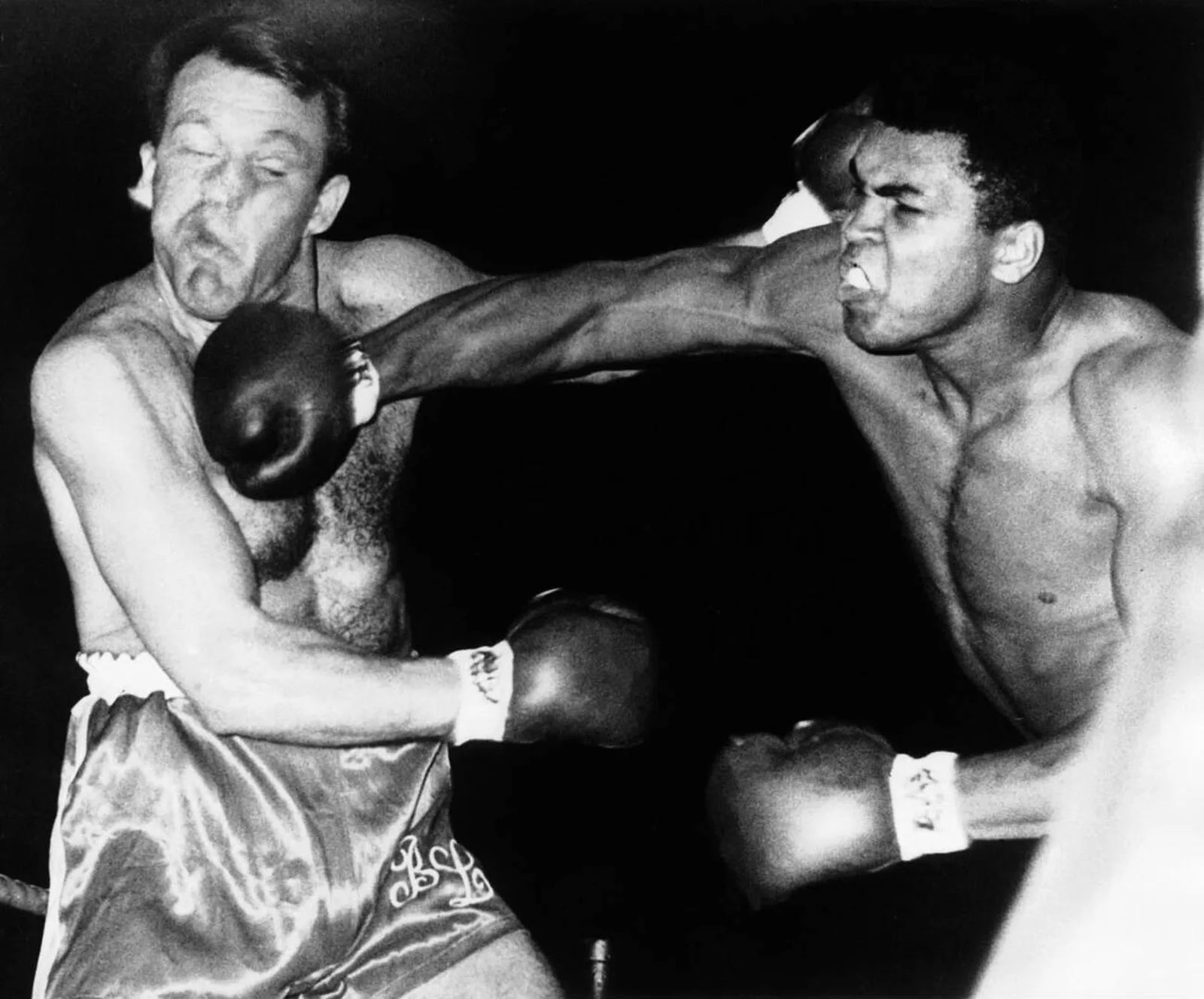
Then Ali went to work. He beat Floyd Patterson in November 1965, and in 1966 he defended the title five times in four countries: George Chuvalo in Toronto, Cooper again and Brian London in London, Karl Mildenberger in Frankfurt, and on 14 November 1966 Cleveland Williams at the Houston Astrodome. Before 35,460 people, a record for an indoor fight, Ali unveiled the Ali Shuffle, put Williams down four times and stopped him in the third round. His biographers think it was the best night of his life in a ring.
He beat Ernie Terrell and Zora Folley in early 1967. Terrell had insisted on calling him Clay, and Ali spent fifteen rounds asking him what his name was. It was his last fight for three and a half years.
Houston, 28 April 1967
In early 1966, as the Vietnam War grew and the army lowered its standards, Ali was reclassified 1-A, and a reporter who telephoned him for comment got the sentence that followed him everywhere: he had no quarrel with the Viet Cong. His claim to exemption as a conscientious objector was refused. On 28 April 1967, at the induction centre in Houston, his name was called three times and he did not step forward. Within hours New York had suspended his licence and the World Boxing Association had stripped his title. In June a federal jury took twenty-one minutes to convict him; the sentence was five years and a fine of ten thousand dollars. He stayed out of prison on appeal, but no state would let him box.
From 25 to 28, the years a heavyweight is supposed to be at his best, Ali lectured on college campuses and waited. The war became unpopular; so, slowly, did the ban. In 1970 Georgia, which had no state athletic commission, found room for him in Atlanta. He stopped Jerry Quarry in three rounds on 26 October 1970 and Oscar Bonavena in December, and signed to fight the man who had won the title in his absence.
The Fight of the Century, and what the court said
Joe Frazier was unbeaten, an Olympic champion himself, and a fighter who came forward behind a left hook for as long as it took. On 8 March 1971 at Madison Square Garden, each man paid two and a half million dollars, they fought fifteen rounds. Frazier’s hook put Ali on his back in the fifteenth and won him a unanimous decision. It was the first loss of Ali’s career.
On 28 June 1971 the Supreme Court decided Clay v. United States. The government had conceded that Ali’s objection was sincere and religious; the court found that the draft board had never said which test he had failed, and reversed the conviction, 8–0. He was free. He was also 29, and the title belonged to a man who had just beaten him.
It took three years. Ken Norton broke his jaw in the second round in San Diego on 31 March 1973 and won a split decision after twelve; Ali fought on with the broken jaw for ten rounds, and won the rematch in September. In January 1974 he beat Frazier over twelve rounds at the Garden. By then the title belonged to somebody else again.
Kinshasa, four in the morning
George Foreman had taken the championship from Frazier in two rounds in January 1973, knocking him down six times, and had done the same to Norton. He was 40–0 with 37 knockouts, 25 years old, and the most frightening heavyweight since Liston. Ali was 32. The promoter Don King put the fight in Kinshasa, Zaire, for five million dollars each, and the bell went at four in the morning on 30 October 1974 so that America could watch in the evening.
Everybody expected Ali to dance. Instead, from the second round, he lay back against the loose ropes with his gloves and forearms in front of his head and let Foreman hit him in the body and arms until Foreman could barely lift his hands. Between punches he asked Foreman whether that was all he had. In the eighth, Ali came off the ropes with a combination that ended in a right hand, and Foreman turned and fell. Ali named the tactic the rope-a-dope. Mailer wrote a book about it. The rain that had held off all night came down on the stadium minutes after the count.
Manila, ten in the morning
The third Frazier fight took place at the Araneta Coliseum outside Manila on 1 October 1975, at ten in the morning for American television, in heat the corners put at well over 40 °C (104 °F) under the lights. Ali won the early rounds, Frazier the middle ones, hooking to the body until Ali was fighting from memory. In the thirteenth and fourteenth Ali found something and closed Frazier’s eyes with right hands. Before the fifteenth, Frazier’s trainer Eddie Futch would not let him out. Ali stood up to celebrate and collapsed onto his stool. He later said it was the closest thing to dying he knew of.
He was champion for three more years and should probably have stopped sooner. He beat Norton a third time at Yankee Stadium in 1976, and on 15 February 1978, at 36 and badly prepared, lost the title on a split decision to Leon Spinks, an Olympic champion with seven professional fights. He trained properly for the rematch. On 15 September 1978 at the Louisiana Superdome, before 63,350 people, he boxed fifteen careful rounds and took the title back, the first man to win the heavyweight championship three times. He announced his retirement in 1979.
Two fights too many, and a long third act
Ali came back in 1980 for eight million dollars against Larry Holmes, his former sparring partner, the best heavyweight in the world and a man who did not want to hurt him. On 2 October at Caesars Palace, Holmes hit him for ten rounds and Dundee stopped it at the end of the tenth, the only time in 61 fights that Ali failed to finish. Fourteen months later, on 11 December 1981 in Nassau, he lost ten slow rounds to Trevor Berbick, and that was the end: 56 wins, 5 losses, 37 knockouts.
In 1984, after tests in New York, he was diagnosed with Parkinson’s syndrome. His speech slowed and his hands shook, and he spent the next thirty years travelling on behalf of causes he chose himself. On 19 July 1996, at the opening ceremony of the Olympic Games in Atlanta, the torch was passed to him and the stadium, which had not been told, stood up and made a sound that people who were there still describe. His left hand shook as he lit the cauldron. He did not stop.
He died of septic shock in Scottsdale, Arizona, on 3 June 2016, aged 74. The funeral procession in Louisville went past the Columbia Gym, and people threw flowers at the hearse.
Where to go next
- The boxing discipline hub collects training articles, workouts and gear; the history of boxing explains where the rules came from.
- Ali fought at light heavyweight in Rome and heavyweight for the rest of his life: boxing weight classes explained and amateur vs professional boxing cover the two worlds he crossed between in 1960.
- How a judge would have scored Frazier I or Manila today: how boxing is scored.
- The heavyweight who arrived five years after Ali retired, and could not have fought more differently: Mike Tyson: The Rise, the Fall and the Long Second Act.
Sources
- Thomas Hauser, Muhammad Ali: His Life and Times (Simon & Schuster, 1991)
- David Remnick, King of the World: Muhammad Ali and the Rise of an American Hero (Random House, 1998)
- Norman Mailer, The Fight (Little, Brown, 1975)
- BoxRec – Muhammad Ali professional record
- Muhammad Ali Center, Louisville – Ali’s life and legacy
- Encyclopaedia Britannica – Muhammad Ali
- Clay v. United States, 403 U.S. 698 (1971), Supreme Court of the United States
- Wikipedia: Muhammad Ali
Frequently asked questions
- What was Muhammad Ali’s professional record?
- 56 wins, 5 losses, 37 by knockout, in 61 fights between 1960 and 1981. His five losses were to Joe Frazier (1971), Ken Norton (1973), Leon Spinks (1978), Larry Holmes (1980) and Trevor Berbick (1981).
- Why did Cassius Clay change his name to Muhammad Ali?
- He joined the Nation of Islam, and in March 1964, days after beating Sonny Liston, its leader Elijah Muhammad gave him the name Muhammad Ali. He called Cassius Clay his slave name and refused to answer to it for the rest of his life.
- Why was Muhammad Ali banned from boxing?
- On 28 April 1967 he refused induction into the US Army on religious grounds, opposing the Vietnam War. Boxing commissions stripped his title and licence the same day and he was convicted of draft evasion. He did not fight from March 1967 until October 1970, and the Supreme Court overturned the conviction in June 1971.
- How many times was Ali heavyweight champion?
- Three. He won the title from Sonny Liston in 1964, regained it from George Foreman in 1974 and won it a third time from Leon Spinks in 1978, the first heavyweight to do so.
- What was the rope-a-dope?
- Ali’s tactic against George Foreman in Kinshasa in 1974: he lay back on the ropes, covered up and let Foreman punch himself tired for several rounds, then knocked him out in the eighth. The name was Ali’s.
- How did Muhammad Ali die?
- He died of septic shock on 3 June 2016 in Scottsdale, Arizona, aged 74, after living with Parkinson’s syndrome since a diagnosis in 1984. He was buried in Cave Hill Cemetery in Louisville.