History
Mas Oyama: The Man Who Fought Bulls and Founded Kyokushin
The life of Mas Oyama (1923–1994): Korean-born, trained under Funakoshi, hardened on a mountain, famous for fighting bulls, founder of full-contact Kyokushin.
10 min read · 21 September 2026 · updated 21 September 2026
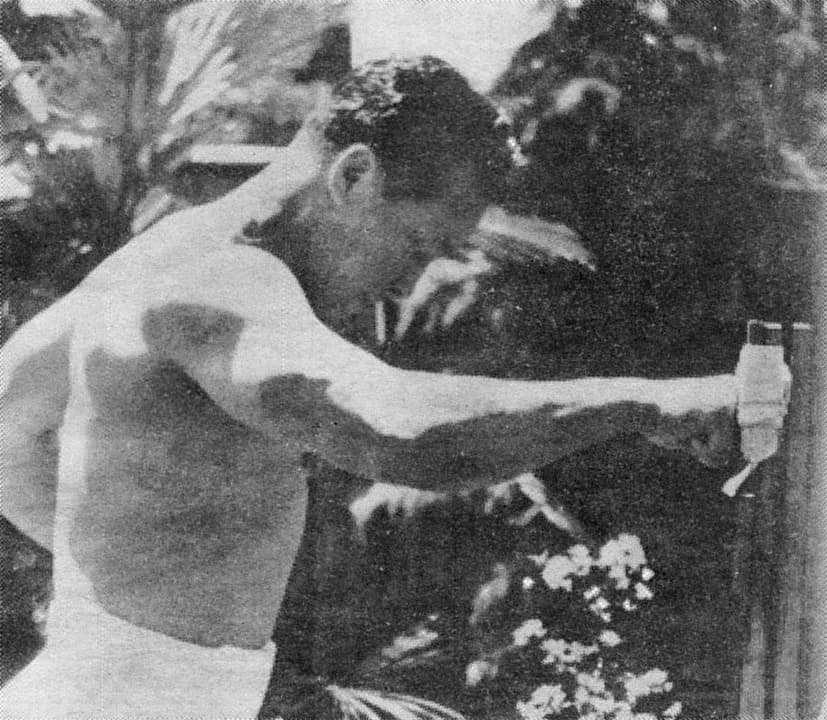
Photo: Nihon Sports Shuppansha, 1954. Public domain, via Wikimedia Commons.
In this article
Timeline
- 1923
Choi Yeong-eui is born on 27 July in Gimje, in Japanese-ruled Korea.
- 1938
Aged fifteen he moves to Japan, hoping to train as a pilot, and takes the Japanese name Ōyama Masutatsu.
- c. 1939–1945
He trains Shōtōkan karate under Funakoshi Gichin at Takushoku University and, later, Gōjū-ryū under the Korean-born teacher So Nei Chu. The dan grades he later claimed for these years are his own account.
- 1946–1947
Widely reported first mountain retreat on Mount Minobu, Yamanashi, training alone for more than a year.
- 1947
Oyama wins the karate division of an all-Japan martial arts tournament held in Kyoto, the first after the war.
- 1948–1949
Second retreat, on Mount Kiyosumi in Chiba, said to have lasted eighteen months.
- 1950
He begins fighting bulls in public demonstrations, filmed and reported in the Japanese press through the mid-1950s.
- 1952
A year-long tour of the United States with the wrestler Great Togo: demonstrations, television and challenge matches, the number of which rests on Oyama’s account.
- 1953
The Oyama Dojo opens on an empty lot in Mejiro, Tokyo; in 1956 it moves into a former ballet studio behind Rikkyo University.
- 1958
What Is Karate? is published, the first of his books to sell in the West; This Is Karate follows in 1965.
- 1964
The International Karate Organization Kyokushinkaikan is founded and a purpose-built headquarters opens in Ikebukuro, Tokyo.
- 1965
Steve Arneil of South Africa becomes the first student to complete the 100-man kumite under Oyama.
- 1969
The first All-Japan Open Full-Contact Karate Championship is held in Tokyo, won by Yamazaki Terutomo.
- 1975
The first World Open Karate Championship, Kyokushin’s world tournament, is held in Tokyo, won by Satō Katsuaki.
- 1994
Oyama dies of lung cancer in Tokyo on 26 April, aged 70. His organisation splits within months.
On 21 May 1965 a South African called Steve Arneil walks onto the floor of a karate dōjō in Tokyo and fights a hundred men, one after another, full contact, without leaving the mat. The rules are the founder's: each opponent fresh, each bout to a knockdown or the bell, no rest between them. Arneil finishes. He is the first person to do so under those rules and one of a handful who have done it since, and the man who set the test, who watched from the side and had by his own account once fought 300 in three days, was a 41-year-old Korean who had come to Japan as a teenager to learn to fly.
The short answer: Mas Oyama was born Choi Yeong-eui in Korea in 1923, trained in Japan under the founder of Shōtōkan and in Gōjū-ryū, and spent the 1950s becoming famous in a way no karate master had before: alone on mountains, in front of bulls, on American television. In 1964 he turned that fame into Kyokushin, the first major full-contact karate style, and ran it for thirty years as its sōsai, its president. The art's wider history, from Okinawa to the Olympics, is in The History of Karate. This is the man who took the gloves off.
Key facts
- Born
- 27 July 1923, Gimje, Korea (then under Japanese rule), as Choi Yeong-eui
- Died
- 26 April 1994, Tokyo, aged 70, of lung cancer
- Teachers
- Funakoshi Gichin (Shōtōkan); So Nei Chu (Gōjū-ryū)
- Founded
- Oyama Dojo, Tokyo, 1953; IKO Kyokushinkaikan, 1964
- Tournaments
- First All-Japan Open 1969; first World Open 1975
- Books
- What Is Karate? (1958), This Is Karate (1965)
Choi Yeong-eui
He was born on 27 July 1923 in Gimje, a farming district in the south-west of Korea, which had been a Japanese colony for thirteen years. His name was Choi Yeong-eui. Much of what is written about his childhood, the years on a sister's farm in Manchuria, a first teacher who taught him a Chinese art, comes from Oyama himself and his organisation, and the reader should hold it loosely. What is certain is that in 1938, at fifteen, he went to Japan, enrolled at an aviation school in Yamanashi with the idea of becoming a pilot, and, like most Koreans in Japan under colonial rule, took a Japanese name. He chose Ōyama Masutatsu, after the family that took him in. In the West it became Mas Oyama.
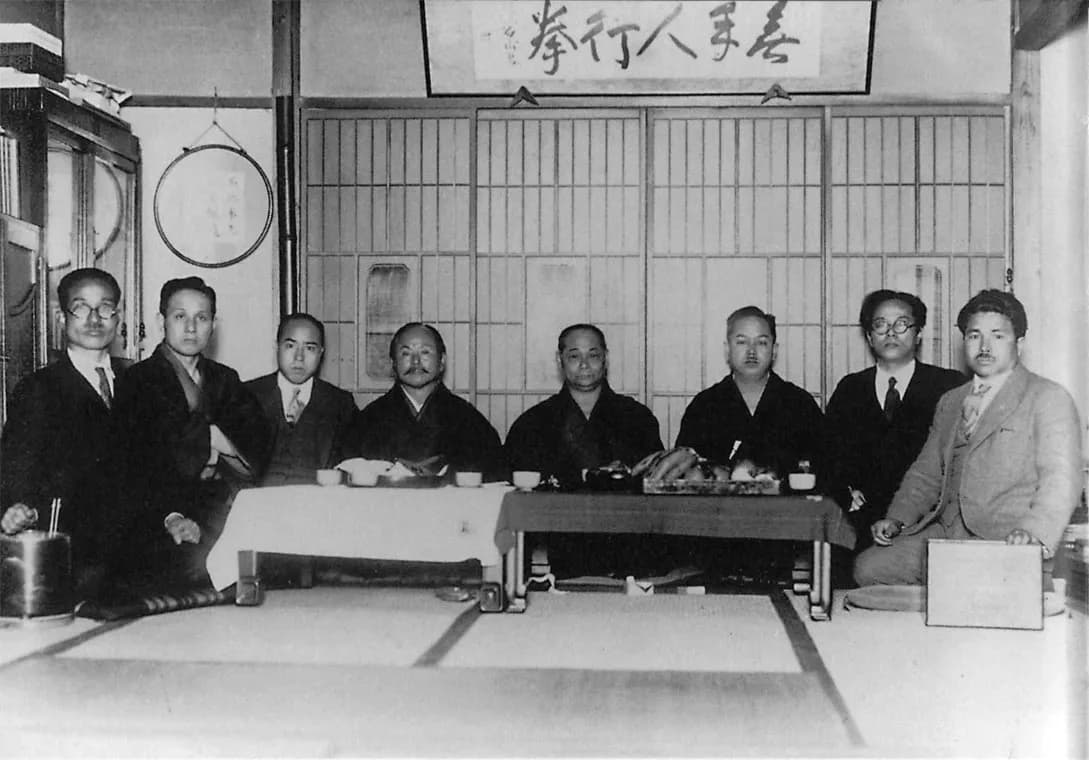
The flying came to nothing. The karate did not. He trained at the dōjō of Funakoshi Gichin, the Okinawan schoolteacher who had brought karate to Tokyo in 1922, through the club at Takushoku University, and later gave himself second dan by seventeen and fourth by twenty; those grades are his own account, as is most of what he said about the war years, and Shōtōkan's records are quieter. What the Shōtōkan gave him was the basics and a lifelong argument. Funakoshi's karate stopped its punches short of the target. Oyama, by temperament, did not want to.
The teacher who mattered more was So Nei Chu, a Korean-born master of Gōjū-ryū, the hard-soft Okinawan style, who taught in Tokyo after the war and became, by Oyama's account, his mentor. Gōjū-ryū gave him the close-range, body-hardening karate that Kyokushin would be built on. So gave him something else: the advice, when the young man's life in occupied Tokyo was going badly, to go into the mountains.
The mountain
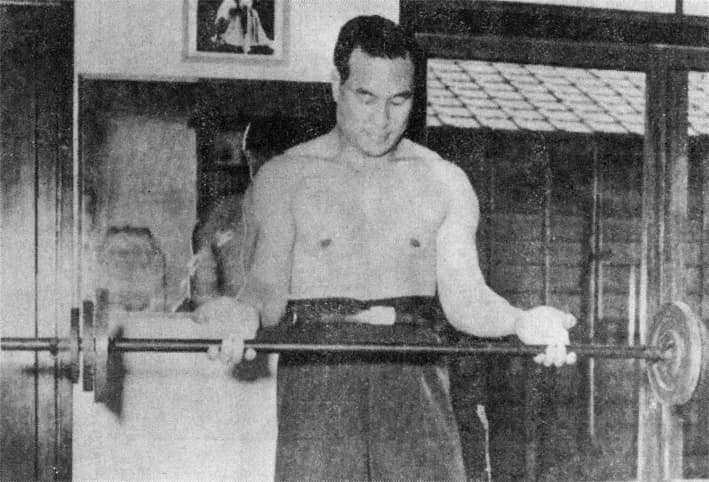
The retreats are the founding myth of Kyokushin, and, as founding myths go, unusually well attested for the outline and thin for the details. In 1946 Oyama went up Mount Minobu in Yamanashi, the mountain where the swordsman Musashi is said to have trained, with a student and a sponsor's promise of supplies, and lived and trained alone for more than a year, striking trees, meditating under waterfalls and, in the version he told, fighting off despair. The sponsor stopped sending supplies. He came down. In 1947 he entered the karate section of an all-Japan martial arts tournament in Kyoto, the first after the war, and won it. Then, in 1948, he went up again, to Mount Kiyosumi in Chiba, for a stay his organisation gives as eighteen months.
Whatever the exact months, he came down from Kiyosumi in 1949 with the thing he had gone up for: a body that could take and give full-power blows, and a style of karate, still unnamed, in which the point was not to score but to stop the other man. He was 26. Japan was still occupied, and he had no dōjō, no money and no reputation outside the small world of tournament karate. He needed something people would come to see.
The bull
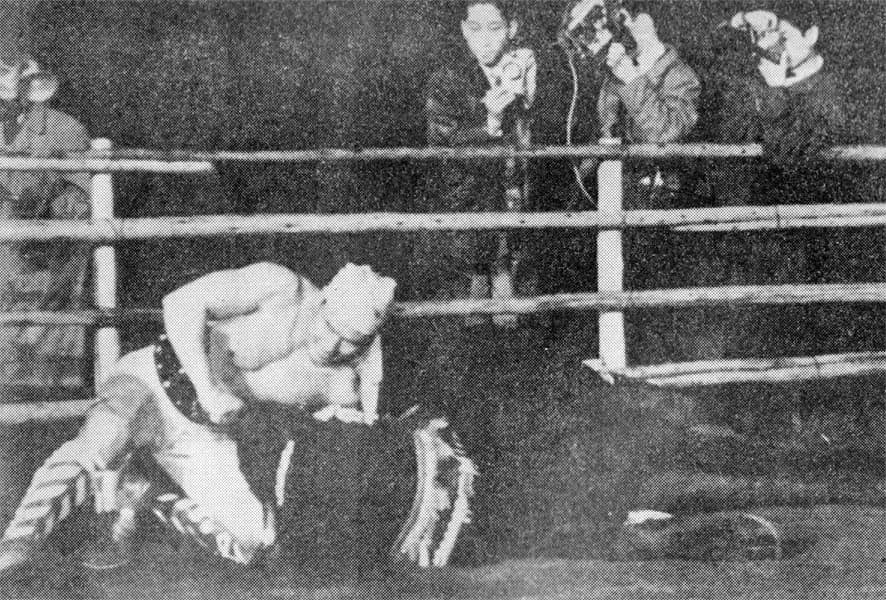
From 1950 he fought bulls. The demonstrations, at Tateyama in Chiba and elsewhere, were staged, reported in the Japanese press and in at least one case filmed for the cinema, and the footage survives: a heavy man in a gi facing a bull, grabbing its horns and, with knife-hand strikes, breaking one off. It was, and was intended to be, a spectacle, and it made him the most famous karateka in Japan. The numbers are another matter. His organisation later gave a total of 52 bulls, three killed outright and 49 with a horn removed; the figure comes from Oyama and has never been independently counted.
The bulls led to America. In 1952 the Japanese-American wrestler Great Togo brought him to the United States for a year of demonstrations: breaking, bull-fighting displays, television appearances and matches against professional wrestlers and anyone else who would step up. Oyama said later that he fought 270 men there and knocked most of them out in seconds. That is his account. What the tour verifiably did was teach him how a karate master could be marketed, in a country that had just discovered Japan, and Oyama, who by every description was a showman as much as a fighter, learned it thoroughly.
A vacant lot in Mejiro
In 1953 he began teaching on an empty lot in Mejiro, in north Tokyo, outdoors, to whoever turned up. In 1956 the class moved into a former ballet studio behind Rikkyō University, and the Oyama Dojo became a place people talked about, mostly for the sparring. Students fought full contact, with bare fists to the body and kicks anywhere; punches to the head were the one thing eventually removed, because too many were being hurt. Many left in the first months. The ones who stayed, among them Kurosaki Kenji, Nakamura Tadashi and Ōyama Shigeru (no relation), became the instructors who would build the organisation, and the lot in Mejiro is where the two things Kyokushin is known for, the hardness and the loyalty, were made.
Kyokushin
In 1964 Oyama named the thing. The International Karate Organization Kyokushinkaikan was founded that year and a purpose-built headquarters, the honbu, opened in Ikebukuro, a few streets from the ballet studio. Kyokushin means the ultimate truth. The same year he sent three of his fighters, Kurosaki, Nakamura and Fujihira Akio, to Bangkok to fight Muay Thai boxers under Thai rules, a challenge nobody in Japanese karate had accepted before; they won two of the three bouts, and Kurosaki, who lost his, came home and helped invent Japanese kickboxing. The organisation grew as its founder had, by spectacle and by sparring. Branches opened across Japan and then abroad, run by instructors who had fought in Mejiro and by foreigners who had come to Tokyo to test themselves against the man who fought bulls.
The tournaments came next. The first All-Japan Open Full-Contact Championship was held in Tokyo in September 1969, the first major karate tournament in which competitors fought bare-knuckle to the knockdown, and Yamazaki Terutomo won it. The first World Open followed in 1975, again in Tokyo, with fighters from dozens of countries and Satō Katsuaki as champion; it has been held every four years since. The scoring, in which a knockdown wins outright and a judges' decision is the alternative, is set out beside the WKF's point system in Karate Kumite Scoring Explained. The rules have changed less since 1969 than the rest of karate has.
One hundred men
The 100-man kumite was Oyama's idea of a final examination and, in a sense, a portrait of himself. He is said to have completed 300 bouts over three days in the 1950s, a claim that rests on his word and on the memories of those who fought him. The formal test, one fighter against a hundred fresh opponents in a single day, was first passed by Steve Arneil in 1965 and then by Nakamura Tadashi the same year, Ōyama Shigeru in 1966, the Welshman Howard Collins in 1972, Miura Miyuki in 1973 and, in the next generation, Matsui Shōkei in 1986 and the Brazilian Francisco Filho, who did it twice. The list of people who have finished it under Oyama's conditions fits on a small sheet of paper. Some of the strongest fighters in the style stopped at fifty.
Books, a manga and an actor
Oyama wrote as he fought, for effect. What Is Karate? (1958), a photographic manual that sold in the West when almost nothing else on karate did, and This Is Karate (1965), a larger and more technical book, put his face and his breaking on coffee tables from London to Los Angeles. In Japan the manga Karate Baka Ichidai, “a karate-crazy life”, serialised from 1971 and written by Kajiwara Ikki, turned him into a comic-book hero for a generation of boys who then walked into Kyokushin dōjō, and in the mid-1970s the actor Sonny Chiba, a student, played him in a trilogy of films. By the end of the 1970s the organisation claimed millions of members. The figure is the organisation's. The queues outside the Ikebukuro honbu were real.
After the founder
Oyama, who had never smoked, died of lung cancer in a Tokyo hospital on 26 April 1994, aged 70. He had named the 31-year-old Matsui Shōkei, a world champion and a 100-man finisher, as his successor, in a will that his widow and several senior instructors disputed, and within months the organisation broke apart: IKO 1 under Matsui, a second body under Nishida Yukio that later became the World Karate Organization Shinkyokushinkai, a third under Matsushima Yoshikazu, and in 2003 Kyokushin-kan under Rōyama Hatsuo, among others. Each holds its own world tournament and its own 100-man kumite. The style, like its founder, was too large for one organisation to contain, and each of them says so.
Where to go next
- The art he took the gloves off: The History of Karate, and the karate discipline hub.
- How knockdown karate is scored against the WKF's point system: Karate Kumite Scoring Explained.
- The belt Oyama earned under Funakoshi and later awarded himself: How Long Does It Take to Get a Black Belt in Karate?.
- Where Kyokushin fighters went next: the kickboxing hub and Karate vs MMA.
- Two founders of a different temperament: Jigorō Kanō and Ip Man.
Sources
- Masutatsu Oyama, What Is Karate? (Tokyo News Service, 1958; Japan Publications, 1966)
- Masutatsu Oyama, This Is Karate (Japan Publications, 1965)
- Cameron Quinn, The Budo Karate of Mas Oyama (Coconut Productions, 1987)
- International Karate Organization Kyokushinkaikan – History of Kyokushin and Sosai Masutatsu Oyama
- World Karate Organization Shinkyokushinkai – History
- Wikipedia: Mas Oyama
- Wikipedia: Kyokushin
Frequently asked questions
- Who was Mas Oyama?
- Masutatsu Oyama (1923–1994), born Choi Yeong-eui in Japanese-ruled Korea, was a karate master who founded Kyokushin, the first major full-contact style, in Tokyo in 1964. He trained under Funakoshi Gichin and in Gōjū-ryū, became famous in the 1950s for fighting bulls in demonstrations, and built one of the largest karate organisations in the world.
- Did Mas Oyama really fight bulls?
- Yes, in staged public demonstrations from 1950 into the 1950s, some of them filmed. The number of bulls, and the claim that he killed several with his bare hands, comes from Oyama and his organisation rather than from any independent count.
- What is Kyokushin?
- Kyokushin, “the ultimate truth”, is the full-contact karate style Oyama founded in 1964. Its tournaments are fought bare-knuckle with full-power kicks and body punches, no punches to the head, and are won by knockdown or by a judges’ decision.
- What is the 100-man kumite?
- A Kyokushin test in which one fighter faces 100 opponents in succession, each bout lasting one to two minutes, in a single day. Steve Arneil was the first to complete it under Oyama in 1965; only a small number of people have done so since.
- How did Mas Oyama die?
- He died of lung cancer in Tokyo on 26 April 1994, aged 70. He had never smoked.
- Why are there several Kyokushin organisations?
- Oyama left no undisputed successor. After his death in 1994 his organisation divided over the leadership of Matsui Shōkei, and today at least three bodies use the IKO name alongside the World Karate Organization Shinkyokushinkai, Kyokushin-kan and others, all teaching essentially the same syllabus.