History
The History of Silat: The Fighting Arts of the Malay World
How the fighting arts of Sumatra, Java and the Malay Peninsula grew into pencak silat, a national art in four countries and a UNESCO heritage.
6 min read · 20 September 2026 · updated 21 September 2026
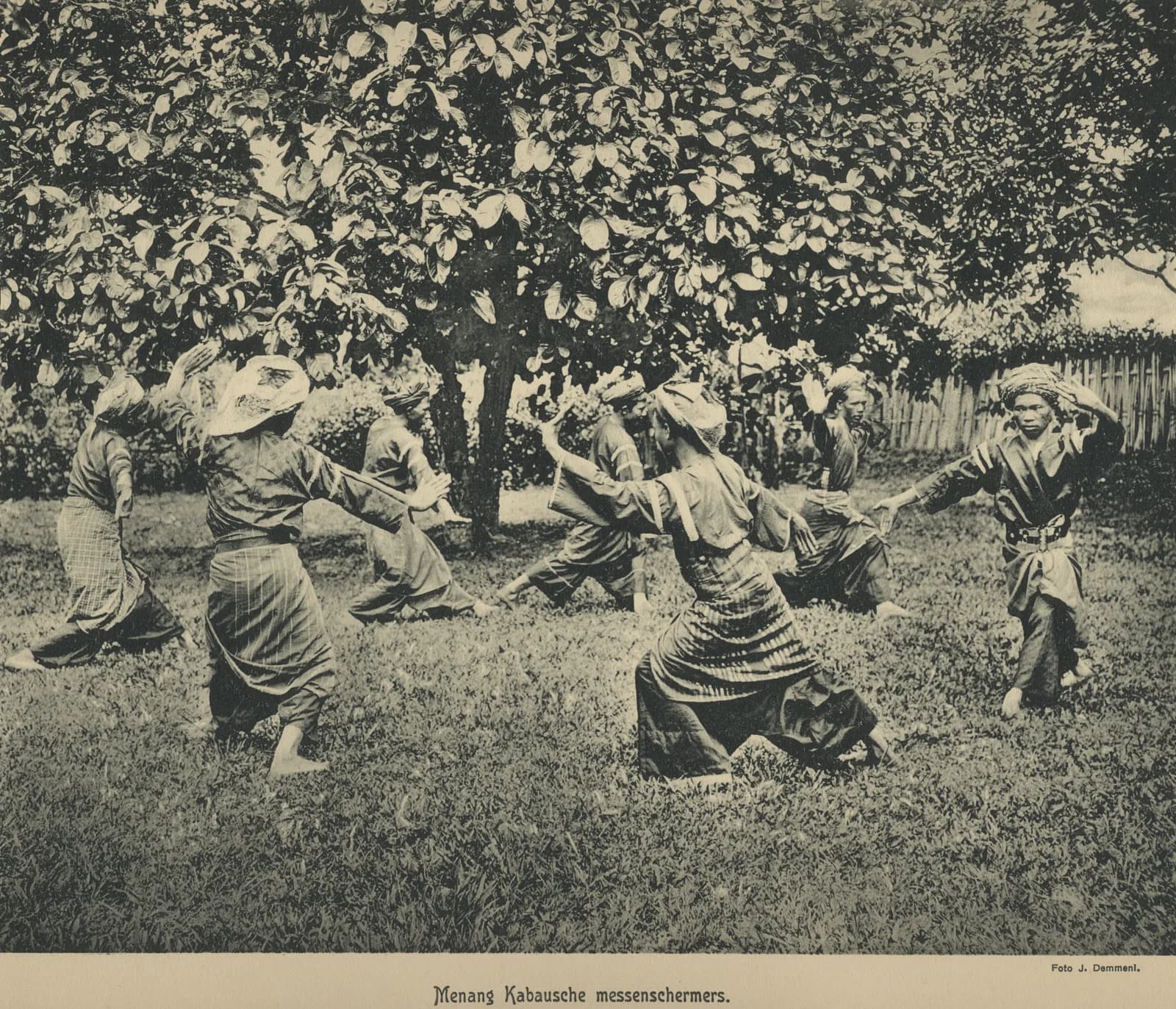
Photo: Minangkabau men practising silat on the west coast of Sumatra, c. 1915. Photograph by Jean Demmeni, KITLV collection, public domain, via Wikimedia Commons.
In this article
Timeline
- 7th–13th c.
The maritime empire of Srivijaya and later Majapahit link Sumatra, Java and the peninsula; court and village fighting traditions develop across the archipelago.
- 15th c.
The Sultanate of Malacca. The Hikayat Hang Tuah, the Malay epic, describes its hero's combat with the kris and unarmed skill – the classic literary image of silat.
- 18th c.
Cimande, the first named Sundanese style of West Java, is attributed to Embah Kahir; Minangkabau silek is taught in the surau of West Sumatra.
- 19th c.
Dutch and British colonial rule. Silat is practised in villages, Islamic schools and secret societies and observed by colonial ethnographers.
- 1948
The Ikatan Pencak Silat Indonesia (IPSI) is founded on 18 May in Surakarta and adopts pencak silat as the national term.
- 1980
Indonesia, Malaysia, Singapore and Brunei found PERSILAT, the international federation, in Jakarta on 11 March.
- 1982
The first World Pencak Silat Championship is held in Jakarta.
- 1987
Pencak silat is contested at the Southeast Asian Games in Jakarta for the first time.
- 2009
The film Merantau, followed by The Raid in 2011, brings silat to international cinema through Iko Uwais and Yayan Ruhian.
- 2018
Pencak silat is a medal sport at the Asian Games in Jakarta; Indonesia wins fourteen of sixteen gold medals.
- 2019
UNESCO inscribes Indonesian pencak silat traditions and Malaysian silat on the Intangible Cultural Heritage list.
In 2018 the Asian Games came to Jakarta, and for the first time pencak silat was on the programme as a medal sport. Indonesia won fourteen of the sixteen gold medals. It was a home win in more senses than one, because the art being contested had been named, organised and given a rulebook by an Indonesian federation only seventy years earlier, out of traditions that had never before agreed they were the same thing.
The short answer: silat is the family of fighting arts of the Malay world – Indonesia, Malaysia, Singapore, Brunei and the south of the Philippines and Thailand – with hundreds of regional styles, a repertoire of blades led by the kris, and a character that mixes combat with dance, music, ethics and, in many schools, religion. It has no founder and no single birthplace. Its literary hero is Hang Tuah of 15th-century Malacca, its oldest named styles date from the 18th century, and its modern form, pencak silat, was organised by the Indonesian federation founded in 1948, made an international sport by four countries in 1980 and inscribed by UNESCO in 2019. What follows is the history of an art that was never one thing.
Key facts
- Region
- Malay Archipelago – Indonesia, Malaysia, Singapore, Brunei, southern Philippines and Thailand
- Literary origin
- Hikayat Hang Tuah, Malacca, 15th–17th century
- Oldest named styles
- Cimande (West Java, 18th c.), Minangkabau silek (Sumatra)
- Modern organisation
- IPSI, Indonesia, 1948; PERSILAT, international, 1980
- Sport
- SEA Games since 1987; Asian Games 2018; categories tanding, tunggal, ganda, regu
- Heritage
- UNESCO Intangible Cultural Heritage, Indonesia and Malaysia, 2019
A thousand villages, each with a beginning
The Malay world is islands and coasts, and its history belongs to the traders, sailors and kingdoms that rose and fell on the straits between the Indian Ocean and the South China Sea. Srivijaya on Sumatra from the 7th century. Majapahit on Java in the 14th. The Sultanate of Malacca in the 15th. Around and between them, the hundreds of smaller courts of Sumatra, Java, Borneo, Sulawesi and the peninsula. Their warriors fought with the spear, the shield and the kris, the wavy-bladed dagger that became the region's symbol, and every court and every village had its own way of teaching them. Indian, Chinese and Arab traders left their marks, Islam arrived from the 13th century, and later so did the Portuguese, the Dutch and the British. Silat is the Malay word for the fighting skill that came out of all this. The historian who goes looking for its beginning finds a thousand villages, each with its own.
The literature is older than the styles. The Hikayat Hang Tuah, the Malay epic set at the court of Malacca and written down by the 17th century, follows the admiral Hang Tuah, his kris Taming Sari and his fights, armed and unarmed, against pirates, rivals and finally his own friend Hang Jebat. He is the classic image of the pendekar, the silat master as loyal warrior, and every Malay style claims his lineage in spirit. Court chronicles, Dutch reports and travellers such as Stamford Raffles describe fighting dances and duels at weddings and festivals, which is how silat was seen for centuries: as a performance that also happened to be training.
The tiger, the flower and the fruit
The named styles begin in the 18th century. In West Sumatra the Minangkabau taught silek in the surau, the village prayer house, as part of a young man's education before he left on the merantau, the journey away from home that Minangkabau culture expects of him. Their styles, silek harimau (tiger), silek tuo (old) and others, are low, ground-hugging and built around the knife. In West Java the Sundanese Cimande, attributed to the 18th-century master Embah Kahir, and its offshoot Cikalong became the parents of dozens of Javanese schools. Central and East Java produced the great brotherhoods of the 20th century, Setia Hati Terate (1922) and Perisai Diri (1955), with hundreds of thousands of members, strong ethical teaching and, in some cases, the mystical training of tenaga dalam, inner power. On the peninsula Silat Seni Gayong, founded by Meor Abdul Rahman in the 1940s, and Silat Cekak are the best-known Malaysian systems, and the Bugis of Sulawesi, the Betawi of Jakarta and the Malays of Patani in southern Thailand all kept their own.
What the styles share matters more than what divides them. A fluid, dance-like movement called bunga, the flower, hides the fighting technique called buah, the fruit. Low stances and sweeps. Joint locks and throws. The kris, the machete-like golok, the sickle sabit and the staff. Music, in the Malay styles the gendang drums and the serunai oboe. And a code that ties the art to religion, to family and to the ruler. A stranger watching a wedding dance might see only the flower. The fruit was for later.
One name for all of it
Under Dutch rule in Indonesia and British rule in Malaya, silat was tolerated as folklore and watched as politics. Fighting arts and secret societies overlapped; silat schools turned up in peasant uprisings and, in the 1940s, in the resistance to the Japanese occupation and the wars of independence that followed. When Indonesia declared independence in 1945 the new state wanted a national art, and on 18 May 1948 the Ikatan Pencak Silat Indonesia (IPSI) was founded in Surakarta. It coined a compound, pencak silat, from pencak, the Javanese word for the performed art, and silat, the Sumatran word for the fighting, and with that one phrase it named a heritage stretching across the islands. Then it started the slow work: registering styles, more than 800 of them in time, writing rules and building a sport.
Malaysia, Singapore and Brunei organised federations of their own after independence, and on 11 March 1980 the four countries founded PERSILAT, the international federation, in Jakarta. The first World Championship followed in 1982. The sport entered the Southeast Asian Games in 1987 and became a medal event at the Asian Games in Jakarta in 2018, which is where this story began. Competitive pencak silat has four categories: tanding, full-contact sparring with points for strikes, sweeps and takedowns, and the forms events tunggal (solo, with weapons), ganda (pairs) and regu (teams). The last three exist so that the sport never loses the flower.
How the rest of the world found out
For most of the world, silat arrived through the cinema. Merantau (2009) and The Raid (2011), directed in Indonesia by the Welsh filmmaker Gareth Evans with the silat practitioners Iko Uwais and Yayan Ruhian, showed the Minangkabau and Javanese styles at full speed, and the same two men then carried silat into the John Wick and Star Wars films. The art had reached Europe and the Americas long before, through emigrants and through Dutch-Indonesian teachers after 1949, and the American researcher Donn Draeger's books of the 1970s had put it into the martial-arts literature. But it was the films that filled the schools.
In 2019 UNESCO inscribed both the Indonesian Traditions of Pencak Silat and Malaysian Silat on its Representative List of the Intangible Cultural Heritage of Humanity, recognising a living tradition with ethical, social and spiritual dimensions as well as fighting ones. That is the paradox silat has always carried and never needed to resolve: a martial art that is also a dance, a sport that is also a ceremony, and a national symbol in four countries that was never, until 1948, one art at all.
Where to go next
- The silat discipline hub collects training articles, workouts and gear.
- The blade arts of the neighbouring archipelago: The History of Kali, Eskrima and Arnis.
- Another Southeast Asian art shaped by royal patronage and sport: The History of Muay Thai.
- Hip mobility for low stances: Kettlebell Strength for Fighters.
Sources
- UNESCO – Traditions of Pencak Silat (Indonesia, 2019) and Silat (Malaysia, 2019)
- Donn F. Draeger, Weapons and Fighting Arts of Indonesia (Tuttle, 1972)
- Ian Douglas Wilson, The Politics of Inner Power: The Practice of Pencak Silat in West Java (PhD thesis, Murdoch University, 2002)
- Sheikh Shamsuddin, The Malay Art of Self-Defense: Silat Seni Gayong (North Atlantic Books, 2005)
- PERSILAT – International Pencak Silat Federation
- Wikipedia: Silat
- Wikipedia: Pencak silat
- Wikipedia: Hikayat Hang Tuah
Frequently asked questions
- What is the difference between silat and pencak silat?
- Silat is the general Malay word for the fighting arts of the archipelago, used in Malaysia, Singapore and Brunei. Pencak silat is the Indonesian compound adopted in 1948, joining the Javanese pencak (the performed, artistic side) with the Sumatran silat (the fighting side), and it is the name of the international sport.
- Where does silat come from?
- From the whole Malay world – Sumatra, Java, the Malay Peninsula, Borneo, Sulawesi and the southern Philippines – with no single origin. Village and court traditions, Islamic schools, Chinese and Indian influences and the requirements of kris and blade fighting all contributed, and hundreds of regional styles resulted.
- How many styles of silat are there?
- Indonesia's federation has registered more than 800 styles, and Malaysia recognises dozens more. Well-known ones include Cimande and Cikalong (West Java), Minangkabau silek harimau (Sumatra), Setia Hati Terate and Perisai Diri (Java), Silat Seni Gayong and Silat Cekak (Malaysia).
- Is silat a religious or spiritual practice?
- Often, yes. Many styles are taught in Islamic boarding schools and include prayers, ethical codes and, in some Javanese schools, inner-power (tenaga dalam) training; others are purely sporting. The relationship between silat and Islam, and older animist and Hindu-Buddhist elements, varies by region.
- Is pencak silat an Olympic sport?
- No. It is contested at the Southeast Asian Games since 1987 and was a medal sport at the 2018 Asian Games in Jakarta. Its federation PERSILAT campaigns for wider recognition; the sport's four categories are tanding (sparring) and the forms events tunggal, ganda and regu.
- Which films show real silat?
- Merantau (2009) and The Raid (2011, The Raid 2 in 2014), with the silat practitioners Iko Uwais and Yayan Ruhian, are the best-known; both use Minangkabau and Javanese styles. Silat also appears in Malaysian films and in the John Wick series through the same performers.