History
The History of Kali, Eskrima and Arnis: The Filipino Martial Arts
How the stick and blade arts of the Philippines survived Magellan, Spain and America, took three names, and became a national sport and a worldwide system.
6 min read · 20 September 2026 · updated 21 September 2026
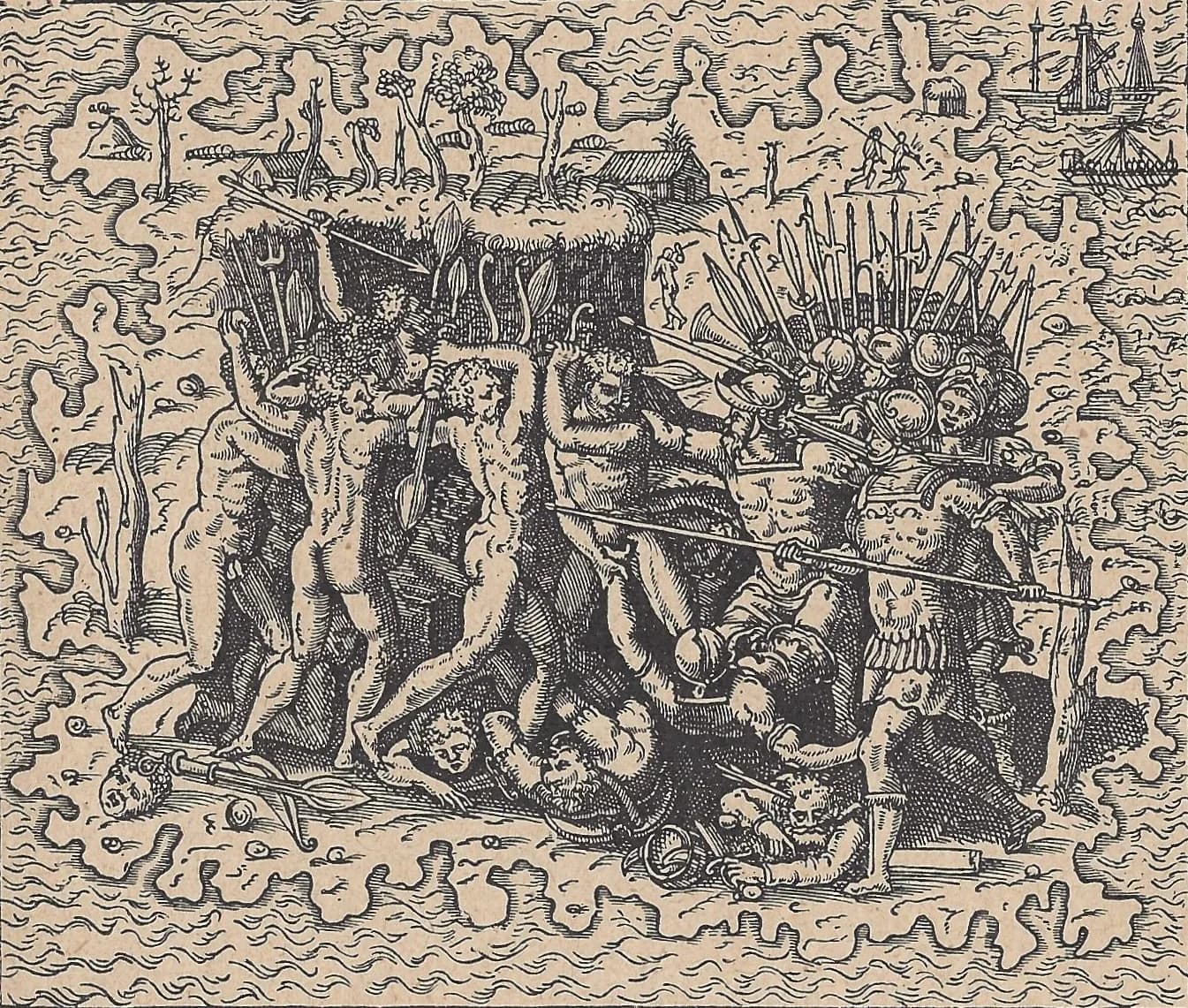
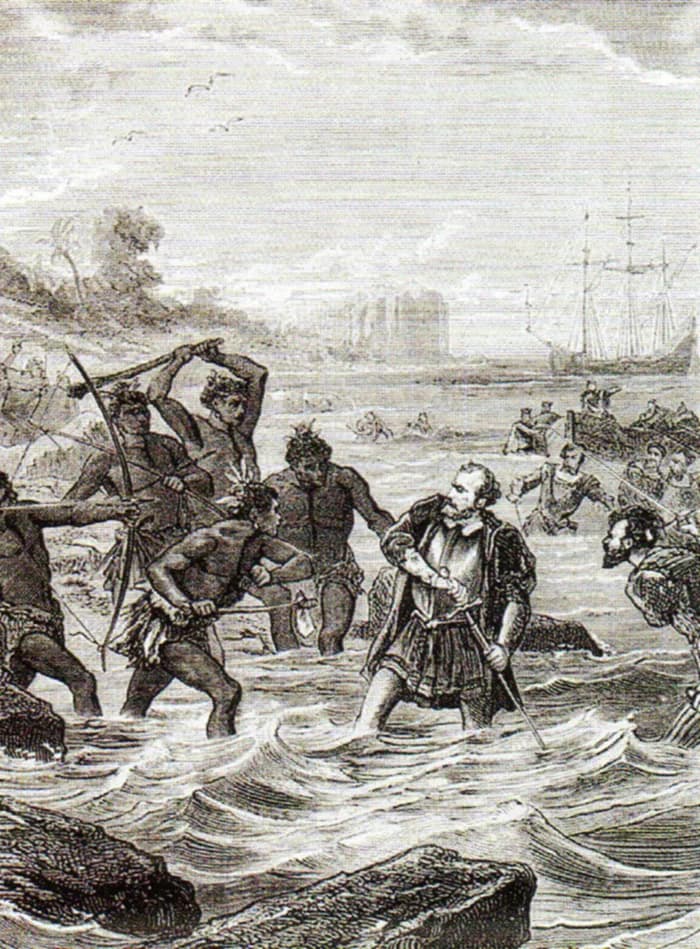
Photo: The death of Magellan at Mactan, 27 April 1521, in a 16th-century engraving. Public domain, via Wikimedia Commons.
In this article
Timeline
- 1521
Ferdinand Magellan is killed at Mactan by the warriors of Lapulapu, armed with spears, bladed weapons and fire-hardened stakes – the first written record of Filipino fighting.
- 1565
Spain begins its colonisation of the islands. Native weapons arts continue, taught within families and villages.
- 17th–18th c.
Spanish fencing terms enter the arts – esgrima becomes eskrima – and the moro-moro plays with staged sword fights give arnis its name, from the Spanish arnés.
- 1898
The Philippine Revolution and the Spanish–American War; Filipino fighters with bolos face Spanish and then American troops.
- 1900s–1910s
In Cebu and Manila, family systems are taught openly; the Saavedra and Cañete families lay the foundations of the Cebuano schools.
- 1932
The Doce Pares club is founded in Cebu City, the first formal eskrima organisation.
- 1952
Venancio “Anciong” Bacon founds Balintawak in Cebu, the close-range counterpart to Doce Pares.
- 1957
Placido Yambao's Mga Karunungan sa Larong Arnis, the first book on the art in a Philippine language, uses the term kali for the ancient art.
- 1960s–1970s
Remy Presas develops Modern Arnis and takes it to the United States in 1975; Dan Inosanto, Bruce Lee's training partner, popularises the name kali in America.
- 1987
The World Eskrima Kali Arnis Federation (WEKAF) is founded in Cebu; the first World Championships follow in 1989.
- 2009
Republic Act 9850 declares arnis the national martial art and sport of the Philippines.
- 2019
Arnis is contested at the Southeast Asian Games in Manila with fourteen gold medals.
On 27 April 1521 Ferdinand Magellan, having claimed Cebu for Spain, landed on the neighbouring island of Mactan to punish its chief, Lapulapu. He did not get back to the boats. Antonio Pigafetta, the Italian who kept the expedition's chronicle and was there that day, recorded the islanders' spears and bamboo lances, the fire-hardened stakes and poisoned arrows, and the “large cutlass” that finished the captain in the shallows, along with about forty of his men. It is the first written account of Filipino fighting, and it was written by the side that lost.
Here is what happened next. The stick and blade arts of the Philippines passed through three empires and came out with three names – arnis, eskrima and kali – then travelled from backyards in Cebu to seminar halls in California and, in 2009, into Philippine law. They are the only major martial-arts family that puts a weapon in a beginner's hand on the first day, and that is not a quirk of style. It is the whole story.
Key facts
- Names
- Arnis (Luzon), eskrima (Visayas), kali (20th-century term for the older art)
- First record
- Battle of Mactan, 27 April 1521 – Magellan killed by Lapulapu's warriors
- Weapons first
- Rattan stick as stand-in for sword and bolo; knife; empty hands as a subset
- Modern schools
- Doce Pares (Cebu, 1932), Balintawak (1952), Modern Arnis (1960s), Inosanto Kali
- Sport body
- WEKAF, founded 1987; Philippine national sport by law since 2009
- In the world
- Via Dan Inosanto and Remy Presas from the 1970s; in film through Inosanto and his students
Mactan, 1521: the first record
The islands had no single state before Spain, but they had warriors. The chiefdoms of the Visayas and Luzon fought one another and raided by sea, and their men went into it with spears, shields and a long knife or sword – the kampilan in the south, the bolo elsewhere – and, the earliest Spanish observers agreed, considerable skill. Mactan was meant to be a lesson to Cebu's neighbour. The lesson ran the other way. Every arnis school in the country now claims Lapulapu as its own, and not one of them can say what system, if any, his men had trained in. Pigafetta describes weapons, not a method.
Spain came back in 1565 and stayed for 333 years. Colonial accounts mention native fencing and a ban on carrying weapons in the towns, and the arts did what such arts do under a ban: they went home. They lived in families, in villages a long walk from the nearest friar, in fiesta demonstrations and in the moro-moro, folk plays in which Christian and Muslim characters fought staged battles for the crowd. Two of the three names come off that stage. Eskrima is the Spanish esgrima, fencing; arnis is arnés, the harness or armour the players wore for their sword fights. The decree of 1764 by which Spain is so often said to have banned arnis outright appears in no archive. The arts were suppressed, disguised and Hispanicised, which is a different thing, and a more interesting one.
Cebu: the birth of the schools
In 1898 the Philippine Revolution against Spain ran into the Spanish–American War, and that ran into the bloody Philippine–American War, in which men with bolos faced American rifles. What followed the fighting was public schools, organised sport and, for the first time, permission to teach the old arts in the open. They came out of the families almost at once. In Cebu City the Saavedra and Cañete families had taught eskrima privately for generations; in 1932 they joined to found Doce Pares, the first formal eskrima club, named “twelve pairs” after the twelve knights of Charlemagne who marched through the moro-moro plays. Its members fought challenge matches in the 1930s, some of them to the death. Its most famous fighter, Lorenzo Saavedra, was killed by the Japanese during the occupation. After the war the Cañete brothers, above all Cacoy Cañete, built what remained into the largest system in the Philippines.
Its great rival came from inside the clubhouse. Venancio “Anciong” Bacon was a Doce Pares member who had decided that the club's long-range style was impractical, and in 1952 he founded Balintawak, named for the street where his backyard group met. Bacon's method was single stick and close range, built on counters and disarms, and it has been called the most technical of the Cebuano systems. Between them the two clubs marked out the poles of eskrima – the largo mano of long range and the corto of close – and most systems founded since have chosen a spot on the line between a Cebu clubhouse and a Cebu backyard.
Three names and a national art
Of the three names, kali is the youngest. The Cebuanos said eskrima, the Tagalogs said arnis, and kali first turns up in print in 1957, in Placido Yambao's Mga Karunungan sa Larong Arnis, the first book on the art in a Philippine language, where it names the pre-Spanish blade art from which arnis supposedly descends. Whether any such single art ever existed is doubtful, and the etymologies on offer – kalis, a blade, or a word meaning “to scrape” – are guesses. The name stuck for a reason that had nothing to do with the Philippines. Dan Inosanto, a Filipino-American who was Bruce Lee's training partner and heir, taught the arts as kali in California from the 1960s, and through his school and Lee's film Game of Death kali became the word Americans learned. When the Philippine government's turn came, it chose arnis.
The other great exporter was Remy Presas (1936–2001), a Cebuano who took what he had learned from Balintawak and other sources, systematised it as Modern Arnis in the 1960s, taught it in Philippine schools and moved to the United States in 1975, where his seminars produced a generation of instructors. Through Presas and Inosanto, and through the Filipino diaspora in Hawaii, California and the US military, the arts reached the wider martial-arts world at the same moment as Bruce Lee's films. For a family of arts with modest numbers, the reach is out of all proportion: knife defence in military and law-enforcement training, the fight choreography of Hollywood, and the way mixed martial arts thinks about weapons all carry Filipino fingerprints.
Sport and law
Competition arrived in the 1980s. The World Eskrima Kali Arnis Federation (WEKAF) was founded in Cebu in 1987 and held its first world championships in 1989, with two disciplines: padded-stick sparring in body armour and helmets, and anyo, the forms. The Philippine federations built a national sport on the same model, and arnis was contested at the Southeast Asian Games in 2005 and again in Manila in 2019, with fourteen gold medals on the table. Then, in December 2009, Republic Act 9850 declared arnis the national martial art and sport of the Philippines, mandated its teaching in schools and placed its symbol in the national sports commission's emblem. Lapulapu's warriors, the fiesta fencers under the friars and the men in the Cebu backyards had never had anything of the kind.
Today there are hundreds of systems – Doce Pares and Balintawak, Modern Arnis, Inosanto Kali, Pekiti-Tirsia, Lameco, Kalis Ilustrisimo, Lightning Scientific Arnis and any number of family lines – and they share a method no other martial art uses. The weapon comes first. The rattan stick stands in for the sword. The angles of attack are numbered, so that a defence learned against a stick works against a knife or a fist, and the footwork exists to take you off the line of a blade. Call it what you like; the method is what the Philippines gave the fighting arts.
Where to go next
- Training articles, workouts and gear are collected in the kali / eskrima discipline hub.
- The blade culture next door in the archipelago: The History of Silat.
- The European fencing that lent eskrima its vocabulary: The History of Fencing.
- Footwork that gets you off the line: Jump Rope Conditioning.
Sources
- Antonio Pigafetta, The First Voyage Around the World (1524; Hakluyt Society editions)
- Mark V. Wiley, Filipino Martial Culture (Tuttle, 1996)
- Republic of the Philippines, Republic Act No. 9850 (2009) – declaring arnis the national martial art and sport
- World Eskrima Kali Arnis Federation – History
- Wikipedia: Arnis
- Wikipedia: Battle of Mactan
- Wikipedia: Doce Pares
- Wikipedia: Remy Presas
Frequently asked questions
- What is the difference between kali, eskrima and arnis?
- They are three names for the same family of Filipino weapon arts. Eskrima (from the Spanish esgrima, fencing) and arnis (from arnés, harness) are the historical names used in the Visayas and Luzon; kali was popularised in the 20th century, first by Filipino authors and then by Dan Inosanto in the United States, as a name for the supposedly older, pre-Spanish art. In practice the terms mark regions and lineages, not different systems.
- Why do Filipino martial arts start with weapons?
- Because they were built for the blade. Training begins with the rattan stick as a safe substitute for the sword or bolo; the same angles, footwork and disarms then apply to knives, the empty hand and improvised weapons. Learning the weapon first makes the empty-hand methods a subset, not a separate art.
- Did Lapulapu use kali against Magellan?
- Pigafetta, the eyewitness, describes Lapulapu's men fighting with spears, bamboo lances, fire-hardened stakes and “cutlasses”, and killing Magellan with a lance and blades. That is the first record of Filipino weapon fighting, but no source calls it kali or describes a system; the name and the systematic arts come much later.
- Is arnis really banned by the Spanish?
- The often-repeated claim that Spain banned arnis in 1764 has no documentary basis. The arts were certainly restricted, discouraged and disguised under colonial rule, and Spanish fencing vocabulary shows how much contact there was, but a formal ban is a modern legend.
- What are the main styles?
- Hundreds of family and regional systems. The best known are the Cebuano schools – Doce Pares (1932) and Balintawak (1952) – and the international systems built from them: Modern Arnis (Remy Presas), Inosanto Kali, Pekiti-Tirsia, Lameco, Kalis Ilustrisimo and Lightning Scientific Arnis.
- Is arnis a sport?
- Yes, since the 1980s. WEKAF and the Philippine federations hold competitions in padded-stick sparring with armour and in anyo (forms). Arnis has been the national sport of the Philippines since 2009 and was contested at the 2019 Southeast Asian Games.