History
The History of Fencing: From the Duel to the Electric Piste
How the sword schools of Renaissance Italy and France turned the duel into a science, invented foil, mask and sabre, and became a founding Olympic sport.
7 min read · 20 September 2026 · updated 21 September 2026
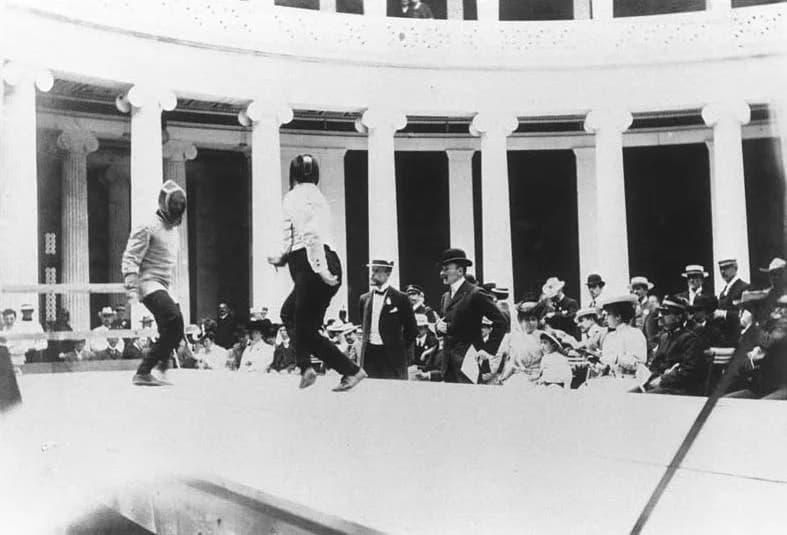
Photo: A fencing bout at the Athens Olympics of 1896. Public domain, via Wikimedia Commons.
In this article
Timeline
- c. 1300
The oldest surviving European fencing manual, the German manuscript I.33, illustrates sword-and-buckler techniques taught by a priest.
- 14th–15th c.
The tradition of Johannes Liechtenauer's longsword teaching spreads through the German fencing masters; Fiore dei Liberi writes his Italian treatise around 1410.
- 1536
Achille Marozzo of Bologna publishes Opera Nova, the most complete manual of the Italian Renaissance schools.
- 1553
Camillo Agrippa's Trattato di Scientia d'Arme applies geometry to the sword and simplifies the guards – the birth of the thrusting rapier school.
- 1567
King Charles IX grants letters patent to the Académie des Maîtres en fait d'Armes de Paris, the French masters' guild.
- 17th c.
The lighter smallsword replaces the rapier; the French school's foil, a practice weapon with a buttoned point, and its conventions of right of way take shape.
- c. 1780
The Paris master La Boëssière introduces the wire-mesh mask, making fast, safe practice possible.
- 1860s
Giuseppe Radaelli in Milan founds the modern sabre school for the Italian cavalry; the épée, a dueling sword for competition, follows in the 1880s.
- 1896
Foil and sabre are contested at the first modern Olympic Games in Athens – the only sport in which professional masters were allowed a separate event.
- 1913
The Fédération Internationale d'Escrime is founded in Paris on 29 November.
- 1924
Women's foil enters the Olympic programme in Paris.
- 1936
The electric épée is used at the Berlin Olympics; electric foil follows in 1956 and sabre in 1988.
- 2004
Women's sabre completes the programme; all six individual events are Olympic.
Paris, around 1780. A fencing master called La Boëssière puts a mesh of wire over a student's face and tells him he can now attack at full speed. The fencers of Europe look at the contraption and reach the obvious conclusion: the man is a coward. They go on saying so for decades, and they go on fencing carefully, because a sword point near an unprotected eye makes everyone careful. The mask won in the end. It is the reason the sport looks the way it does.
Here is the shape of the story. Europe wrote down its sword-fighting from about 1300, the Italians turned it into a science in the 16th century, the French gave it a practice weapon and its rules of conduct in the 17th and 18th, and the mask made it fast. The three modern weapons – foil, épée and sabre – were fixed in the 19th century, and when the Olympic Games were revived in Athens in 1896, fencing was on the programme. It has been on every one since. This is the road from the fight-books of medieval Germany to the electric piste, and why the world's oldest surviving combat-sport tradition still behaves like a duel.
Key facts
- Oldest manual
- I.33 (Germany, c. 1300); Fiore dei Liberi (Italy, c. 1410)
- Italian science
- Marozzo 1536, Agrippa 1553, Capo Ferro 1610 – the rapier schools
- French school
- Académie d'Armes 1567; smallsword, foil and right of way, 17th–18th c.
- Safety
- Wire mask, La Boëssière, Paris, c. 1780
- Modern weapons
- Foil (practice), épée (dueling, 1880s), sabre (Radaelli, Milan, 1860s)
- Sport
- Olympics since 1896; FIE founded 1913; electric scoring 1936–1988
A priest with a sword, about 1300
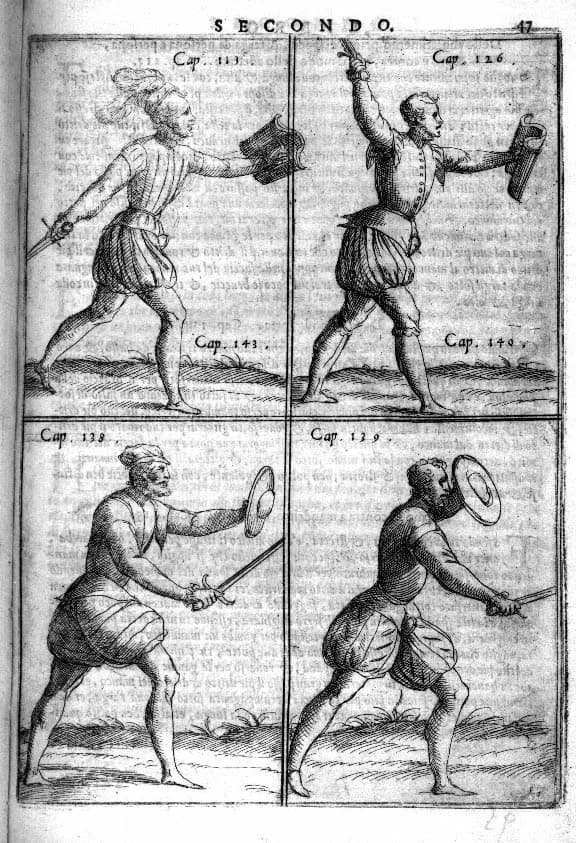
The oldest fencing manual in Europe shows a priest teaching. The German manuscript known as I.33, from about 1300, lays out dozens of illustrated plays with sword and buckler, cleric and student working through them, and it settles one question before anyone can ask it: the sword was taught systematically in the Middle Ages, by people who wrote things down. It was the first of a genre. In the 14th century Johannes Liechtenauer left his longsword teaching in verse, and generations of German masters – Ringeck, Talhoffer, Paulus Kal – glossed and illustrated it; around 1410 the Italian Fiore dei Liberi wrote his Flower of Battle, which runs from wrestling and dagger through sword and spear to fighting in armour, on foot and on horseback. The audience was knights, judicial duellists and the men who trained them. Since the 1990s the historical European martial arts movement has been reconstructing these systems from the pages, and they turn out to be as sophisticated as anything in Asia.
The Renaissance printed them. Achille Marozzo's Opera Nova of 1536, from the school of Bologna, is a complete syllabus of the civilian weapons of its day – sidesword with buckler, two-handed sword, sword and dagger, sword and cloak – and the first manual to reach a wide readership. Seventeen years later an engineer, not a professional master, published a treatise that changed everything.
Agrippa draws a line through the guards
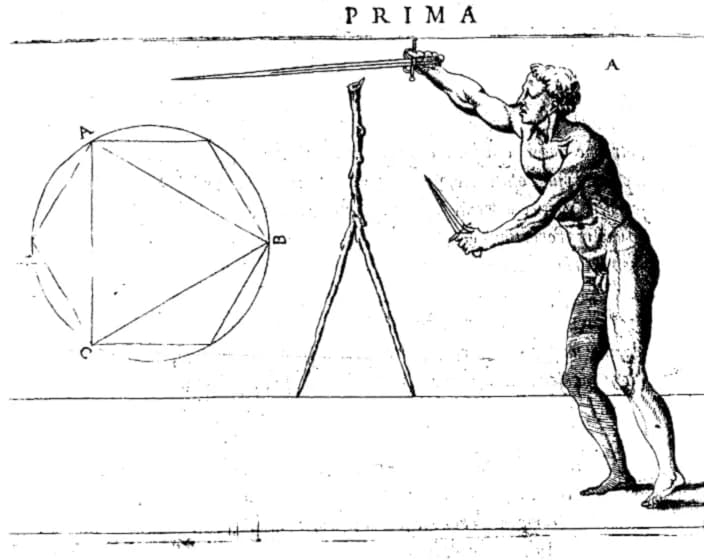
Camillo Agrippa was an engineer, and his Trattato di Scientia d'Arme of 1553 reads like one: geometry applied to the sword. The thrust, he argued, travels a shorter line than the cut and arrives more reliably. The many guards of the old schools could be reduced to four. The body should stand sideways, sword arm forward. Out of those three ideas came the rapier – long, narrow, civilian, built for the thrust – and by 1600 every gentleman in Europe carried one and a generation of Italian masters taught him what to do with it: Giacomo di Grassi, Salvator Fabris, whose 1606 treatise served the Danish court, and Ridolfo Capo Ferro, whose Gran Simulacro of 1610 codified the lunge. The Italians spread across the continent. Elizabethan London complained about their fatal influence on the young, and Shakespeare had Mercutio die of Tybalt's Italian thrust.
What paid for all this science was the duel. Between the 16th and 18th centuries tens of thousands of European gentlemen died in private duels, illegal almost everywhere and fought everywhere, and the sword schools existed to keep their students out of that number. The sport that grew from them never lost the duel's logic. One touch decides.
France writes the rules of conduct
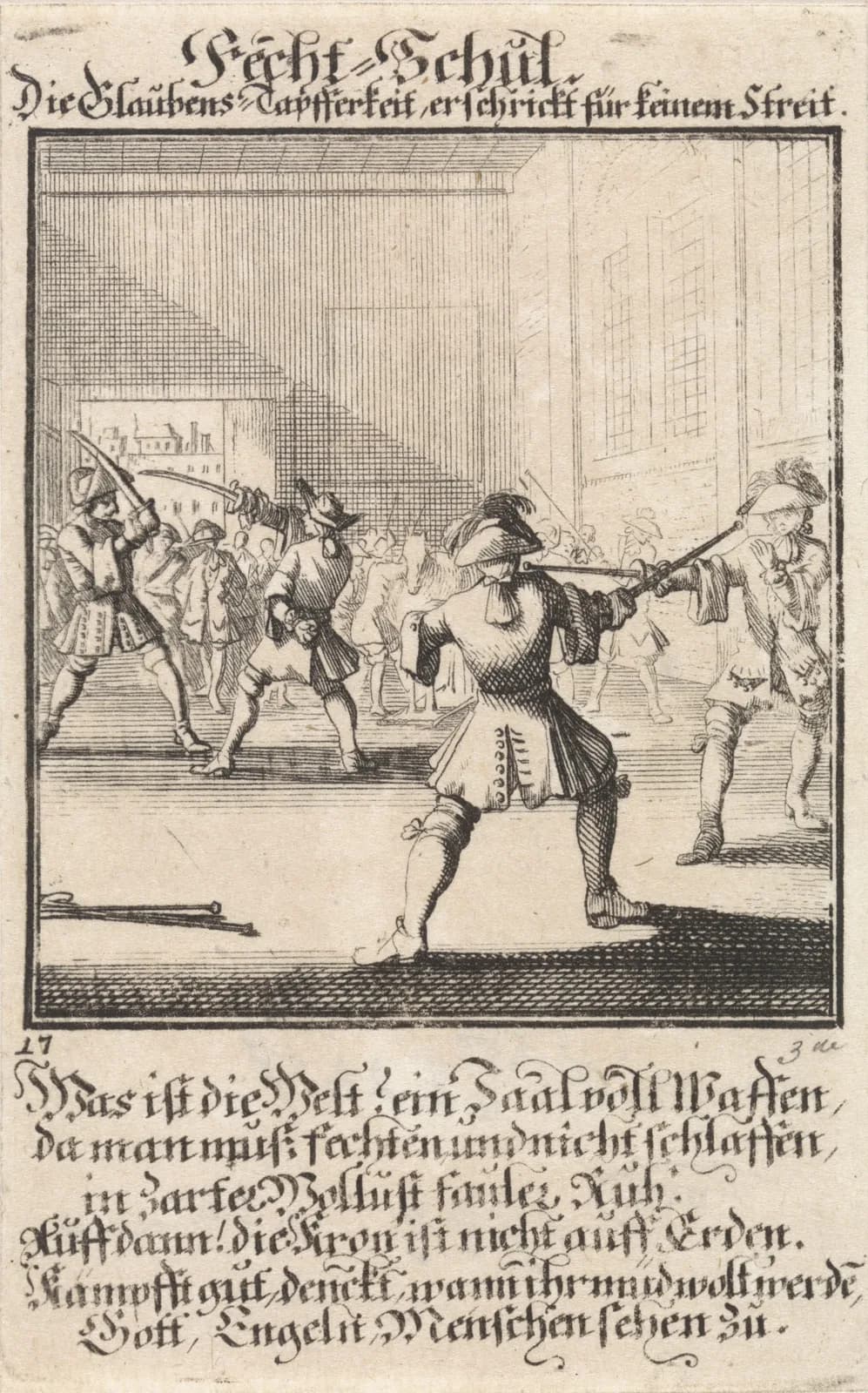
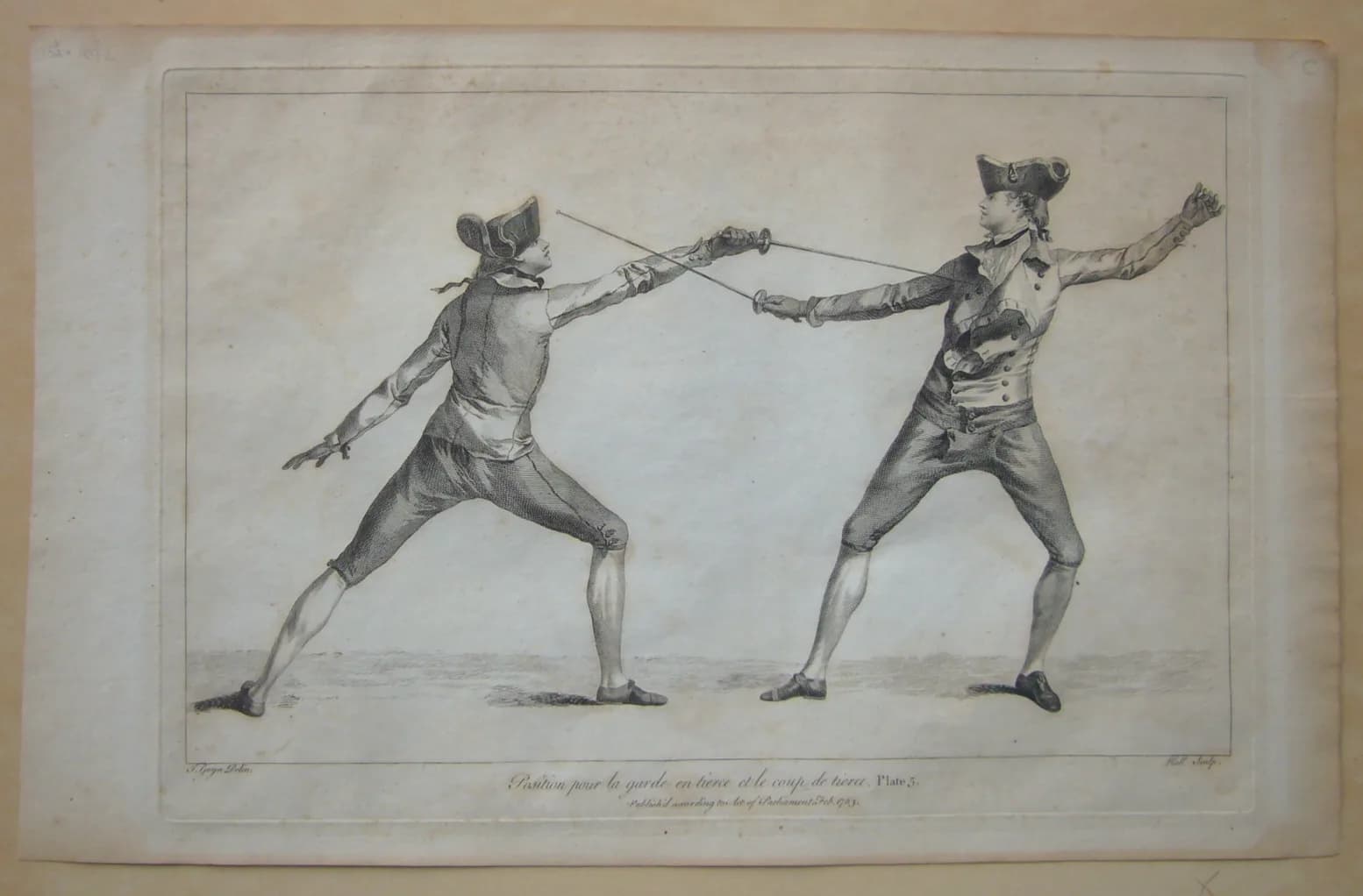
In the 17th century the lead crossed the Alps. France had had a masters' guild since 1567, when Charles IX granted letters patent to the Académie des Maîtres en fait d'Armes de Paris, and it policed who could teach for the next two centuries. Under Louis XIV the rapier gave way to the smallsword, shorter, lighter and used almost entirely for the thrust, and the French masters – Le Perche, Liancour, Girard, then Danet in the 18th century and the London-based Italian Domenico Angelo, whose École des Armes of 1763 is the most beautiful manual of the age – built a system around it. Parries numbered by position. Ripostes, feints. And one convention that mattered more than any technique: a fencer must parry an attack before counter-attacking. That rule became the sport's right of way, and foil and sabre are still judged by it.
Practice needed a safe weapon and a safe face. The weapon came first: the foil, a light blunted sword with a buttoned point, was the smallsword's training version from the 17th century (fleuret, from the flower-like button). The face took another hundred years and the argument this article opened with. La Boëssière's wire mask, around 1780, was resisted for decades by fencers who thought it cowardly. Once it was accepted the art changed character. Fencers could attack at full speed without fear, and out of that came the fast, mobile foil fencing of the 19th century, with its phrase of attack, parry and riposte, which is the direct parent of the Olympic sport.
Three weapons and a sport
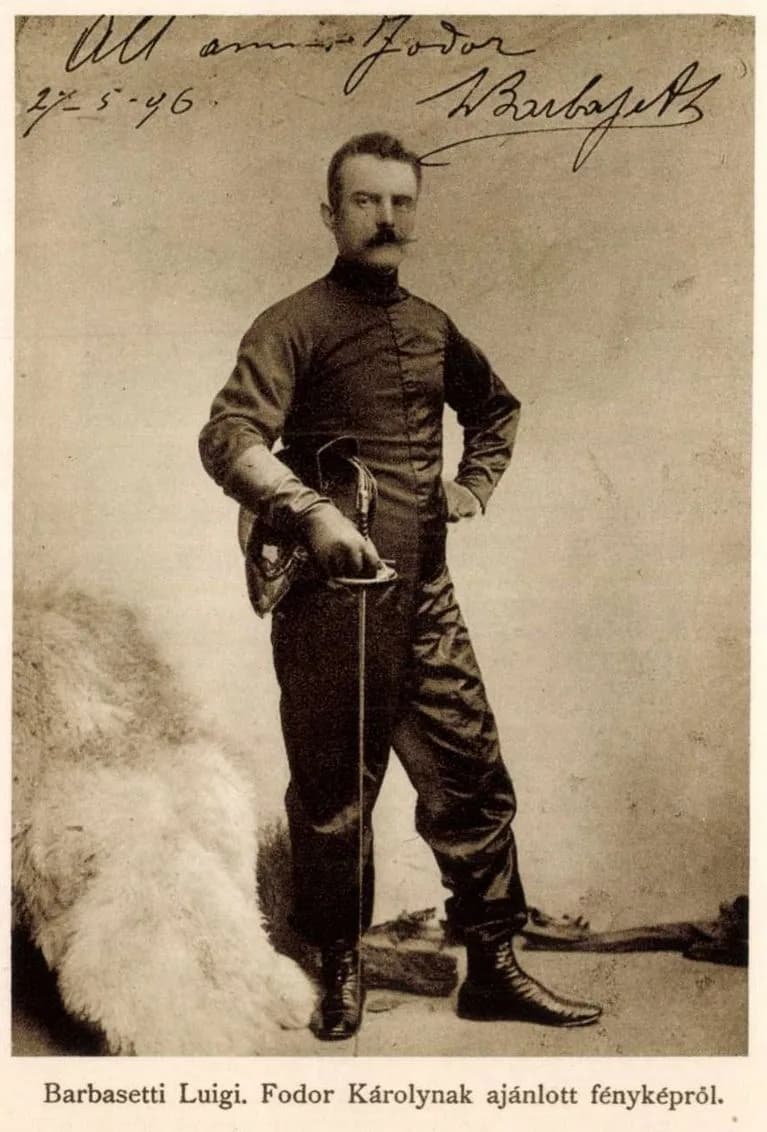
The 19th century fixed the weapons. Duelling with the sword declined but did not stop, and the duellists who found the foil's conventions artificial revived a heavier thrusting sword scored on the whole body with no right of way: the épée de combat, taught from the 1880s and the closest thing to a real duel the sport has. The sabre rode in from the cavalry. Giuseppe Radaelli, a Milanese master, built a school of light-sabre fencing for the Italian army in the 1860s, and his students carried it east – Italo Santelli to Budapest, Luigi Barbasetti to Vienna – into the Austro-Hungarian empire, where Hungarian fencers made the sabre their national weapon and dominated it for most of the 20th century.
Then Athens, 1896. Fencing was at the first modern Olympic Games with foil and sabre events and, uniquely, a separate event for professional masters, who were otherwise banned from the amateur Games. Épée followed in 1900, women's foil in 1924, women's épée in 1996 and women's sabre in 2004. The Fédération Internationale d'Escrime was founded in Paris on 29 November 1913 and wrote one set of rules for everyone, and the Italian and French schools, joined later by the Hungarians, Soviets, Germans, Koreans and Americans, fought over the medals. The classic names: Nedo and Aldo Nadi of Italy, Edoardo Mangiarotti with thirteen Olympic medals, the Hungarian sabreurs Aladár Gerevich and Pál Kovács, and Russia's Valentina Sidorova.
A lamp instead of an argument
Judging a touch by eye had always ended in a dispute, so the last transformation was electrical. At the Berlin Olympics of 1936 an electric épée closed a circuit at the point and lit a lamp. Electric foil, which needed a conductive jacket to tell valid target from invalid, followed in 1956, and electric sabre, the hardest problem of the three, in 1988. The wiring changed the fencing – the flick hit in foil, the whip-over in sabre – and forced rule change after rule change, including the shortened timings introduced in the 2000s so that television could follow a bout. Today it is fought on a 14-metre piste under FIE rules in more than 150 countries, with world championships since 1921 and a world cup circuit, and it remains one of only five sports contested at every modern Olympic Games.
Alongside the sport, the older arts have come back. The historical European martial arts movement has grown since the 1990s into clubs and tournaments across Europe and the Americas, reconstructing longsword, rapier and sabre from the fight-books, so that Liechtenauer's longsword and Marozzo's sword and buckler are practised again, with steel, after five centuries. Fencing, in both its forms, is the European martial art that never stopped.
Where to go next
- The fencing discipline hub collects training articles, workouts and gear.
- Japan's parallel road from sword school to sport: The History of Kendo.
- The Filipino arts that borrowed Spanish fencing's vocabulary: The History of Kali, Eskrima and Arnis.
- Footwork and explosive legs, the fencer's engine: Jump Rope Conditioning.
Sources
- Fédération Internationale d'Escrime – History of fencing
- Sydney Anglo, The Martial Arts of Renaissance Europe (Yale University Press, 2000)
- Richard Cohen, By the Sword: A History of Gladiators, Musketeers, Samurai, Swashbucklers, and Olympic Champions (Random House, 2002)
- International Olympic Committee – Fencing
- Wikipedia: Fencing
- Wikipedia: History of fencing
- Wikipedia: Camillo Agrippa
- Wikipedia: Fencing at the 1896 Summer Olympics
Frequently asked questions
- What are the three fencing weapons?
- Foil, a light thrusting weapon scored on the torso with right-of-way conventions; épée, a heavier thrusting weapon scored anywhere on the body without right of way, closest to the duel; and sabre, a cutting and thrusting weapon scored on the body above the waist with right of way. Each has its own history and technique.
- Where does modern fencing come from?
- From the Italian and French sword schools of the 16th and 17th centuries, which turned the rapier and then the smallsword into a science of thrusts, parries and timing. The foil was the French practice weapon, the épée a 19th-century return to dueling realism, and the sabre came from the cavalry through Italy and Hungary.
- Why do fencers wear masks?
- Because before the 1780s they could not practise at full speed. The wire-mesh mask, introduced in Paris by the master La Boëssière around 1780, removed the fear of losing an eye and allowed the fast, continuous fencing that defines the modern sport.
- What is right of way?
- The rule in foil and sabre that when both fencers hit, the point goes to the one who attacked first or correctly parried and riposted. It comes from the smallsword schools' teaching of defence before counter-attack and does not apply in épée, where a double hit scores for both.
- Has fencing always been in the Olympics?
- Yes. Foil and sabre were contested at Athens in 1896, épée from 1900, women's foil from 1924, women's épée from 1996 and women's sabre from 2004. Fencing is one of only five sports on every modern Olympic programme.
- What is the difference between fencing and HEMA?
- Sport fencing descends from the smallsword schools and is fought with three standardised weapons under Olympic rules. HEMA, historical European martial arts, is a revival since the 1990s of the older systems – longsword, rapier, sword and buckler – reconstructed from the medieval and Renaissance manuals.