Training
The Muay Thai Roundhouse Kick: Six Common Mistakes and How to Fix Them
Kicking with the foot, no pivot, no hip, a chambered knee, a dropped hand: six mistakes that turn the hardest strike in stand-up into a slap, and the fix.
8 min read · 20 September 2026 · updated 21 September 2026
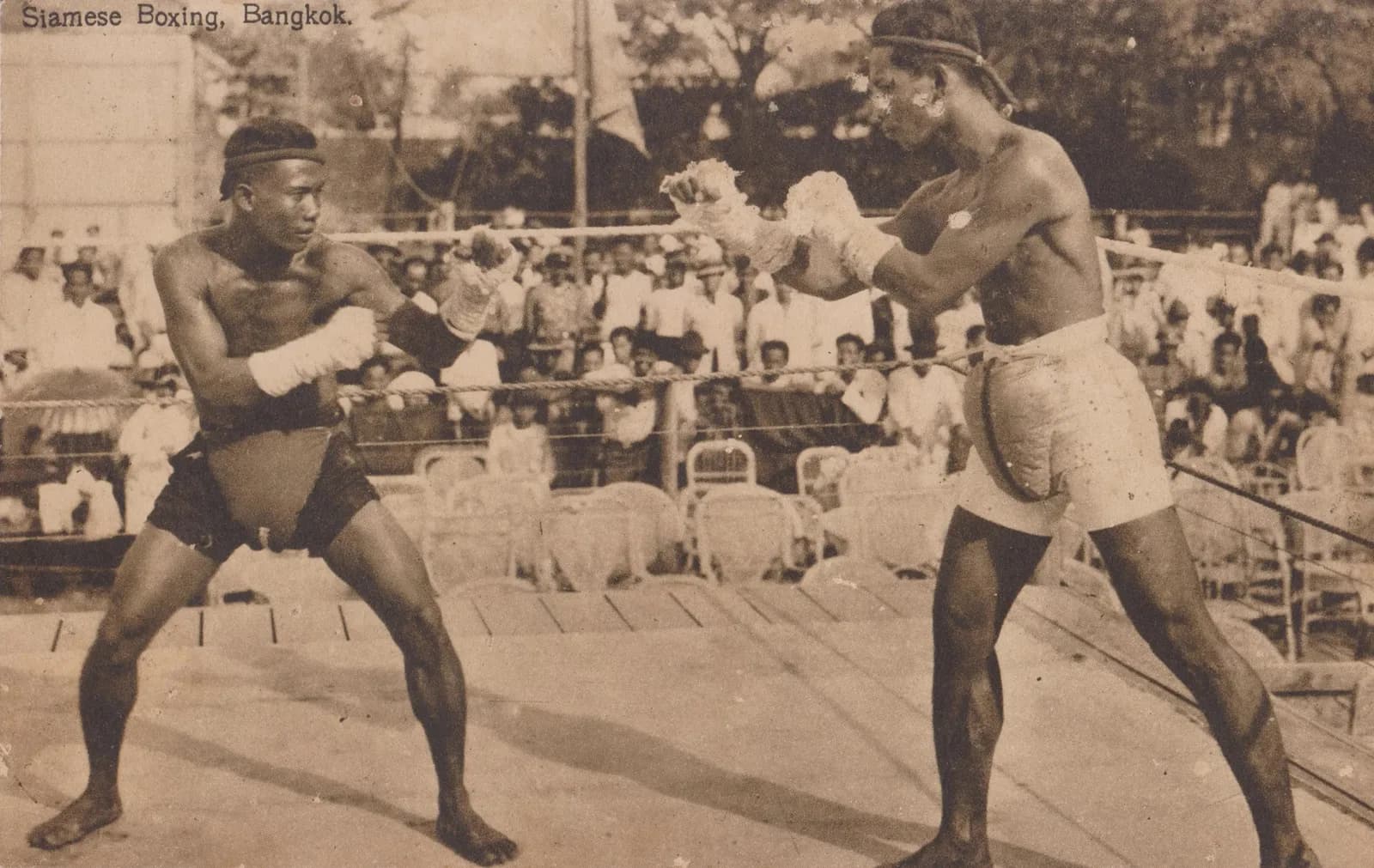
Photo: Siamese boxing, Bangkok, 1920s. Public domain, via Wikimedia Commons.
In this article
The first time you hear a proper Thai kick land on a heavy bag you will look round to see who dropped something. It is the most powerful strike in stand-up fighting and the one beginners get wrong for the longest time, because it works differently from every other kick they have ever seen. It is not a snap. It is not a leg lift. It is a swing of the whole body, delivered with the shin, in which the leg is the last thing to move, and until your hip understands that, you are going to sound like someone patting a cushion.
The short answer: pivot the standing foot, turn the hip over, hit with the shin, keep the other hand on your head. Every mistake below is a way of not doing one of those, and every one has a fix a Thai trainer would give you with a tap of the pad and a single word. The word is usually "hip".
The six mistakes
- 1
- Kicking with the foot instead of the shin
- 2
- Not pivoting the standing foot
- 3
- Not turning the hip over
- 4
- Chambering the knee like a karate kick
- 5
- Dropping the guarding hand
- 6
- Kicking from too close, or stopping at the target
1. You are kicking with a bag of small bones
What the trainer sees: The kick lands on the instep or the ankle, the foot is pointed like a footballer's, and after three rounds on the bag the top of your foot is the colour of a plum.
Why your body does it: Every other kick you know – football, karate, the one from the film – uses the foot, and the foot is further away, so it reaches. You are also standing too far from the bag.
What it costs: Power and bones. The instep is twenty-six small bones held together by hope; it breaks on an elbow, a knee or a hard block. The shin is a club. A foot kick lands on a small surface and bounces off; a shin kick lands with the whole lower leg and drives through.
The fix: Strike with the lower third of the shin, just above the ankle, foot relaxed and slightly pointed. That means standing closer than feels polite: your shin, not your foot, should reach the bag.
The drill: Stand close enough that your knee could touch the bag and kick at half power, aiming to lay the shin flat across it. Fifty each side. If the instep touches, step in.
2. Your standing foot is nailed to the floor
What the trainer sees: The standing foot stays flat and pointed at the target, the kick swings out from the hip like a gate on a hinge, and your whole body is arguing with its own knee.
Why your body does it: Turning the standing foot feels unstable, and nobody has told you it is where the kick comes from.
What it costs: Power, reach and the knee. Without the pivot the hip cannot open, the kick arrives short and weak, and the twisting force that should go into the bag goes into the ligaments of your standing leg instead. That is how people end up on the physio's table with a kick that never hurt anyone.
The fix: As the kick starts, rise onto the ball of the standing foot and turn the heel towards the target, so that at impact the standing foot points away from it – a full 180 degrees on a hard kick. The pivot is the beginning of the movement, not the end.
The drill: Slow kicks in the air, one hand on a wall, with the only goal being the pivot: heel to the target, hip open, before the kicking leg has left the floor. Then the bag, ten a side, eyes on your own heel.
3. The hip stays home
What the trainer sees: The kick goes up and across but the hip stays square to the target. It looks like a leg being lifted sideways, which is what it is.
Why your body does it: The hip turn needs the pivot, and it needs a commitment of the whole body that feels like falling over. Beginners hold back from falling over. Sensible in life, fatal in kicking.
What it costs: Everything the kick exists for. A Thai kick is a hip rotation with a leg attached. Without the rotation it is a slap with a shin.
The fix: Throw the hip over the top of the kick, so that at impact the hip of the kicking leg is above the target and your body is turned side-on to it. Let the arm on the kicking side swing down and back to help. Land through the target and let the momentum take the leg back to the stance or all the way round in a spin.
The drill: Kick a heavy bag and try to spin fully round if you miss. If you cannot, you are not committing the hip. Then pads, with the trainer saying "hip" on every kick that stays square. They will say it a lot.
4. A beautiful kick, from the wrong art
What the trainer sees: The knee lifts first, high and bent, then the lower leg snaps out. It is a lovely karate roundhouse. It is in a Muay Thai gym.
Why your body does it: It is the correct technique for a different kick, and you learned it from a class or a film years ago. It came with you.
What it costs: Power. A chambered kick uses the knee extension and hits with the foot; a Thai kick uses the whole body and hits with the shin. The chambered one reaches the target sooner and hurts about half as much, and it announces itself with the knee lift.
The fix: Keep the knee only slightly bent and swing the whole leg in one arc from the hip, like a bat. No separate lift and snap; the leg comes up and round in one piece, and the shin arrives with the hip behind it.
The drill: Slow-motion kicks on the bag, four seconds each, feeling for the single arc. Any moment where the knee is high and the foot is still hanging below it is a chamber. Smooth it out, then speed it up.
5. The hand that waves goodbye
What the trainer sees: As the kick goes, both hands drop – the kicking-side arm to swing, the other hand along with it out of sympathy – and your head is out in the weather.
Why your body does it: Balance. The body wants to counter-rotate with the arms, and you let both of them go.
What it costs: The counter. The moment of the kick is exactly the moment the straight punch comes down the middle, and with your guarding hand at your hip it lands clean. This is how kickers get knocked out, and it is on every highlight reel.
The fix: Two hands, two jobs. The arm on the kicking side may swing down and back for rotation; the other hand stays touching your head, elbow in, for the whole kick.
The drill: Kick the bag with a partner watching the guarding hand and tapping your head with a pad every time it leaves. It leaves less after a week. It leaves a lot in the first session.
6. Too close, or too polite
What the trainer sees: Either you are so close that your knee hits the bag and the shin never arrives, or you are at the right distance and the kick stops on the surface like a knock on a door.
Why your body does it: Judging distance takes months, and stopping at the target is the natural way to kick something you would rather not fall over.
What it costs: The first costs the technique entirely. The second costs the power, because a Thai kick delivers its force by driving through the target, not by arriving at it and pausing.
The fix: The right distance is where the lower shin lands flat with the leg nearly straight at impact. Then kick through it: imagine the bag is a foot further away than it is and let the kick keep going after contact.
The drill: Mark your kicking distance on the floor with tape and kick from it fifty times a side, checking the landing surface every ten. On the pads, ask the trainer to hold firm and tell you which kicks moved them. Those are the ones that went through.
Where to go next
- Everything else that goes wrong in the first months: Common Muay Thai Beginner Mistakes.
- Where the kick comes from: Muay Thai and The History of Muay Thai.
- Put it on the bag properly: Heavy Bag Intervals.
- Why the kickboxing round kick is a different animal: Muay Thai vs Kickboxing.
Frequently asked questions
- Should I kick with the shin or the foot?
- The shin, always, in Muay Thai. The lower third of the shin is the striking surface; the foot is a bag of small bones that breaks on an elbow or a knee. Kicking with the foot is the first mistake every beginner makes, and the reason the top of your foot is purple in week one.
- Why does my roundhouse kick have no power?
- Because your hip is not turning over. The power in a Thai kick comes from the pivot of the standing foot and the rotation of the hip, which swing the whole leg like a bat; the leg on its own adds almost nothing. If the kick feels like lifting your leg, the hip is the problem.
- How do I stop my shins hurting when I kick the bag?
- Kick with the right part of the shin, kick a soft bag, and give it months. Shin conditioning is a matter of regular bag work, not of rolling bottles on your legs like a YouTube video told you. Pain on the instep or ankle means you are kicking with the wrong surface.
- Do I chamber the knee for a Thai roundhouse?
- No. Karate and taekwondo roundhouse kicks chamber the knee and snap; the Thai kick swings the whole leg in one arc with the knee slightly bent, like swinging a baseball bat. Chambering is the most common habit people bring from other arts, and it halves the power.
- Which hand should drop when I kick?
- The arm on the kicking side swings down and across for balance. The other hand stays glued to your head, because the moment you kick is the moment the straight punch comes down the middle, and a dropped guarding hand is how kickers get knocked out.
- How many kicks should I do per session?
- Thai gyms do hundreds; ten each side on the pads, repeated, is a normal warm-up there. For a beginner, fifty per side on the bag at low power with your attention on the pivot and the hip is a good day. Volume with bad technique only makes the mistakes permanent.