Training
Shadow Boxing With Purpose: Five Rounds, Five Jobs
Most shadow boxing is a dance with nobody in it. Give each round one job – footwork, defence, combinations, a plan, pressure – and fifteen minutes becomes work.
6 min read · 17 September 2026 · updated 21 September 2026
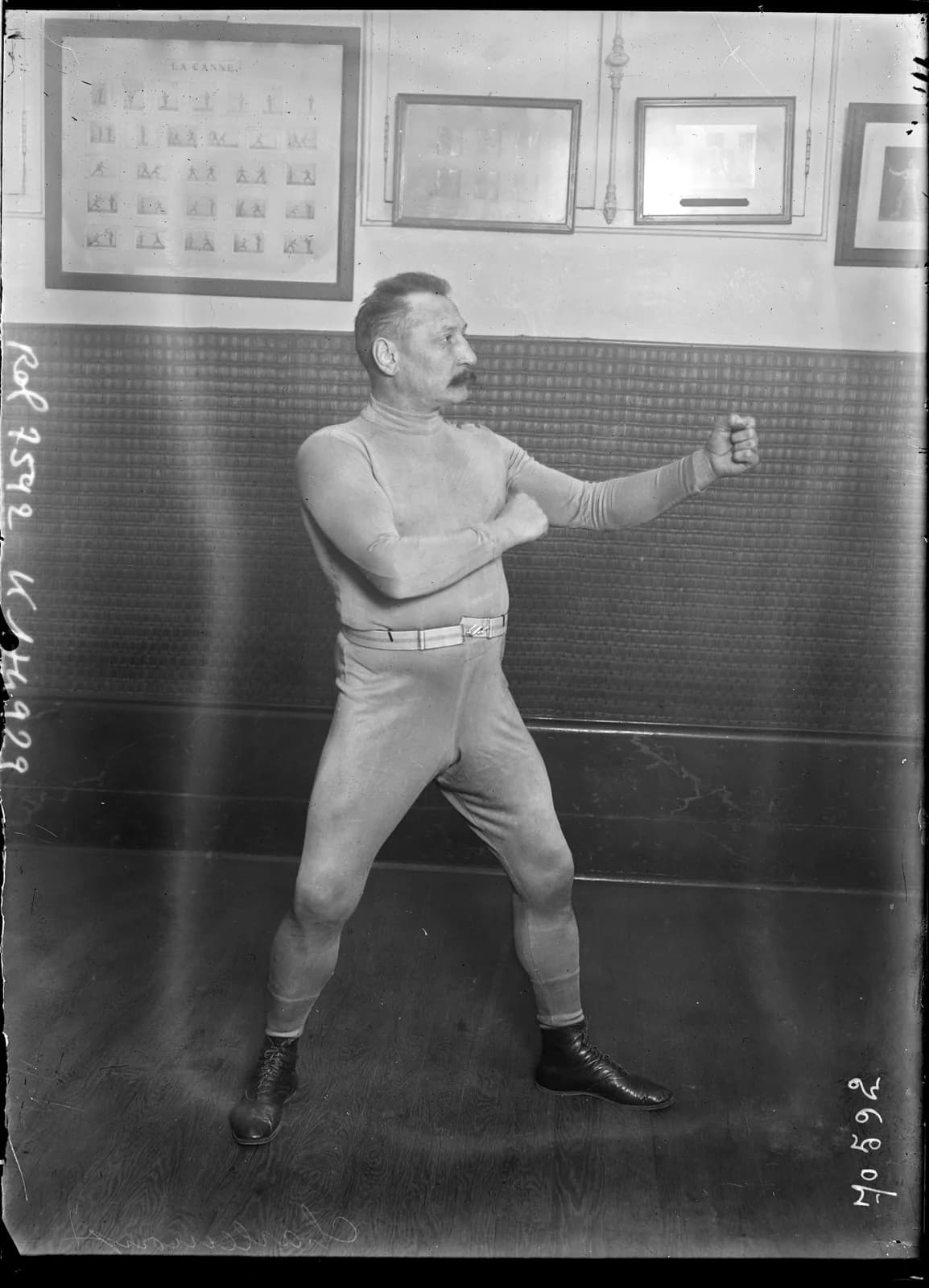
Photo: Charles Charlemont shadow-fighting for the camera, 1921. Bibliothèque nationale de France, public domain, via Wikimedia Commons.
In this article
Walk into any gym at open-mat time and you will see it: ten people shadow boxing, and eight of them are dancing. The same three combinations, the same shuffle, the same hand drifting down, ten minutes of it, eyes somewhere near the ceiling, thinking about dinner. It looks like training. It is a rehearsal of everything they already do, the bad habits included, and it is the most common way the cheapest training tool in the world gets thrown away.
The short answer: give every round one job. Footwork, defence, combinations with exits, a game plan, pressure. Five rounds, five jobs, fifteen minutes, no equipment except a timer and a picture of a person in your head. Done that way, shadow boxing is the most efficient technical session in your week. Done the other way, it is cardio with hand gestures.
Key facts
- Format
- 5 rounds × 3 minutes, 30 seconds between rounds – 15 to 18 minutes
- Jobs
- Footwork, defence, combinations, game plan, pressure
- Equipment
- A timer; a mirror once a week
- When
- Before sessions as a warm-up (3 rounds) or on rest days in full
- Rule
- One job per round – if you catch yourself doing something else, reset
Why it fails, and the one thing that fixes it
Movement without intention builds nothing. When you shadow box "generally", your nervous system does what it does whenever attention is low: it plays the most familiar patterns. The same three combinations. The same flat-footed shuffle. The same dropped hand you came here to unlearn. A coach watching an open gym can tell you who will be better in a month, and it is always the ones whose shadow boxing looks like a problem being solved rather than a routine being performed.
Intention needs a constraint. A round with one job gives your attention something to hold, forces the movement you have been avoiding, and makes it obvious the second you drift. The five jobs below are in order for a reason: you cannot throw combinations with exits until you can move, and you cannot fight a game plan until you can defend. Timer on, three-minute rounds, thirty seconds between, in order.
Round 1 – Feet only, and no, you may not punch
No punches. Move in your stance: forward, back, sideways, pivots on the lead foot, pivots on the rear. Feet the same width apart on every step, weight between them, knees soft. The three classic sins are crossing the feet, narrowing the stance when you go backwards, and rising onto straight legs when you go forwards. You will do all three in the first minute.
The job: end every movement in a position you could punch from. If you step and cannot immediately jab with your weight balanced, the step was wrong. Do it again.
Round 2 – They throw first
Imagine someone who attacks. Slip the jab, roll under the hook, block the cross with the rear hand, parry, step off the line, check the low kick, and answer every attack with one counter, then reset. No combinations yet. The point is to make the defence automatic and to feel the counter coming out of the defence, not after it, like a door that swings back the moment it is pushed.
The job: the head is never still, and the hands come home after every counter. If your head has been parked in one place for more than two seconds, you are watching the fight, not in it.
Round 3 – Every combination has a way out
Now build. Two, three and four punches – jab-cross, jab-cross-hook, jab-cross-hook-cross – and, if you kick, combinations that end in a low kick or a knee. Every one finishes with an exit: a step back out of range, a pivot off the line, a slip. Say the combination in your head before you throw it, and say the exit too.
The job: every combination ends with your feet moving, not with you standing in front of the imaginary opponent admiring your work. The exit is part of the combination, not a suggestion.
Round 4 – Pick your opponent
One opponent type, three minutes, solve them. The tall jabber: your own jab to the body, lateral movement to the outside, get inside behind a slip. The pressure fighter walking you down: pivots, the check hook, counters off the back foot, and never straight back. The southpaw: lead hand, outside foot position, the rear straight down the middle. If you train Muay Thai or MMA, add the problem that keeps you up at night: the clinch, the takedown, the low kick.
The job: solve one specific problem, not "fight". The picture should be so concrete that a coach watching could guess who you are boxing. If they could not, neither can your nervous system.
Round 5 – When you are tired, we find out who you are
Last round, high pace. Stay in range, throw, move, throw, move. This is the conditioning round and the honesty round: the form from rounds one to four has to hold when the legs are gone. Hands back, head moving, feet under you, exits on every combination.
The job: breathe out on every punch. If you catch yourself holding your breath or punching with your mouth clamped shut, slow down until the breathing returns, then build the pace again. Speed without breath is a countdown.
Once it runs itself
After a month the structure can be bent to what you need. Swap round four for a round of one weapon – only the jab, only the rear kick, only the check hook – to build the tool you keep neglecting. Turn round two into a pure Muay Thai defence round: checks, long guard, teeps to keep range. Add a sixth round with a partner calling numbers if you have one. Or film round five once a month and compare it with the last one; the exits, the head movement and the breathing are the things that should have changed.
What it looks like a month from now
Fifteen minutes, five rounds, five jobs, before every session or on rest days. In a month you notice it in sparring before anyone tells you: the exits are there, the head moves, the combinations have endings, and the round you used to waste has become the round that fixes things. All it ever needed was a timer and a person in your head who wants to hit you.
Where to go next
- The punch that starts every combination: The Jab: Five Most Common Mistakes.
- What you are rehearsing for: Sparring Mistakes Beginners Make.
- When you have the bag: Heavy Bag Intervals.
- Footwork that never sits down: Jump Rope Conditioning.
- The boxing, Muay Thai and MMA hubs.
Frequently asked questions
- How long should I shadow box?
- Fifteen minutes – five rounds of three minutes with thirty seconds between them – is a complete technical session, and three rounds is a good warm-up. Longer than that drifts into aimless movement unless every round has a job.
- Should I shadow box with weights in my hands?
- Rarely, and never for technique. Light hand weights change the path of the punch and teach you to brake early to protect the shoulder. If you want conditioning, use the pressure round; if you want punch speed, use a heavy bag or bands.
- Is a mirror good or bad for shadow boxing?
- Both. A mirror shows you what your coach sees – the dropped hand, the flared elbow, the flat feet – and it makes you watch yourself instead of an imaginary opponent. One round a week, not every session.
- Should I shadow box before or after training?
- Both work. Before a session, three rounds warm you up and sharpen the movements you are about to drill; on rest days, the full five rounds are technical work that costs nothing. Avoid doing it exhausted after hard sparring, when your form is at its worst and you are teaching yourself the worst version of it.
- What should I imagine while shadow boxing?
- A specific person doing a specific thing: a taller fighter jabbing, a pressure fighter walking forward, a southpaw circling to your left. The more specific the picture, the more the round teaches. “Fight” is not an instruction. “Solve the pressure fighter” is.
