History
Jigorō Kanō: The Educator Who Invented Judo
The life of Jigorō Kanō (1860–1938): the bullied boy from Mikage who built the Kōdōkan, ran Japan’s teacher training and became Asia’s first IOC member.
10 min read · 21 September 2026 · updated 21 September 2026
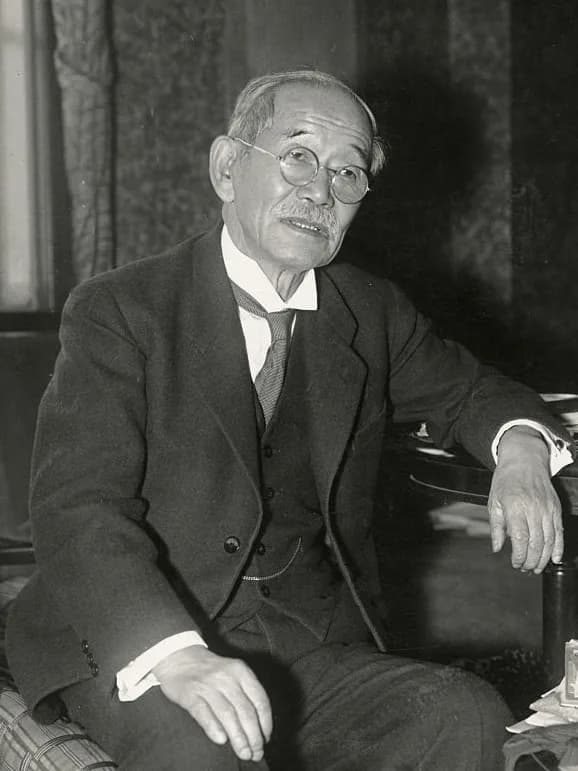
Photo: Asahi Shimbun, c. 1937. Public domain, via Wikimedia Commons.
In this article
Timeline
- 1860
Kanō Jigorō is born on 28 October in Mikage, near Kobe, the youngest son of a family with a sake-brewing fortune on the mother’s side.
- c. 1870
After his mother’s death, the family moves to Tokyo, where Kanō attends private academies and learns English and German.
- 1877
Kanō enters Tokyo Imperial University and, small and tired of being bullied, finds a jujutsu teacher: Fukuda Hachinosuke of the Tenjin Shin’yō-ryū.
- 1879
He takes part in a jujutsu demonstration for the former US president Ulysses S. Grant. Fukuda dies the same year; Kanō continues under Iso Masatomo.
- 1881
Kanō graduates in politics and economics and begins Kitō-ryū jujutsu, the source of judo’s throws, under Iikubo Tsunetoshi.
- 1882
He founds the Kōdōkan in the Eishō-ji temple in Tokyo, twelve mats and nine students, and starts teaching at Gakushūin, the Peers’ School.
- 1883
The first dan grades go to Tomita Tsunejirō and Saigō Shirō; the black belt follows within a few years.
- 1886
Tradition places the Kōdōkan’s tournament victory over the Totsuka-ha Yōshin-ryū before the Tokyo police in this year.
- 1893
Kanō becomes principal of the Tokyo Higher Normal School, the country’s main teacher-training college, a post he holds for most of the next 27 years.
- 1909
He is nominated to the International Olympic Committee, its first Asian member.
- 1912
Kanō leads Japan’s first Olympic team, two athletes, to the Stockholm Games, having founded the Japan Amateur Athletic Association the year before.
- 1922
The Kōdōkan Cultural Council is founded and Kanō states judo’s two principles: seiryoku zen’yō and jita kyōei. He is also appointed to the House of Peers.
- 1926
The Kōdōkan opens a women’s section under Kanō’s direct supervision.
- 1936
At the IOC session in Berlin, Kanō helps win the 1940 Olympic Games for Tokyo.
- 1938
After the IOC session in Cairo, Kanō dies of pneumonia aboard the Hikawa Maru on 4 May, aged 77. Japan gives up the Tokyo Games in July.
On 4 May 1938 a 77-year-old man dies of pneumonia in a cabin of the liner Hikawa Maru, somewhere in the Pacific between Vancouver and Yokohama. Two months earlier, in Cairo, he had stood in front of the International Olympic Committee and held on to the Games he had won for Tokyo in Berlin two years before. He had been on the road since March. The Games he secured would never be held; Japan gave them back in July, at war in China. The man in the cabin was Jigorō Kanō, and the loss of the 1940 Olympics was the smallest of the things he left behind.
The short answer: Kanō was a schoolmaster before he was anything else. He built judo in 1882 as an educational method, not a fighting style, in a Tokyo temple with twelve mats, then spent forty years running schools, a ministry department and a country's teacher training, and used the Olympic movement to carry Japan into international sport. The story of the art is in Judo: Kanō Jigorō and the Gentle Way. This is the story of the man.
Key facts
- Born
- 28 October 1860, Mikage (now Kobe), Japan
- Died
- 4 May 1938, aboard the Hikawa Maru at sea, aged 77
- Jujutsu teachers
- Fukuda Hachinosuke and Iso Masatomo (Tenjin Shin’yō-ryū); Iikubo Tsunetoshi (Kitō-ryū)
- Founded
- The Kōdōkan, Eishō-ji temple, Tokyo, 1882
- Day job
- Principal of the Tokyo Higher Normal School, 1893–1920, with spells at the Ministry of Education
- Olympic role
- First Asian IOC member, 1909–1938; led Japan’s first team to Stockholm, 1912
The smallest boy in the class
Kanō was born on 28 October 1860 in Mikage, a village of sake breweries on the coast west of Osaka, into a family that did well out of both sake and shipping. His father, Kanō Jirosaku, worked as a shipping agent for the shogunate and then, after the Meiji Restoration of 1868, for the new government; his mother died when the boy was nine, and around 1870 the family moved to Tokyo. There Kanō went through the private academies of the capital, learned English and German, and was, by every account including his own, a bright, small child who was bullied for it.
He did not forget it. What he wanted, from the age of about fourteen, was a way for a small man to beat a big one, and he had heard that the old samurai art of jujutsu was exactly that. Finding a teacher in the Tokyo of the 1870s was the hard part. The samurai class had been abolished, the sword banned in 1876, and the jujutsu masters who had once served the daimyō were now bonesetters and street performers. Kanō, who entered Tokyo Imperial University in 1877, went looking for them among the bonesetters. He found one.
Three teachers and a temple
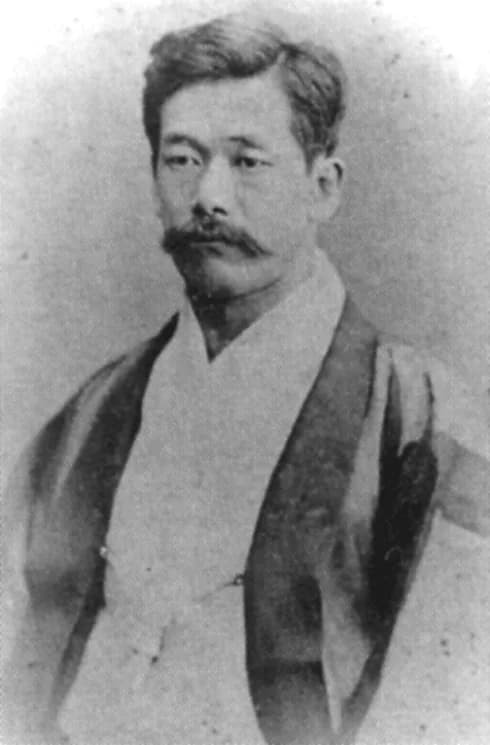
Fukuda Hachinosuke taught the Tenjin Shin'yō-ryū, a school strong in striking, pinning and choking, in a small dōjō where practice meant randori, free sparring, more than the choreographed forms most schools preferred. Kanō started in 1877. In July 1879 Fukuda's students gave a demonstration for the former American president Ulysses S. Grant, then touring Japan, at the home of the industrialist Shibusawa Eiichi, and Kanō was on the mat. Fukuda died a few weeks later. Kanō moved to the school's senior teacher, Iso Masatomo, a man in his sixties who was said to be unthrowable, and when Iso died in 1881 he went to a third master, Iikubo Tsunetoshi of the Kitō-ryū, whose art was almost entirely throwing. Kanō was 21 and had just graduated. Iikubo threw him around the dōjō for a year before Kanō, by his own account, worked out the principle of breaking balance first and began to throw his teacher back.
In February 1882 he rented rooms at the Eishō-ji, a small Buddhist temple in the Shitaya district of Tokyo, laid down twelve tatami mats and called the place the Kōdōkan, the hall for teaching the way. Nine students came in the first year, and the priest complained about the floor. Kanō, who at the same time was running an English-language school and taking a teaching post at Gakushūin, the school for the children of the nobility, meant the name literally: this was a school, with a curriculum. He picked the techniques of his two jujutsu schools that could be practised at full speed without injury, dropped the ones that could not, explained each by a principle, and called the result jūdō, the gentle way, rather than jūjutsu, the gentle technique. In 1883 he gave the first dan grades to two students, Tomita Tsunejirō and Saigō Shirō, and a few years later put black belts on them so that beginners could tell the seniors apart. Every black belt in every martial art since descends from that decision. He never gave one to himself.
The tournament everyone tells
Every account of the early Kōdōkan reaches the same scene. The Tokyo Metropolitan Police wanted a jujutsu system for their officers and, in 1886, held matches between Kanō's students and the Totsuka-ha Yōshin-ryū, the strongest of the old schools; the Kōdōkan won nearly everything, and judo became the police's art. The scene is in the timeline above with the word tradition attached, because that is what it is. Contemporary records are thin, the date and the number of bouts vary from one telling to the next, and the details grew for fifty years in the retelling, not least in a 1940s novel about Saigō Shirō that became the film Sanshiro Sugata. What can be documented is the result: by the 1890s the police and the schools were teaching Kōdōkan judo, and the Kōdōkan had outgrown four premises. Whether the decisive day happened as told matters less than the fact that everyone in Japan believed it had.
The day job
Kanō spent his working life in the Japanese education system and rose near the top of it. After more than a year in Europe for the Ministry of Education, looking at schools, he was made principal of a higher school in Kumamoto, then in 1893, at 33, principal of the Tokyo Higher Normal School, which turned out the teachers of the entire country. He held the post, with interruptions for Ministry work, until 1920, and used it. Judo went into the college's physical education, and from there into secondary schools across Japan; the students Kanō trained as teachers carried it with them. From 1896 he also took in students sent by the Chinese government, and the school he founded for them in 1902 counted among its pupils a young man called Zhou Shuren, later known as the writer Lu Xun.
The Kōdōkan meanwhile became the largest martial arts school in the world without Kanō ever making a living from it. His instructors went out as he had gone into education, as emissaries: Yamashita Yoshitsugu to Washington in 1903, where he taught President Theodore Roosevelt; Maeda Mitsuyo across the Americas and eventually to Brazil, where the Gracie family learned from him, a line told in BJJ: From Maeda to the Gracies. Kanō's own preferred students were not fighters. They were teachers.
Two principles and a women's section
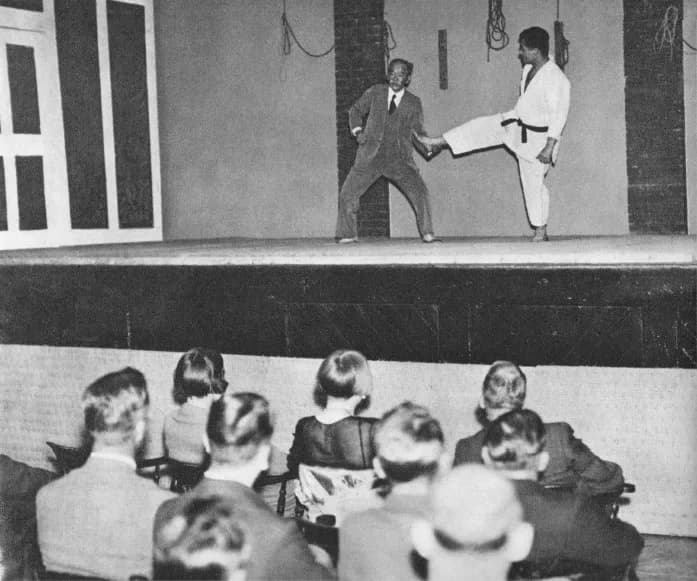
Kanō had always insisted that judo was a method of education, and in 1922, at 61, he said what he meant by it. That year he founded the Kōdōkan Cultural Council and announced two principles that were to govern every technique and every judoka. Seiryoku zen'yō, the most efficient use of energy, was the physical law: the reason a small person can throw a large one, and also the reason to do anything else well. Jita kyōei, mutual welfare and benefit, was the moral one: the training partner who lets you throw him is the person who makes your progress possible, and the same is true of everyone else. He spent the rest of his life lecturing on the pair of them, and they are still on the wall of the Kōdōkan.
He was also, for a man of his time and place, unusually clear that judo was for women. The Kōdōkan had taught individual women since the 1890s; in 1926 it opened a formal women's section, and Kanō supervised the syllabus himself, with an emphasis on kata and a ban on competition that lasted for decades after him. Women's judo reached the Olympic programme in 1992, 54 years after his death, and the Kōdōkan lifted its own restrictions later still. He had opened the door. It took a long time for the rest of the building to follow.
Baron de Coubertin's colleague
Kanō's other career began in 1909, when the French ambassador in Tokyo proposed him to Pierre de Coubertin's International Olympic Committee. He was its first Asian member, at a time when Japan had never sent an athlete to the Games. Two years later he founded the Japan Amateur Athletic Association to change that, and in 1912 he led the country's first Olympic team to Stockholm: two men, a sprinter and a marathon runner, with Kanō as head of delegation. The campaign that made his name in the movement was the bid for 1940. Kanō argued for Tokyo through the mid-1930s as a matter of the Games belonging to the world and not to Europe, and at the Berlin session in July 1936 the IOC gave Tokyo the twelfth Olympiad. What he did not argue for, at least not hard, was his own sport. In a much-quoted letter to his London student Gunji Koizumi that year, he described his attitude to judo as an Olympic event as passive: judo was a way of life, and he was wary of what medals would do to it. Judo entered the Olympics in Tokyo in 1964, a quarter of a century after his death, and the questions about what the rule book does to the art, laid out in Judo Scoring Explained, are the ones he had already asked.
The Hikawa Maru
In March 1938 the IOC met in Cairo, and Kanō, 77, went, by way of Europe, to defend a Games that the Japanese army's war in China had made increasingly hard to justify. He held the line in Cairo. He then travelled on across the Atlantic and North America, and at Vancouver boarded the Hikawa Maru for home. He fell ill on the crossing and died of pneumonia on 4 May. In July the Japanese government withdrew from hosting them, and the twelfth Olympiad was never held anywhere.
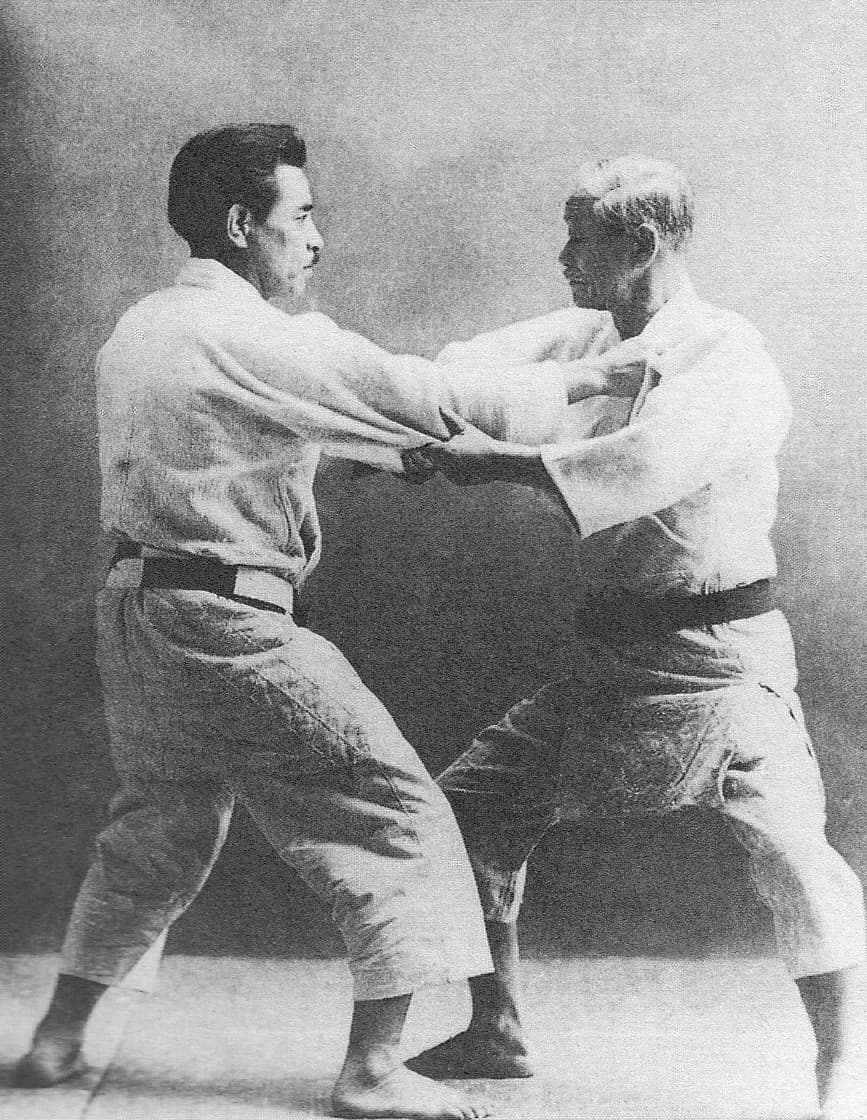
What survived was the school. The Kōdōkan had moved in 1934 into a purpose-built hall at Suidōbashi; by the time of his death it had graded tens of thousands of judoka and the art was in the schools of Japan and the clubs of Europe. Kyūzō Mifune, who had arrived at the Kōdōkan in 1903 and stands beside him in the photograph above, carried the technical tradition into the 1960s; the International Judo Federation was founded in 1951; and in 1964 judo was contested at a Tokyo Olympics, one war and 24 years after the one he had spent his last year securing. He holds no rank in his own art, and never did. The Kōdōkan's position is that the founder stands outside the system he made, which is the kind of principle Kanō would have wanted explained.
Where to go next
- The art's story, from the Eishō-ji to the IJF: Judo: Kanō Jigorō and the Gentle Way, and the judo discipline hub.
- What ippon and waza-ari mean in the current rules: Judo Scoring Explained, with the terms in the glossary under ippon and waza-ari.
- The black belt Kanō invented, as karate later borrowed it: How Long Does It Take to Get a Black Belt in Karate?.
- Two other founders with very different careers: Mas Oyama and Ip Man.
- Where Maeda took Kanō's judo: BJJ: From Maeda to the Gracies.
Sources
- Brian N. Watson, The Father of Judo: A Biography of Jigoro Kano (Kodansha International, 2000)
- Jigoro Kano, Mind Over Muscle: Writings from the Founder of Judo, ed. Naoki Murata (Kodansha International, 2005)
- Kōdōkan Judo Institute – Jigoro Kano and the history of Kodokan judo
- International Olympic Committee – Jigoro Kano, IOC member profile
- International Judo Federation – History of judo
- Encyclopaedia Britannica: Kanō Jigorō
- Wikipedia: Kanō Jigorō
Frequently asked questions
- Who was Jigorō Kanō?
- Jigorō Kanō (1860–1938) was a Japanese educator who founded judo in 1882 at the Kōdōkan in Tokyo. He spent most of his career running the Tokyo Higher Normal School and working for the Ministry of Education, and in 1909 became the first Asian member of the International Olympic Committee.
- Why did Kanō create judo instead of teaching jujutsu?
- He had learned two jujutsu schools, Tenjin Shin’yō-ryū and Kitō-ryū, and believed their best techniques could be selected, explained by principle and taught safely as physical, mental and moral education. Judo was meant to be a method of training people, not only a way of fighting.
- What do seiryoku zen’yō and jita kyōei mean?
- Seiryoku zen’yō means the most efficient use of energy; jita kyōei means mutual welfare and benefit. Kanō presented them in 1922 as the principles behind every judo technique and behind the conduct of judoka outside the dōjō.
- Was Kanō a member of the International Olympic Committee?
- Yes. He was nominated in 1909 as the IOC’s first Asian member, led Japan’s first Olympic team to Stockholm in 1912 and campaigned for the 1940 Games to be held in Tokyo, which the IOC awarded in 1936 and Japan later relinquished.
- How did Kanō die?
- He died of pneumonia on 4 May 1938 aboard the liner Hikawa Maru in the Pacific, aged 77, on his way home to Japan from the IOC session in Cairo.
- What rank did Kanō hold in judo?
- None. Kanō created the dan and kyū grading system but never awarded himself a grade, and the Kōdōkan has never assigned him one; as founder he stands outside the ranks.