History
Ip Man: The Foshan Policeman Who Taught Bruce Lee
The documented life of Ip Man (1893–1972): rich boy in Foshan, Nationalist policeman, refugee in Hong Kong, and the teacher who made Wing Chun public.
10 min read · 21 September 2026 · updated 21 September 2026
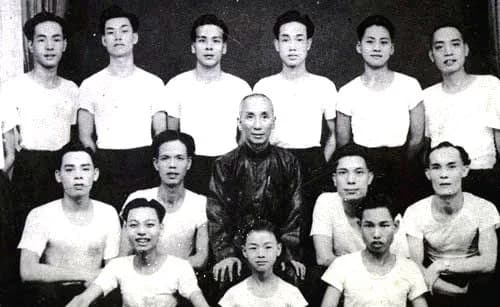
Photo: Ip Man with students in Hong Kong, c. 1950. Public domain, via Wikimedia Commons.
In this article
Timeline
- 1893
Ip Man is born on 1 October in Foshan, Guangdong, into one of the town’s wealthy landowning families.
- c. 1905
At about twelve he becomes the last student of Chan Wah-shun, who teaches Wing Chun in a hall rented from the Ip family; after Chan’s death his senior Ng Chung-sok continues the boy’s training.
- c. 1909
Ip Man is sent to Hong Kong to study at St. Stephen’s College. Tradition says he trains there with Leung Bik, son of Leung Jan; the story is disputed.
- c. 1917
He returns to Foshan, marries Cheung Wing-sing and lives on the family’s income, training privately with friends.
- 1930s–1940s
Ip Man serves as a police officer in Foshan under the Nationalist government and teaches a small circle of private students.
- 1938–1945
Foshan is occupied by Japan. The family’s account is that Ip Man refuses to teach the occupiers and lives in reduced circumstances.
- 1949
With the Communist victory his property is lost and his police past becomes dangerous; he leaves for Hong Kong at the end of the year, alone.
- 1950
He begins teaching for money at the Restaurant Workers’ Union in Kowloon. Leung Sheung, Lok Yiu and Chu Shong-tin are among the first students.
- c. 1953
Wong Shun-leung joins, then a teenager named Lee Jun-fan, later Bruce Lee, who trains until he leaves for the United States in 1959.
- 1962
His sons Ip Chun and Ip Ching join him in Hong Kong and begin training under him.
- 1967
Ip Man and his students found the Ving Tsun Athletic Association, giving the art a registered public body for the first time.
- 1972
Weeks before his death he films the forms and the wooden-dummy set on 8 mm so that a record survives.
- 1972
Ip Man dies in Hong Kong on 2 December, aged 79, of throat cancer. Bruce Lee dies seven months later.
- 2008
The film Ip Man, with Donnie Yen, turns a teacher known to martial artists into a global figure and fills Wing Chun schools worldwide.
In the autumn of 1972 a thin man of 79 stands in front of an 8 mm camera in Hong Kong and performs the first form of Wing Chun, Siu Nim Tau, the little idea. He is dying of throat cancer and knows it. He goes on to the second form and then to the wooden dummy, the hundred-odd movements against a post with three arms and a leg, and the film runs out of things to record. He had refused to be filmed for twenty years. Now, with weeks left, Ip Man wanted the art he had taught to a few hundred people to be seen exactly as he did it, so that nobody could argue about it afterwards. They argue anyway. But the footage exists.
The short answer: Ip Man was a rich man's son from Foshan who learned a rare boxing style as a boy, worked as a policeman, lost everything to the revolution of 1949 and, at 56, rebuilt his life by teaching that style for money in Hong Kong. He taught for 22 years, and among the people he taught was Bruce Lee. The story of the art, from the opera boats to the rooftops, is in The History of Wing Chun. This is the man in the middle of it.
Key facts
- Born
- 1 October 1893, Foshan, Guangdong, China
- Died
- 2 December 1972, Hong Kong, aged 79
- Teachers
- Chan Wah-shun and Ng Chung-sok in Foshan; Leung Bik in Hong Kong (tradition)
- Career
- Police officer in Foshan, 1930s–1940s; professional Wing Chun teacher in Hong Kong from 1950
- Notable students
- Leung Sheung, Lok Yiu, Chu Shong-tin, Wong Shun-leung, Bruce Lee, Ip Chun and Ip Ching
- Organisation
- Ving Tsun Athletic Association, Hong Kong, 1967
The richest boy in Chan Wah-shun's class
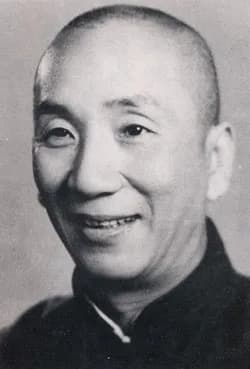
Foshan in 1893 was a manufacturing town of ironworks, pottery kilns and martial artists, a place where a boxing teacher could make a living, and the Ip family was one of its richest, with land, property and a large house on Mulberry Garden Street. Ip Man was born there on 1 October 1893, the second son, and grew up with the private tutors and the Confucian education of his class. He also grew up watching. Part of the family's property was a hall it rented to Chan Wah-shun, a former money changer who had learned Wing Chun from the physician Leung Jan and taught it, at a price most people could not pay, to a handful of students.
Around 1905, aged about twelve, the boy asked to be taught. The story told in the family is that Chan, who had turned down richer applicants, tested whether the request was serious by naming a fee that should have ended the conversation, and the boy produced the silver. Whatever the details, Ip Man became Chan's last student, the sixteenth or so in a teaching career of decades, and trained with him for about three years until Chan fell ill. After that the senior student, Ng Chung-sok, took over the lessons. It was a small world: the whole art, at that point, was perhaps two dozen people in one town.
Hong Kong and a man who may not have existed
At about fifteen Ip Man was sent to Hong Kong to study at St. Stephen's College, the school where wealthy Chinese families sent sons to learn English. He was, by the family's account, a confident boy who fought willingly, and it is at St. Stephen's that the most contested chapter of his life takes place. As Ip Man told it, an older man living at the business of a classmate's father asked to see his kung fu, put him on the floor twice, and turned out to be Leung Bik, a son of Leung Jan. Ip Man trained with him for some years and came home with a Wing Chun that his Foshan seniors found unfamiliar and, in his telling, better.
The trouble is that nobody can document Leung Bik. Leung Jan's sons and the Foshan lineage are on record; a Leung Bik who taught in Hong Kong is not, apart from Ip Man's own account and the accounts of his students. Some researchers and rival lineages regard the story as an explanation invented to justify changes Ip Man made himself. Others accept it. This article takes no side, except to say that the version of Wing Chun that came back to Foshan around 1917 was his, and that he taught it for the rest of his life.
The gentleman policeman
Back in Foshan, Ip Man did what a man of his family was expected to do. He married Cheung Wing-sing, had four children, of whom the sons Ip Chun (born 1924) and Ip Ching (born 1936) would matter to the art, and lived on the family's rents. He trained with friends and taught a few of them, among them Chow Kwong-yue, Kwok Fu and Lun Kah, but he was not a professional teacher and did not want to be. Foshan was full of martial artists and he was one of the better-known ones, a gentleman practitioner who did not need the money.
In the 1930s he joined the police, serving under the Nationalist government as an officer and, later, a detective in the Foshan force. The job put him on the Kuomintang side of a country sliding into civil war, and the Japanese occupation of Foshan from 1938 to 1945 made everything harder. The family says he refused to teach the occupiers and lived poorly; there is no evidence, and no claim from the family, that he fought them. When Japan surrendered he went back to police work. When the Communists won in 1949 he was a landlord and a former Nationalist policeman in a town they now governed, which was two reasons too many. His property was confiscated. At the end of the year he left for Hong Kong with almost nothing, leaving his wife behind. The border closed in 1951 and they did not live together again; she died in Foshan in 1960.
Dai Nam Street
Hong Kong in 1950 was full of refugees with pasts, and a Wing Chun master with no money was one more. Through a friend, Lee Man, Ip Man was introduced to the Restaurant Workers' Union on Dai Nam Street in Sham Shui Po, Kowloon, and that summer he began doing what no Wing Chun master had ever done: teaching it to strangers for a fee. The first class was small, and not everyone stayed. Those who did were Leung Sheung, a senior member of the union who had trained in other styles and who stands to his teacher's right in the photograph at the top of this article; Lok Yiu; and Chu Shong-tin, the union's secretary, who lived at the hall. They became the first generation, and Leung Sheung the first to open a school of his own.
The student who made the school's reputation arrived in about 1953: Wong Shun-leung, a former boxer who took Wing Chun into the illegal rooftop challenge matches of the decade, the beimo, and won them, dozens of times, against practitioners of every style in the colony. Ip Man did not fight them himself. He was in his sixties, and he had a policeman's view of the law. But the rooftops were the best advertising a Kowloon school could have, and they brought the teenagers.
The teenager who would not stop asking
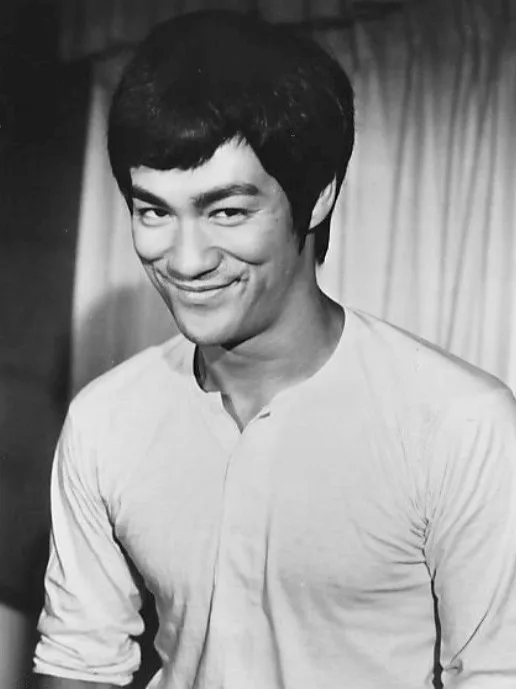
One of them was a film-industry child called Lee Jun-fan, thirteen or so when he joined in about 1953, who had been losing street fights and wanted to stop. He trained obsessively, mostly under Wong Shun-leung, and for a while the school had a problem with him: when some of the students learned that his mother was of part-European descent, they objected to his being taught, and he was for a time trained apart. The teacher kept him. Bruce Lee learned the first two forms, the sticking hands and the centreline, left for the United States in 1959, and spent the next fourteen years turning what he had been given into something else, a story told in Jeet Kune Do: Bruce Lee's History. He came back to Hong Kong in the early 1970s a film star and visited his old teacher. He is said to have offered to buy a flat in exchange for being filmed doing the dummy set, and to have been refused.
It is worth being exact about what Ip Man did and did not give Bruce Lee, because the films have blurred it. He gave him six years in a school with a method and a culture of testing it; he did not make him a fighter, and he did not teach him most of what Lee later used. Lee's importance to Ip Man is the other way round. When Lee's films played from Hong Kong to Los Angeles, they made an old man in Kowloon the most famous kung fu teacher alive, and his students, by then running schools of their own, found that the name on the door had become a brand.
An association and a film camera
The 1960s were the years the art became public. Ip Man's sons crossed from Foshan in 1962, trained under him and became teachers; students opened schools across Hong Kong, and the differences between what each had been taught began to harden into lineages. In 1967 Ip Man and his senior students founded the Ving Tsun Athletic Association, using his preferred romanisation, and registered it with the government, the first time the art had a public body with a name and a constitution. He served as its head, taught less and less, and by the early 1970s was frail.
Then, in 1972, came the camera. Ip Man had refused to be filmed throughout his career, apparently because a film could be copied and a lineage could not. In the last weeks before his death he changed his mind and had himself recorded performing Siu Nim Tau, Chum Kiu and the wooden-dummy set. He died on 2 December 1972 in Hong Kong, aged 79. Bruce Lee, his most famous student, died the following July, aged 32. Within a year the art had lost its founder and its face, and the schools were left holding a few minutes of 8 mm film and a great many opinions.
The man in the film
The film Ip Man (2008), directed by Wilson Yip with Donnie Yen in the title role, is the reason most people outside the martial arts have heard the name, and it should be read as fiction with a real name attached. Its Ip Man is a humble, saintly master who fights Japanese officers in occupied Foshan and flees to Hong Kong during the war; the real one was a wealthy Nationalist policeman who left in 1949 for political reasons, fought no recorded duels with anyone in uniform, and was by most accounts reserved, particular about money and not especially humble about his art. The sequels invent further. What the films got right is the shape of the thing: a man who lost a world and rebuilt it out of a boxing style, and who, in the end, had it filmed.
Where to go next
- The art, from the Red Boats to the rooftops: The History of Wing Chun, and the Wing Chun discipline hub.
- What his most famous student did with it: Jeet Kune Do: Bruce Lee's History and the Jeet Kune Do hub.
- How the style measures up against the western art Wong Shun-leung came from: Wing Chun vs Boxing.
- The southern Chinese world Foshan belonged to: The History of Kung Fu.
- Two other founders, an educator and a bull-fighter: Jigorō Kanō and Mas Oyama.
Sources
- Ip Ching & Ron Heimberger, Ip Man: Portrait of a Kung Fu Master (King Dragon Press, 2001)
- Leung Ting, Roots and Branches of Wing Tsun (Leung’s Publications, 2000)
- Matthew Polly, Bruce Lee: A Life (Simon & Schuster, 2018)
- Ving Tsun Athletic Association – History of the association and of Ip Man
- Ip Man Tong, the Ip Man memorial hall at the Foshan Ancestral Temple, Foshan
- Wikipedia: Ip Man
- Wikipedia: Wing Chun
Frequently asked questions
- Who was Ip Man?
- Ip Man (1893–1972), also written Yip Man, was a Wing Chun master from Foshan in southern China who fled to Hong Kong in 1949 and became the first person to teach the style openly and for a fee. His students founded the schools through which Wing Chun spread worldwide, and one of them was Bruce Lee.
- Was Ip Man really Bruce Lee’s teacher?
- Yes. Bruce Lee joined Ip Man’s school in Hong Kong in about 1953, aged twelve or thirteen, and trained until he left for the United States in 1959. Much of his hands-on instruction came from the senior student Wong Shun-leung, as was normal in the school.
- Was Ip Man a policeman?
- Yes. He served as a police officer in Foshan under the Nationalist government in the 1930s and 1940s, a career that became a liability after the Communist victory in 1949 and was one reason he left for Hong Kong.
- Did Ip Man fight the Japanese, as in the film?
- There is no record of it. Foshan was occupied from 1938 and the family’s account is that he refused to teach the occupiers and lived poorly, but the duels in the 2008 film are invented. He moved to Hong Kong in 1949 for political reasons, not during the war.
- How did Ip Man die?
- He died of throat cancer in Hong Kong on 2 December 1972, aged 79. A few weeks earlier he had filmed the Wing Chun forms and the wooden-dummy set so that a record of his practice would survive.
- Who was Leung Bik?
- According to Ip Man’s own account, Leung Bik was a son of the Foshan master Leung Jan who taught him in Hong Kong around 1909 and refined what he had learned from Chan Wah-shun. Some researchers and members of other lineages doubt that this training, or Leung Bik himself, can be documented, so the story is best treated as tradition.