History
The History of Wing Chun: From Foshan to Ip Man and Bruce Lee
How a compact southern Chinese style passed from the Red Boat opera troupes through Foshan to Ip Man’s Hong Kong school and Bruce Lee.
7 min read · 20 September 2026 · updated 21 September 2026
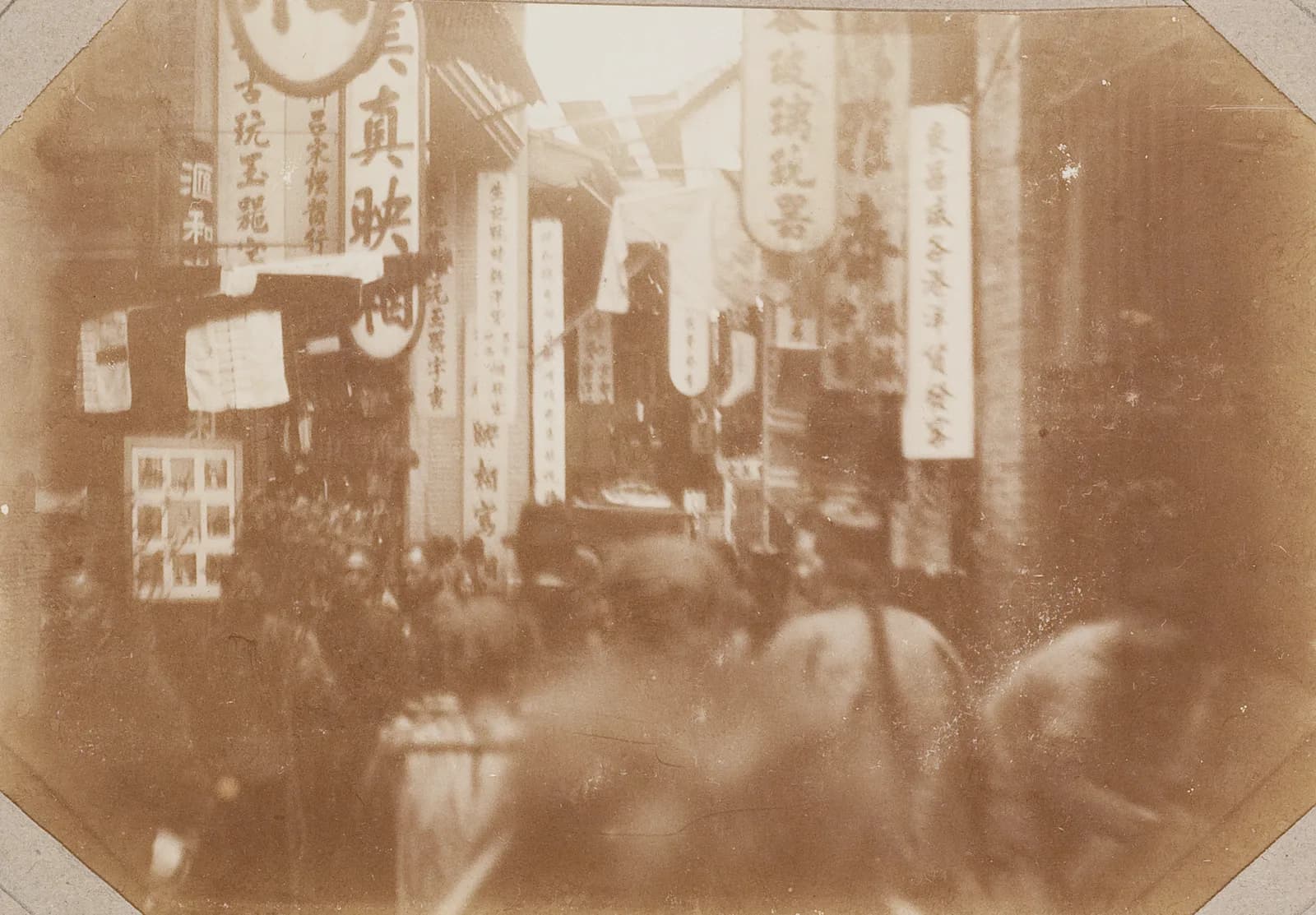
Photo: A street in Canton (Guangzhou) around 1900. Wing Chun took shape in the towns of the Pearl River Delta in the 19th century. Public domain, via Wikimedia Commons.
In this article
Timeline
- 18th c.
Legend places the art's origins with the Buddhist nun Ng Mui and her student Yim Wing Chun after the burning of the Shaolin temple – a story without documentary support.
- early 19th c.
The Red Boat Opera Company of Guangdong tours the Pearl River Delta; its performers Leung Yee-tai and Wong Wah-bo are the first named practitioners.
- 1850s–1860s
The opera troupes are banned for supporting the Taiping-era Red Turban Rebellion; their fighting methods pass to civilians in Foshan.
- c. 1870s
Leung Jan, a physician in Foshan, learns from the opera performers and becomes the town's most famous fighter, “Mr Leung of Foshan”.
- 1890s
Leung Jan's student Chan Wah-shun, a money changer, teaches a small number of students in Foshan.
- c. 1906
Ip Man, a 13-year-old from a wealthy Foshan family, becomes Chan Wah-shun's last student; he later trains with Leung Bik in Hong Kong.
- 1930s
Ip Man serves as a police officer in Foshan and teaches a few students privately.
- 1949
Ip Man flees the Communist victory to Hong Kong, arriving almost penniless.
- 1950
He begins teaching Wing Chun to the Restaurant Workers' Union in Kowloon – the first open Wing Chun classes in history.
- 1953–1959
Bruce Lee trains under Ip Man and his senior students before leaving for the United States.
- 1967
The Ving Tsun Athletic Association is founded in Hong Kong, the art's first organisation.
- 1972
Ip Man dies in Hong Kong on 2 December, having filmed the forms for posterity weeks earlier.
- 2008
The film Ip Man, with Donnie Yen, starts a worldwide boom in Wing Chun schools.
In 1949 a former policeman from Foshan, a man in his fifties, arrived in Hong Kong with almost nothing. His property had been confiscated, his years in the Nationalist-era police had become a danger to him, and the one thing he still owned was a boxing style that a few dozen people in the world knew. The following year, needing an income, Ip Man did what no master of that style had ever done: he taught it for money, to anyone who paid, beginning with the Restaurant Workers' Union in Kowloon.
The short answer: Wing Chun's legend is a nun and a girl, and none of it can be documented. Its history begins with the Red Boat opera troupes of Guangdong in the early 19th century, passes through a physician in Foshan named Leung Jan and arrives, by way of that refugee in Kowloon, at a teenager called Bruce Lee. Here is the story the art tells about itself, and then the record.
Key facts
- Origin
- Pearl River Delta, Guangdong; Cantonese opera troupes, early 19th century
- Legend
- The nun Ng Mui and her student Yim Wing Chun – undocumented
- First historical master
- Leung Jan of Foshan (c. 1826–1901)
- Modern founder
- Ip Man (1893–1972), teaching openly in Hong Kong from 1950
- Core method
- Centreline theory, simultaneous attack and defence, chi sao; three forms, wooden dummy, knives and pole
- Most famous student
- Bruce Lee, 1953–1959
The nun, the girl and the snake
Every Wing Chun school tells it. After the Qing dynasty burned the Shaolin temple, five masters escaped, one of them a Buddhist nun named Ng Mui. Watching a snake fight a crane, she worked out a way of fighting that needed no strength, and she taught it to a young woman, Yim Wing Chun, so that the girl could refuse a warlord who had demanded to marry her. Yim Wing Chun beat him, married the man she loved, and passed the art to her husband, who named it after her. It is a good story, and it does a lot of work: it explains the name, the economy of motion and the supposed suitability for smaller people, and it ties the style to the prestige of Shaolin and to the anti-Qing secret societies of the south.
None of it can be documented. The southern Shaolin temple that burns in the story probably never existed. Ng Mui and Yim Wing Chun appear in no record before the 20th century. The historians Benjamin Judkins and Jon Nielson, whose social history is the standard account, treat the tale as a founding myth of the kind every Guangdong style carries. What it preserves all the same is something true about the art's early world: it was taught among people with reasons to hide, and it valued technique over size.
Red boats on the delta
The first names in the lineage belong to the theatre. The Red Boat Opera Company – Cantonese opera troupes touring the rivers of the Pearl River Delta in red-painted junks – trained its performers in acrobatics, weapons and boxing for the stage, and the boats were, by long tradition, also refuges for fugitives and secret-society members. Two performers, Leung Yee-tai, a poler said to have learned the long pole from a fugitive abbot, and Wong Wah-bo, a fighter, are the earliest named practitioners of what would become Wing Chun. In the 1850s the troupes backed the Red Turban Rebellion, an uprising in the delta during the Taiping years, and were banned for it. Their members scattered into the towns, and their arts went with them into civilian hands.
The civilian who mattered was Leung Jan (c. 1826–1901), a herbal physician in Foshan, a manufacturing town famous for its ironware and its martial arts. He learned from the opera men and became the town's most celebrated fighter, remembered as Foshan Jan and Mr Leung of Foshan, and he is the first Wing Chun master whose life can be placed in the record. He taught only a handful, among them his sons and a money changer named Chan Wah-shun (1849–1913), who, tradition says, learned by watching through the window before he was let in. Chan taught for some years in Foshan, and his students numbered fewer than twenty. The last of them, admitted around 1906, was a boy of thirteen from one of the richest families in town.
The gentleman of Foshan
Ip Man (1893–1972), Yip Man in Cantonese, learned from Chan Wah-shun and, after Chan's death, from his senior Ng Chung-sok; then, as a student in Hong Kong around 1909, from Leung Bik, Leung Jan's son, who refined what the boy had. He went home to Foshan, lived on his family's wealth, served as a police officer, and in the 1930s and 1940s taught a few friends and colleagues privately. He was a gentleman-practitioner in a town of martial artists, known but not famous. Had the Communists lost the civil war, he might have stayed that way.
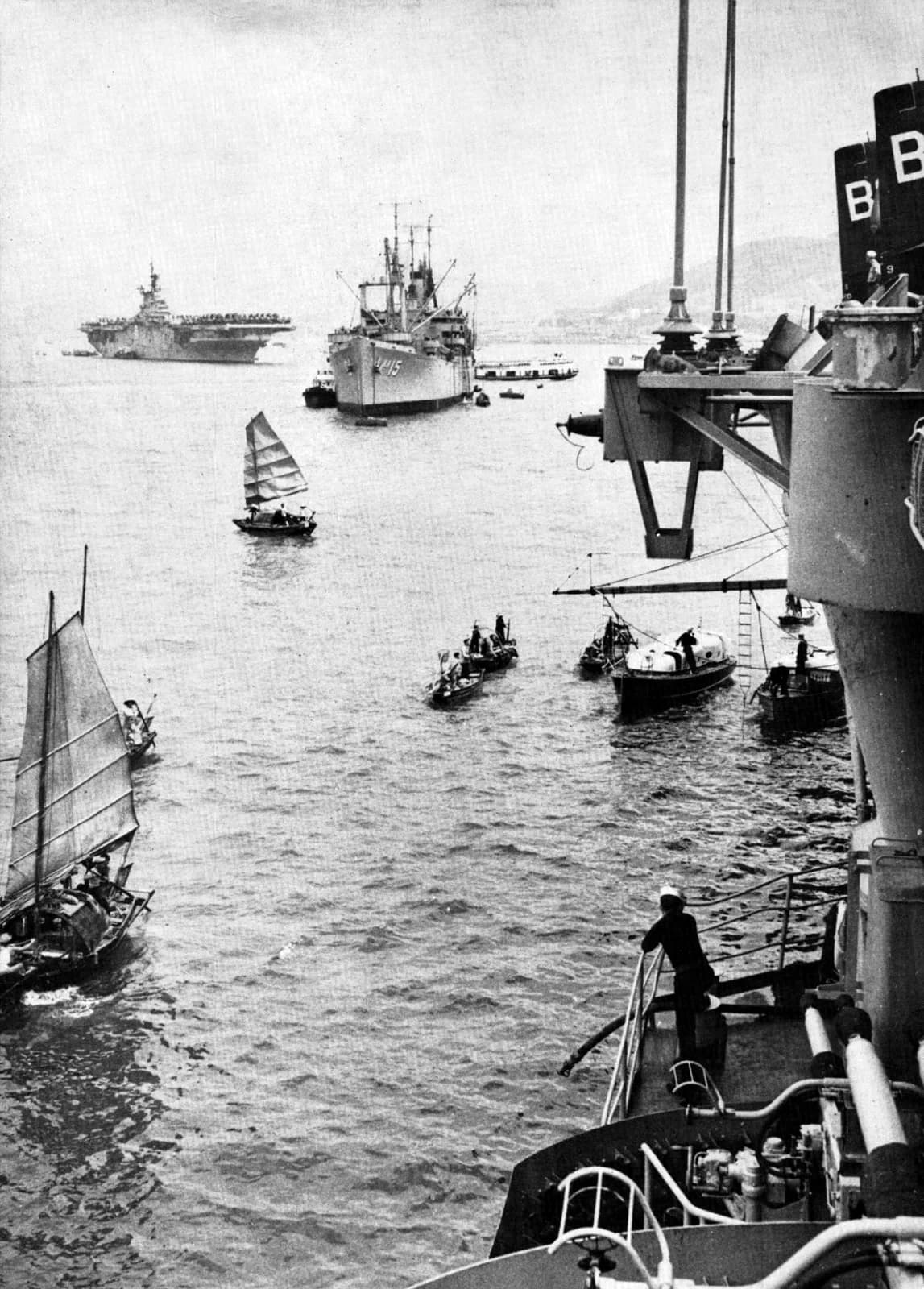
They did not. In 1949, with his property confiscated and his past as a Nationalist-era policeman now a danger, Ip Man fled to Hong Kong with almost nothing. In 1950, needing an income, he taught for money, to anyone who paid, beginning with the Restaurant Workers' Union in Kowloon. His early students – Leung Sheung, Lok Yiu, Chu Shong-tin, Wong Shun-leung – became the art's first generation of professional teachers, and Wong Shun-leung made its reputation the direct way: dozens of beimo, illegal challenge matches fought on Hong Kong rooftops against practitioners of other styles, and dozens of wins.
Among the teenagers who turned up at the school in the mid-1950s was a Hong Kong film-industry child named Lee Jun-fan, known as Bruce Lee. He trained from about 1953 until he left for the United States in 1959, largely under Wong Shun-leung. His later system, Jeet Kune Do, threw out the fixed forms and kept the rest – Wing Chun's centreline theory, its trapping hands, its principle of intercepting an attack – and his films carried his teacher's name far beyond Hong Kong. Ip Man taught until the end. He founded the Ving Tsun Athletic Association with his students in 1967, and in the last weeks before his death on 2 December 1972 he had himself filmed performing the forms so that a record would survive. It survives. The footage is on every Wing Chun student's phone.
What a small system contains
Wing Chun's method is small enough to describe in a paragraph. The shortest path between two fighters is the centreline, and attack and defence should travel along it at once. The stance is narrow and the elbows stay close to the body. The punches are straight, vertical-fisted and delivered in chains. The signature drill, chi sao (“sticking hands”), keeps two students in contact through the forearms until each can feel the other's intention before it becomes a strike. The syllabus has three empty-hand forms – Siu Nim Tao, Chum Kiu and Biu Jee – the wooden dummy form, and two weapons: the long pole inherited from the Red Boats and the paired butterfly knives.
That compactness is why the art spread so fast and split so often. Ip Man's students founded their own schools and organisations, each with its own romanisation – Ving Tsun, Wing Tsun, Wing Chun – and its own claims. Leung Ting's Wing Tsun organisation built the largest network in Europe from the 1970s; William Cheung and Ip Man's sons Ip Chun and Ip Ching taught rival versions; and lineages outside Ip Man's altogether, from Foshan, Malaysia and Vietnam, insist on histories of their own. The arguments are bitter and, to an outsider, hard to follow. The techniques, across all of them, are recognisably one art.
After the films
The film Ip Man (2008), with Donnie Yen as a saintly, invincible master, and its sequels turned a well-known style into a global one. Schools multiplied in every country, and the Ip Man of the films – a family man defending Foshan against Japanese occupiers and Hong Kong against gangsters – replaced the more complicated man of the record. Whether Wing Chun still works has been argued over through the mixed-martial-arts era, in which few of its practitioners have competed successfully. Its defenders point to Wong Shun-leung's rooftops and to fighters who use its trapping and straight punching inside other systems; its critics point to schools that never spar. On the lineage, at least, both sides agree: a river troupe, a Foshan physician, a refugee in Kowloon, and a film star.
Where to go next
- The Wing Chun discipline hub and the kung fu / wushu hub collect training articles, workouts and gear.
- The wider Chinese story: The History of Kung Fu.
- The art's core weapon, thrown straight: The Jab: Five Most Common Mistakes.
- Where Bruce Lee's principles went next: The History of MMA.
Sources
- Ving Tsun Athletic Association – History of Ving Tsun
- Benjamin N. Judkins & Jon Nielson, The Creation of Wing Chun: A Social History of the Southern Chinese Martial Arts (SUNY Press, 2015)
- Ip Ching & Ron Heimberger, Ip Man: Portrait of a Kung Fu Master (King Dragon Press, 2001)
- Robert Chu, René Ritchie & Y. Wu, Complete Wing Chun: The Definitive Guide to Wing Chun's History and Traditions (Tuttle, 1998)
- Wikipedia: Wing Chun
- Wikipedia: Ip Man
- Wikipedia: Leung Jan
- Wikipedia: Bruce Lee
Frequently asked questions
- Who invented Wing Chun?
- Nobody knows. The legend credits a Shaolin nun, Ng Mui, and her student Yim Wing Chun, after whom the style is named, but no document supports it. The earliest named practitioners are members of the Cantonese Red Boat opera troupes in the early 19th century, and the first fully historical figure is Leung Jan of Foshan (c. 1826–1901).
- Is Wing Chun effective for real fighting?
- It was built for close-range fighting and tested in Hong Kong rooftop challenge matches in the 1950s, where Ip Man's student Wong Shun-leung won dozens of bouts. Like any style, it works when it is trained with resistance and sparring; schools that only drill forms and chi sao produce students who cannot apply them.
- What did Bruce Lee learn from Wing Chun?
- He trained under Ip Man and his seniors, especially Wong Shun-leung, from about 1953 to 1959 and learned the first two forms, chi sao and the art's principles of the centreline and simultaneous attack and defence. Jeet Kune Do, his own method, kept those principles and rejected the fixed forms.
- What is chi sao?
- “Sticking hands”: a two-person drill in which the partners keep contact through their forearms and learn to feel and redirect force. It is Wing Chun's distinctive training method and the bridge between the forms and fighting.
- Why are there different spellings – Wing Chun, Ving Tsun, Wing Tsun?
- They are romanisations of the same Cantonese name, chosen by different lineages: Ip Man's association uses Ving Tsun, Leung Ting's organisation Wing Tsun, and Wing Chun is the most common general spelling. They mark organisational boundaries more than technical ones.
- How many people practise Wing Chun?
- There are no reliable figures, but after the Ip Man films of 2008 to 2019 it became probably the most widely taught Chinese style outside China, with several international organisations claiming thousands of schools.